
Harvest
Time Tracking
Sign up free

Printable Utilization Report

Harvest simplifies the creation of printable utilization reports by offering comprehensive tools for tracking billable and non-billable hours, optimizing resource allocation.

Try Harvest Free

How much revenue is your team leaving on the table?

Most agencies run at 55-60% utilization. Even a small improvement means significant revenue. See what closing the gap looks like for your team.

Number of people who track billable time
$
Blended rate across roles (junior, senior, lead)
55%
Percentage of total hours that are billable. Industry average is 55-60%.
75%
A realistic target for service businesses is 70-80%.
Monthly revenue gap $0
Revenue at current utilization $0/mo
Revenue at target utilization $0/mo
Extra billable hours needed per person/day 0h
Annual revenue opportunity $0

Start tracking team utilization

Walk through the entire flow below. Start a timer, check your reports, and create a real invoice — all in three clicks.

Go ahead — start tracking!

One click and you're timing. Try it right here: start a timer, add an entry, edit the details. This is exactly how it feels in Harvest.

  • One-click timer from browser, desktop & mobile
  • Works inside Jira, Asana, Trello, GitHub & 50+ tools
  • Duration or start/end — your call
  • Day, week & calendar views to stay on top of it all
  • Friendly reminders so no hour gets left behind
Acme Corp
Website Redesign
Homepage layout revisions
1:24:09
Content Strategy
Blog calendar planning
1:30:00
SEO Audit
Technical audit report
0:45:00
Brand Guidelines
Color system documentation
2:15:00
Logo Concepts
Initial sketches round 1
1:00:00

Understanding Utilization Reports

A utilization report is a critical tool for assessing how effectively resources are allocated within an organization. It measures the use of time, equipment, and other resources across projects, distinguishing between billable and non-billable activities. This differentiation is essential for optimizing resource workloads, enhancing productivity, and increasing profitability. For instance, professional services typically aim for utilization rates between 70% and 85%, while IT professionals might target 60% to 75% to balance project demands with internal responsibilities.

Utilization reports are not only about tracking hours but also about identifying underutilization or overutilization. An optimal utilization rate of around 80% is often recommended to ensure resource efficiency without risking burnout. Regularly exceeding 85% utilization can lead to employee stress and quality issues, while rates below 55% might indicate inefficiencies or poor resource management. These insights enable managers to make informed decisions about staffing and project planning.
Creating a Utilization Report

Creating a utilization report involves several key steps that ensure accurate data collection and analysis. First, gather raw data on each resource, noting their logged hours, specific tasks, and whether these are billable or non-billable. Organize this data in a structured format, often using a spreadsheet, to facilitate calculations. Next, calculate both billable and total hours worked for each resource.

After organizing the data, define the total available working hours, excluding time off such as vacations or sick days. Apply the utilization rate formula: (Total Productive Hours / Total Available Hours) x 100 to derive the utilization percentage. Visualize the results using charts or graphs to highlight trends and anomalies, which aids in better understanding and communication of the data.

The Benefits of Using Harvest for Utilization Reporting

Harvest offers comprehensive tools to simplify the creation of utilization reports, crucial for teams and freelancers aiming to optimize their productivity. With Harvest, tracking billable and non-billable hours becomes seamless, offering clear insights into how resources are used across projects. This capability allows teams to maintain a healthy utilization rate, typically 75% to 85% for professional services, ensuring balance between client work and essential internal tasks.

Harvest's robust reporting features help teams assess productivity effectively. By integrating with popular project management tools like Asana and Trello, Harvest allows for real-time tracking and easy data import, making the reporting process efficient and accurate. The platform also supports manual time entry and one-click start/stop timers, ensuring all hours are accounted for, whether logged in real time or retroactively.

Optimizing Resource Allocation with Utilization Reports

Utilization reports are invaluable for optimizing resource allocation, helping businesses enhance project profitability and delivery reliability. By analyzing utilization data, managers can identify patterns of underutilization, such as consistently low utilization rates below 55%, which may suggest inefficiencies. Conversely, high utilization rates exceeding 85% can indicate risks of burnout.

Effective utilization reporting enables proactive adjustments, like reallocating resources or rescheduling tasks to prevent overload. These insights are crucial for future project planning and forecasting, ensuring that staffing needs align with project demands. Harvest supports this process by providing detailed reports and integrations with tools like Jira and Slack, facilitating seamless communication and data-driven decision-making.

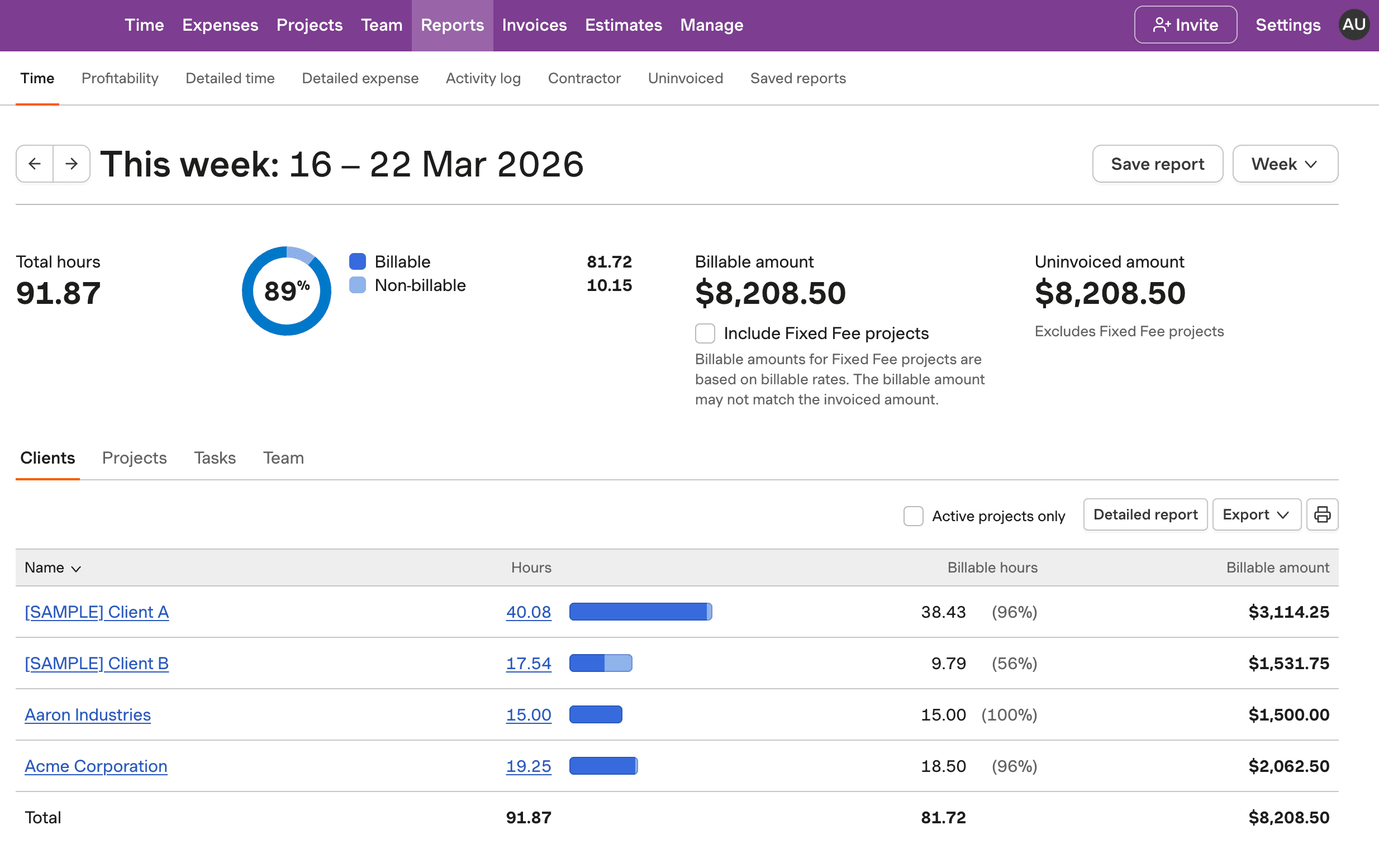
Harvest Printable Utilization Report

The preview shows Harvest's detailed utilization report interface, highlighting billable vs. non-billable hours and resource allocation.

Harvest utilization report interface showing resource allocation and productivity metrics.

Printable Utilization Report FAQs

  • A utilization report is a document that measures how effectively an organization's resources are used. It analyzes time, equipment, and funding allocation across projects, distinguishing between billable and non-billable activities to optimize productivity.

  • To calculate a utilization rate, use the formula: (Total Productive Hours / Total Available Hours) x 100. This gives you the percentage of time resources are effectively used, essential for identifying optimization opportunities.

  • An ideal utilization rate typically ranges from 75% to 85% for professional services, balancing client work with essential internal activities. Rates above 85% can lead to burnout, while rates below 55% may indicate inefficiencies.

  • Harvest provides detailed reporting on billable vs. non-billable hours, helping teams assess productivity effectively. It integrates with project management tools, facilitating real-time tracking and data-driven decision-making.

  • Billable utilization refers to time spent on client-facing, revenue-generating activities, while non-billable utilization involves internal or administrative tasks. Understanding this distinction helps optimize resource allocation.

  • Utilization reports help managers identify overutilization by tracking high rates that can lead to burnout. By adjusting workloads and redistributing tasks, businesses can maintain healthy utilization levels, protecting employee well-being.

  • While Harvest primarily focuses on time tracking for teams, it can be adapted to track various resource utilizations, including equipment, by logging hours or tasks associated with specific resources.

  • Utilization reports provide critical insights into resource usage patterns, informing future project estimates and staffing needs. This data supports better capacity planning and resource allocation, improving project outcomes.