
Harvest
Time Tracking
Sign up free

Team Utilization Report Template

Harvest tracks team utilization with detailed reports, optimizing resource allocation and preventing burnout. Try it for free to enhance productivity.

Try Harvest Free

How much revenue is your team leaving on the table?

Most agencies run at 55-60% utilization. Even a small improvement means significant revenue. See what closing the gap looks like for your team.

Number of people who track billable time
$
Blended rate across roles (junior, senior, lead)
55%
Percentage of total hours that are billable. Industry average is 55-60%.
75%
A realistic target for service businesses is 70-80%.
Monthly revenue gap $0
Revenue at current utilization $0/mo
Revenue at target utilization $0/mo
Extra billable hours needed per person/day 0h
Annual revenue opportunity $0

Start tracking team utilization

Walk through the entire flow below. Start a timer, check your reports, and create a real invoice — all in three clicks.

Go ahead — start tracking!

One click and you're timing. Try it right here: start a timer, add an entry, edit the details. This is exactly how it feels in Harvest.

  • One-click timer from browser, desktop & mobile
  • Works inside Jira, Asana, Trello, GitHub & 50+ tools
  • Duration or start/end — your call
  • Day, week & calendar views to stay on top of it all
  • Friendly reminders so no hour gets left behind
Acme Corp
Website Redesign
Homepage layout revisions
1:24:09
Content Strategy
Blog calendar planning
1:30:00
SEO Audit
Technical audit report
0:45:00
Brand Guidelines
Color system documentation
2:15:00
Logo Concepts
Initial sketches round 1
1:00:00

Understanding Team Utilization: Core Metrics and Importance

Team utilization is a critical metric for assessing how effectively a workforce is deployed across projects. Utilization rates are calculated by dividing productive hours by available hours and multiplying by 100 to express it as a percentage. For instance, a utilization rate of 70% means that 70% of an employee's available time is spent on productive work. This is particularly important because companies with billable utilization below 50% face an 11% chance of project overruns, compared to only an 8% chance for those exceeding 90% utilization.

Understanding these metrics helps organizations optimize resource allocation, enhance profitability, and reduce employee burnout. Utilization rates for full-time employees are typically measured against a 40-hour workweek, minus any planned leave, and are vital for identifying over- or under-utilization trends. In practice, a "good" utilization rate varies by industry, generally ranging from 70% to 85% for professional services and 80% to 90% for manufacturing.
Benchmarking Success: Defining a "Good" Utilization Rate

A "good" utilization rate serves as a benchmark for efficiency and profitability, but it varies widely across industries and roles. For example, professional services firms such as consulting, legal, and accounting often aim for utilization rates between 70% and 85%. In contrast, manufacturing targets are higher, typically between 80% and 90%. However, roles within these industries also influence these benchmarks: junior employees may be expected to achieve 90% billable work, while senior staff might maintain around 70% to balance strategic responsibilities.

Striving for 100% utilization is unsustainable and may lead to burnout and quality issues. Instead, finding the right balance is crucial, such as promoting a healthy mix of billable and non-billable hours. This approach ensures that employees have time for essential activities like training and administrative tasks, which are just as vital for long-term productivity.

Building an Effective Team Utilization Report

Creating a comprehensive team utilization report involves several key steps. First, establish clear work schedules to define each team member's available hours, excluding time off for vacations, sick leave, or holidays. Next, categorize tasks into billable and non-billable activities to accurately track how time is spent. Implementing time tracking software is essential, as it provides the data needed for precise reports.

A complete utilization report should include employee details, project data, billable and non-billable hours, total hours, and utilization rates. It's also beneficial to compare allocated versus actual hours to identify any discrepancies. Regular monitoring of these metrics helps in making informed decisions about resource allocation, workload adjustments, and identifying trends that may require attention.

Optimizing Team Utilization with Harvest

Optimizing team utilization is crucial for maximizing productivity and reducing costs. Harvest offers robust tools to track both billable and non-billable hours across projects, providing the flexibility needed to manage diverse teams effectively. With Harvest, you can generate detailed reports that visualize team workload, compare scheduled assignments with actual hours worked, and provide insights into team performance.

Moreover, Harvest's advanced reporting features allow managers to delve deep into utilization metrics, helping to identify under-used resources or potential burnout risks. By leveraging these insights, teams can make proactive adjustments to workload distribution, ensuring a balanced and sustainable work environment. This not only improves efficiency but also supports employee well-being by preventing overwork.

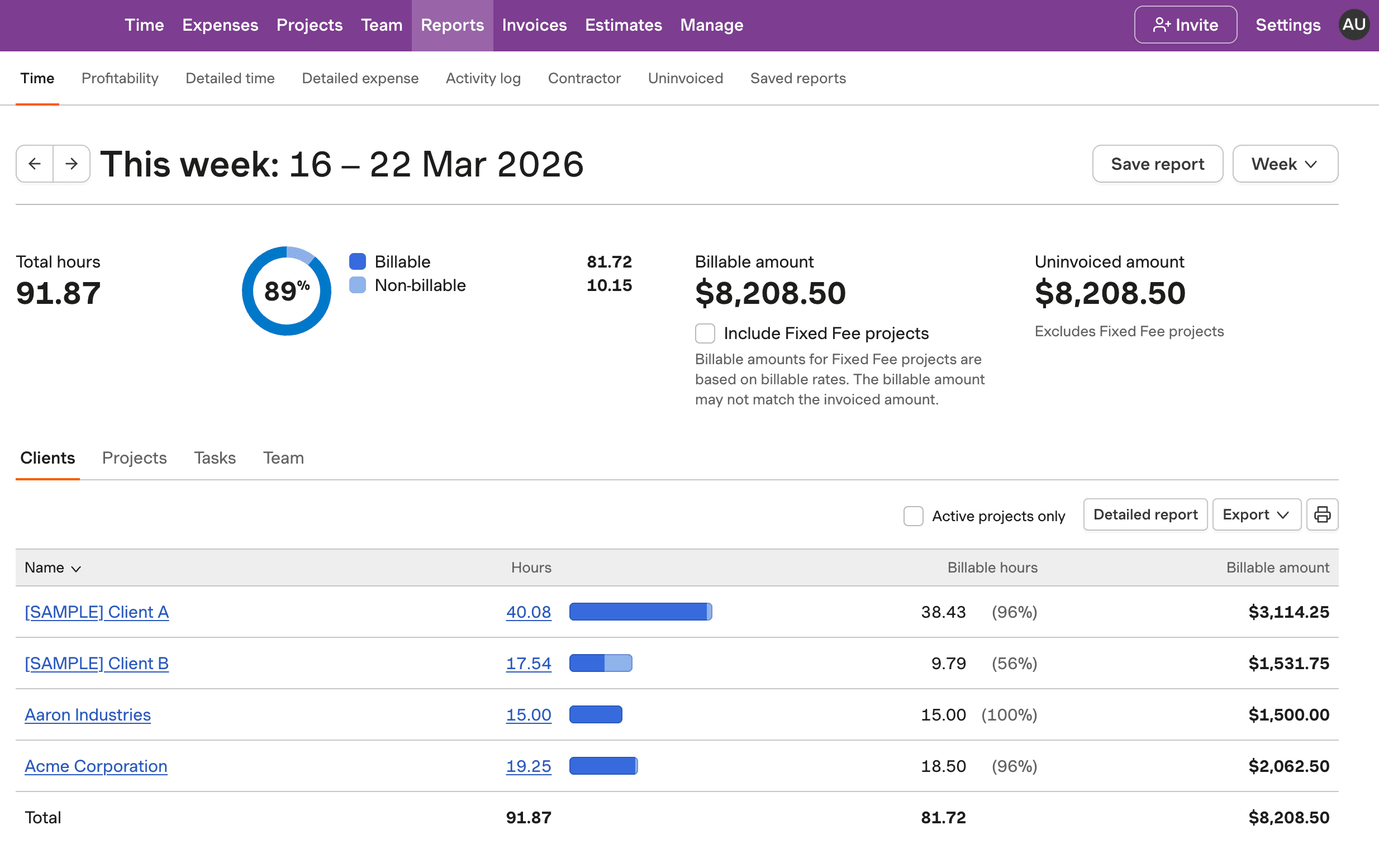
Team Utilization with Harvest

Harvest helps track team utilization with detailed reporting, visualizing workload across projects to optimize productivity.

Harvest's team utilization tracking interface for productivity optimization.

Team Utilization Report Template FAQs

  • A team utilization report measures how effectively a team's available time is used for productive work. It helps in optimizing resource allocation, improving profitability, and preventing burnout by providing insights into billable and non-billable activities.

  • Team utilization is calculated by dividing total productive hours by total available hours, then multiplying by 100. For example, if your team worked 320 productive hours out of 400 available, the utilization rate is 80%.

  • A good utilization rate varies by industry but generally falls between 70% and 85%. This range balances billable work with non-billable tasks like training and administrative duties, avoiding burnout.

  • Harvest provides detailed reports that track both billable and non-billable hours, offering insights into team workload and performance. Its advanced features allow for dynamic reporting and workload visualization across projects.

  • A utilization report should include employee details, project data, billable and non-billable hours, total hours, utilization rates, and a comparison of allocated versus actual hours to identify trends.

  • Yes, Harvest integrates with popular project management tools like Asana, Trello, and Jira, allowing seamless tracking of time and utilization across different platforms.

  • Team utilization should be tracked weekly or monthly to identify trends and make timely adjustments to resource allocation and workload distribution.