
Harvest
Time Tracking
Sign up free

What Are Billable Hours

Harvest is the go-to tool for tracking billable hours, essential for profitability and compensation analysis in professional services firms.

Try Harvest Free

How much revenue is your team leaving on the table?

Most agencies run at 55-60% utilization. Even a small improvement means significant revenue. See what closing the gap looks like for your team.

Number of people who track billable time
$
Blended rate across roles (junior, senior, lead)
55%
Percentage of total hours that are billable. Industry average is 55-60%.
75%
A realistic target for service businesses is 70-80%.
Monthly revenue gap $0
Revenue at current utilization $0/mo
Revenue at target utilization $0/mo
Extra billable hours needed per person/day 0h
Annual revenue opportunity $0

Start tracking team utilization

Walk through the entire flow below. Start a timer, check your reports, and create a real invoice — all in three clicks.

Go ahead — start tracking!

One click and you're timing. Try it right here: start a timer, add an entry, edit the details. This is exactly how it feels in Harvest.

  • One-click timer from browser, desktop & mobile
  • Works inside Jira, Asana, Trello, GitHub & 50+ tools
  • Duration or start/end — your call
  • Day, week & calendar views to stay on top of it all
  • Friendly reminders so no hour gets left behind
Acme Corp
Website Redesign
Homepage layout revisions
1:24:09
Content Strategy
Blog calendar planning
1:30:00
SEO Audit
Technical audit report
0:45:00
Brand Guidelines
Color system documentation
2:15:00
Logo Concepts
Initial sketches round 1
1:00:00

Understanding Billable Hours

Billable hours are the cornerstone of revenue generation for many professional services firms, especially in the legal industry. These are the hours that employees or contractors work directly on client-related tasks, which are then charged to the client. This system ensures that every hour spent on a project is accounted for and contributes to the firm's income. In contrast, non-billable hours include activities like internal meetings or administrative tasks, which do not generate direct revenue but are essential for business operations.

Tracking billable hours accurately is crucial for both firm profitability and employee compensation. For example, in the legal sector, firms often set targets ranging from 1,700 to 2,200 billable hours annually, depending on the firm's size. Failing to meet these targets can significantly affect a lawyer’s performance evaluation and potential bonuses. Therefore, a reliable time tracking tool like Harvest is indispensable. Harvest simplifies the process with one-click start/stop timers and detailed reporting, ensuring that every minute of billable work is captured efficiently.
Calculating Billable Hours

Calculating billable hours involves meticulous time tracking, often broken down into six-minute increments, a standard practice in industries like law. This precise method ensures that every segment of work is properly recorded and billed. For instance, a task lasting 18 minutes would be recorded as 0.3 hours. This granularity not only helps in accurate billing but also aids in identifying time spent on various tasks, allowing firms to optimize their operations.

Utilizing a tool like Harvest can streamline this process, offering both automatic timers and manual entry options. Harvest supports flexible billing rates per project or person, allowing firms to tailor their billing practices to meet specific client agreements. This flexibility ensures that firms can maximize their revenue potential while maintaining transparent and accurate billing practices.

Impact of Billable Hours on Firm Profitability

The impact of billable hours extends beyond immediate revenue generation; it plays a critical role in overall firm profitability and strategic decision-making. For example, law firms often have high annual billable hour requirements, sometimes exceeding 2,000 hours. These targets are not arbitrary; they are aligned with the firm’s financial goals and client service commitments. However, achieving these targets requires efficient time management and robust tracking systems.

Harvest empowers firms to meet these objectives through comprehensive time and expense tracking features. By capturing both billable and non-billable hours, Harvest provides valuable insights into team utilization and project budgets. This data is essential for making informed decisions about resource allocation and identifying areas for operational improvement, ultimately enhancing profitability.

Differentiating Billable and Non-Billable Hours

Understanding the difference between billable and non-billable hours is essential for effective time management and financial planning. Billable hours are directly charged to clients, generating revenue, while non-billable hours encompass tasks that support the business but do not directly contribute to income. Examples of non-billable activities include training, administrative duties, and internal strategy sessions.

Tools like Harvest help firms navigate these distinctions by offering detailed reports on both types of hours. Harvest’s ability to track non-billable time is crucial for analyzing its impact on overall workload and revenue generation. By understanding the balance between billable and non-billable hours, firms can optimize their operations and ensure that their workforce is utilized effectively.

Billable Hours Tracking with Harvest

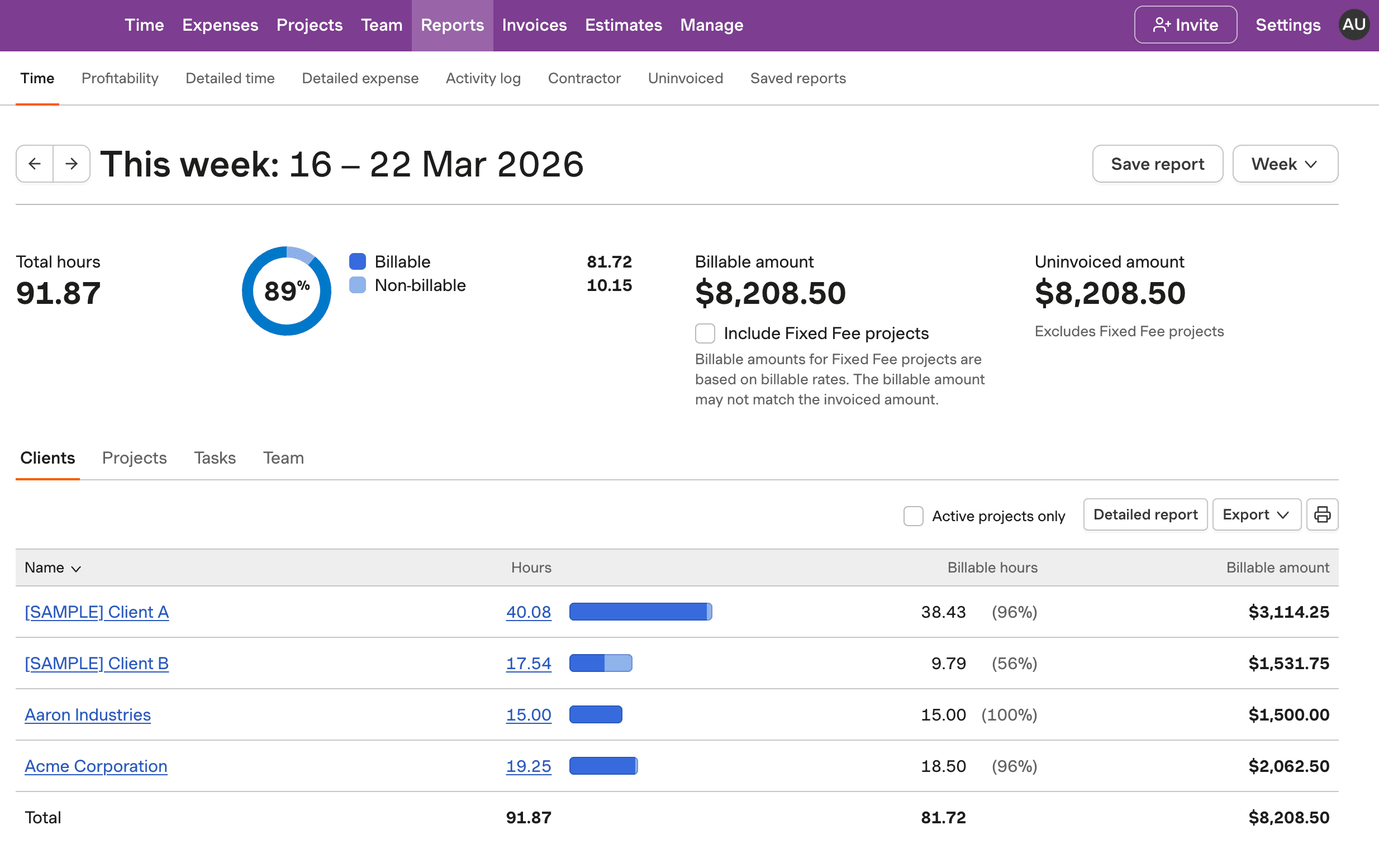
See how Harvest tracks billable hours, crucial for profitability and compensation analysis. Simplify your time management processes.

Screenshot of Harvest time tracking for billable hours.

What Are Billable Hours FAQs

  • Billable hours are the hours worked directly on client-related tasks that are charged to the client, generating revenue for the firm. They are essential for tracking work efficiency and billing accuracy.

  • Billable hours are calculated by tracking time spent on client-specific tasks, often in six-minute increments. Accurate tracking ensures that all billable work is recorded and billed properly.

  • Billable tasks typically include any work directly related to client projects, such as consultations, research, and report preparation. Each firm may have specific guidelines based on their client agreements.

  • Billable hours generate direct revenue as they are charged to clients, whereas non-billable hours include internal tasks that support the business but do not directly generate income.

  • Billable hours directly affect a firm's revenue and profitability. Meeting or exceeding billable hour targets ensures that the firm maximizes its revenue potential and maintains financial health.

  • Harvest tracks both billable and non-billable hours with precision using one-click start/stop timers and detailed reporting. This provides insights into workload and revenue impact.

  • Yes, Harvest integrates with various tools such as Asana, Trello, and Slack, enhancing its time tracking capabilities and ensuring seamless workflow management across different platforms.