
Harvest
Quotes
Sign up

Best Construction Estimating Software

The construction industry faces challenges like estimating errors costing $273 billion annually. Harvest helps manage project budgets and track expenses efficiently.

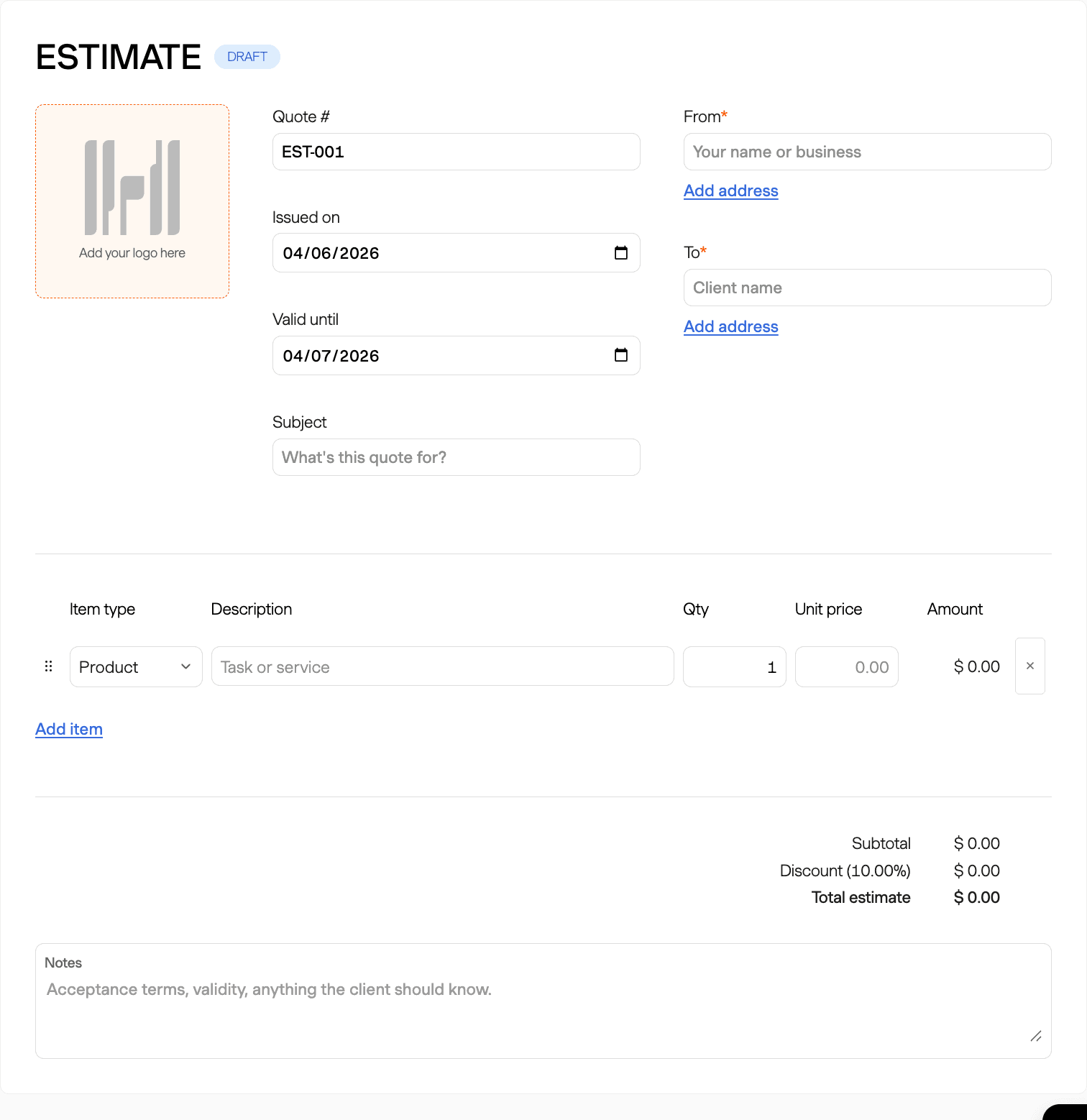
ESTIMATE DRAFT

Add your logo here
Item type
Description
Qty
Unit price
Tax
Amount
Subtotal
$0.00
Discount
$0.00
Total estimate
$0.00
Get paid via:
Credit card / Debit card
ACH
Wire transfer

Customize estimate

Appearance

Add a logo
Show estimate title

Quote settings

Tax Add up to 2 tax rates
%
Discount Apply a discount percentage
%

Top Features of Construction Estimating Software

Construction estimating software has revolutionized the industry by improving efficiency and accuracy in project cost estimation. Historically, manual methods like spreadsheets were prone to errors and time-consuming, especially for large projects. Today, digital tools offer advanced features such as real-time pricing updates, database integrations, and automation of takeoffs, which can save up to 90% of time and significantly enhance productivity. The global market for these tools was valued at USD 1.5 billion in 2024 and is projected to reach USD 2.62 billion by 2030, reflecting a compound annual growth rate of 10.2%.

Key features to look for in construction estimating software include cloud-based solutions, which accounted for 51% of the market in 2024 and are expected to grow to 68.14% by 2025. These solutions facilitate collaboration and ensure consistency across projects. Additionally, integrating these tools with project management systems can streamline workflows, as they allow for seamless data transfer and improved communication among teams.

Addressing Common Construction Estimating Challenges

Accurate construction estimates are crucial for project success, yet many firms still struggle with outdated methods that lead to inconsistent bids and budget overruns. Estimating software addresses these challenges by providing real-time visibility and reliable cost databases, reducing the risk of errors. Industry research highlights that estimating errors can cost U.S. companies up to $273 billion annually, accounting for up to 20% of project costs and causing project delays in 52% of cases.

While some tools offer localized material and labor cost databases, others focus on enhancing project budget management and expense tracking. For example, Harvest excels by integrating with project management tools like Asana, providing a seamless workflow to track time and manage expenses effectively, even if it doesn't offer digital takeoff capabilities.

The Role of Technology and AI in Construction Estimating

Technology and AI are transforming construction estimating, moving beyond traditional speed and accuracy improvements. AI-driven tools can analyze historical data, predict costs, and anticipate price fluctuations, adding a layer of sophistication to cost forecasting and risk assessment. These tools can also flag anomalies in subcontractor bids, supporting estimators in making more informed decisions.

However, it's important to note that while AI enhances the estimating process, human oversight remains crucial. Estimators are essential for scoping projects and interpreting complex data trends. Harvest, while not an AI-driven estimating tool, supports project budget tracking and integrates seamlessly with other software solutions to enhance team efficiency and collaboration.

Best Practices for Implementing Estimating Software

Implementing construction estimating software successfully requires a structured approach. Companies should begin by defining clear objectives and conducting a thorough needs analysis to ensure the selected software aligns with organizational goals. A phased implementation is recommended, alongside preparing thorough documentation to facilitate rapid onboarding of users.

Common pitfalls such as inaccurate material quantities and inconsistent proposals can be avoided by selecting purpose-built software that integrates with other business processes, such as project management and accounting systems. Harvest supports these efforts by offering integrations that enhance workflow consistency and financial management, even though it doesn't provide customizable templates for construction projects.

Why Choose Harvest for Project Management Support

Harvest stands out as a valuable tool for managing project budgets and tracking time and expenses, even if it doesn't offer traditional construction estimating features. Its cloud-based collaboration capabilities, particularly through integrations with tools like Asana, enhance team efficiency and project management. This makes it a strong choice for companies looking to improve workflow and budget management without sacrificing accuracy.

While Harvest may not provide pre-built databases or digital takeoff capabilities, it excels in offering a seamless workflow for tracking project expenses and managing budgets. This focus on integration and collaboration ensures that projects run smoothly and efficiently, providing a practical solution for contractors and service businesses.

Explore Harvest for Construction Estimating

See how Harvest helps manage construction project budgets and track expenses effectively.

Interface of Harvest software for construction estimating

Best Construction Estimating Software FAQs

  • Look for features like real-time pricing updates, cloud-based collaboration, and integration with project management tools. These enhance accuracy and efficiency.

  • Estimating software reduces errors and saves time, leading to cost savings of 5%-20%. It also helps manage bids and budgets more effectively, minimizing overruns.

  • The market is projected to grow at a 10.2% CAGR, reaching USD 2.62 billion by 2030. Cloud-based solutions are becoming increasingly dominant.

  • Harvest integrates with tools like Asana to streamline workflows, enhancing team collaboration and project efficiency by tracking time and expenses.

  • Accurate estimates ensure proper budgeting and resource allocation, impacting project profitability and client satisfaction. Errors can cost billions annually.

  • AI-driven tools can predict costs and flag anomalies, enhancing accuracy. However, human oversight remains essential for complex decision-making.

  • Common mistakes include ignoring indirect costs and using outdated methods. Using specialized software helps avoid these pitfalls and improve accuracy.