
Harvest
Contracts
Sign up

Contract Template in Hungarian

Hungarian employment contracts require specific legal elements to ensure compliance. Harvest helps streamline contract management with up-to-date templates.

Start from a template

AGREEMENT DRAFT

Add your logo here

Scope of work

Payment terms

Duration

Signatures

Client

Sign here

Contractor

Sign here

Get paid via:
Credit card / Debit card
ACH
Wire transfer

Customize contract

Appearance

Add a logo
Show contract title

Contract settings

Include payment terms Total fee, deposit, and schedule
Include termination clause Notice required to end the contract
Include signature blocks Both parties sign at the bottom

Navigating Hungarian Employment Contract Requirements

Crafting a compliant employment contract in Hungary requires understanding and incorporating specific legal elements. According to Hungarian law, employment agreements must be in writing and should include key terms such as the names and addresses of both the employer and employee, job title, description of duties, and the place of work. Additionally, the contract must specify the start date of employment, its duration (if fixed-term), remuneration details, working hours, and any applicable probationary period. These elements are essential to ensure that the contract is legally binding and clear to both parties involved.

In Hungary, fixed-term employment contracts are limited to a maximum duration of five years, including any extensions or renewals. Probationary periods typically last up to three months, but can be extended to six months with a collective bargaining agreement. While contracts are not legally required to be in Hungarian, using a bilingual format is advisable to prevent misunderstandings, especially in employment contexts. This bilingual approach, with a clause favoring the Hungarian version in case of disputes, ensures clarity and compliance with local standards.

Adapting Contract Templates for Hungarian Compliance

Translating a foreign contract template into Hungarian is not sufficient for legal compliance. The Hungarian Civil Code, a comprehensive framework governing contract law, mandates that contracts not only adhere to local legal standards but also reflect Hungarian legal concepts. Common pitfalls include the misclassification of employees as independent contractors, which can lead to significant penalties, such as retroactive taxes and fines up to HUF 500,000. Therefore, it is crucial to adapt contract templates specifically for Hungarian laws and practices.

To mitigate risks, businesses should utilize templates designed for Hungarian legal requirements or seek specialized legal advice. This approach ensures that contracts include essential provisions like liability limitations, which cannot exclude damages caused by intentional breach or those affecting human life. Clarity and precision in contract language help to prevent disputes and safeguard against potential legal challenges.

Leveraging Technology in Contract Management

The digital transformation in Hungary has introduced opportunities for more efficient contract management. With the growing emphasis on digital signatures, companies can now authenticate contracts electronically, saving time and reducing paperwork. This shift is part of a broader trend toward digitization in contract management, allowing for streamlined processes and easier compliance checks.

Moreover, recent regulatory changes, such as those in cybersecurity, necessitate updated contract templates that ensure compliance with new standards. For instance, organizations affected by these changes must draft audit contracts with accredited auditors to avoid fines ranging from 1 to 15 million forints. By keeping templates current and compliant, businesses can avoid legal pitfalls and ensure smoother operations. Embracing these technological advancements aligns contract management with modern business practices, offering a practical solution to evolving legal requirements.

Ensuring Effective Contract Customization

Customization is key to effective contract management in Hungary. Poorly drafted contracts are a primary source of disputes, especially for foreign companies unfamiliar with local legal nuances. Legal experts emphasize the importance of clear, well-structured contracts that reflect practical business needs rather than theoretical constructs. This clarity reduces the risk of disputes and protects business interests.

To customize contracts effectively, businesses should ensure the inclusion of critical terms and conditions such as payment terms, delivery timelines, and dispute resolution mechanisms. Regular reviews and updates to contract templates are necessary to adapt to changes in Hungarian law and market conditions. This proactive approach minimizes legal risks and enhances the efficacy of contractual agreements.

Hungarian Contract Templates with Harvest

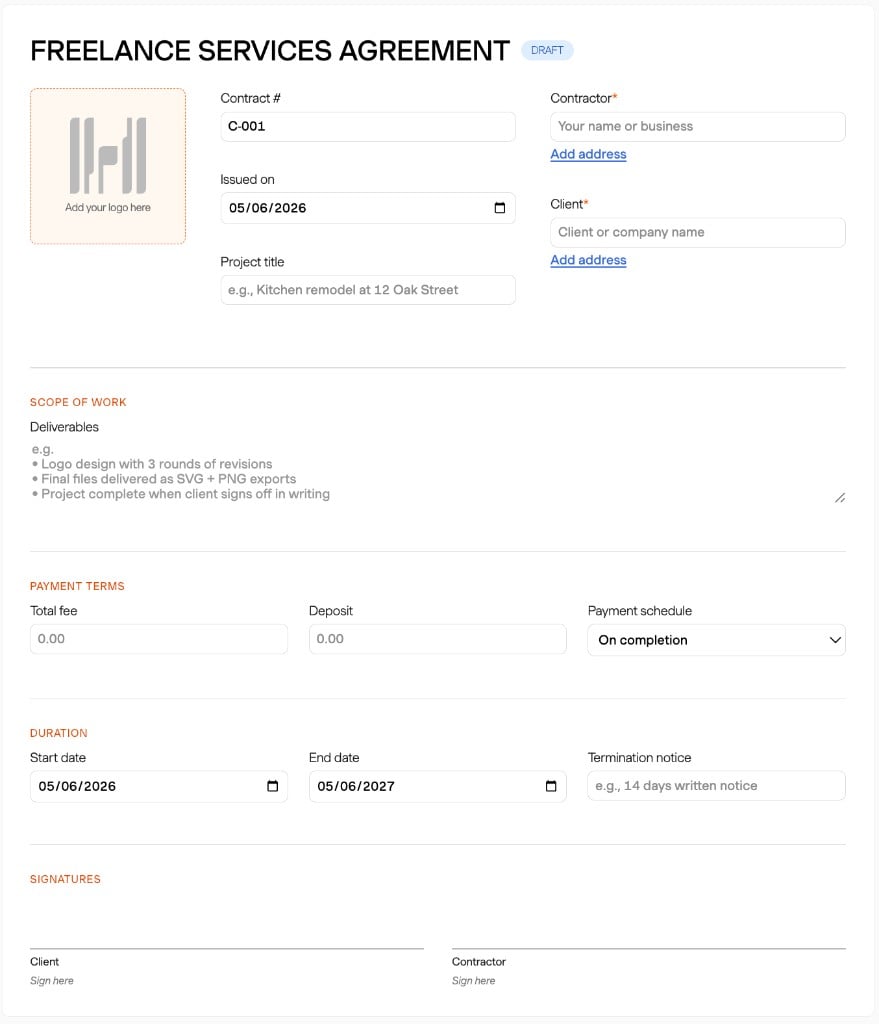
Explore Harvest's templates designed for Hungarian legal compliance, streamlining contract management and ensuring all mandatory elements are included.

Screenshot of a Hungarian contract template in Harvest

Contract Template in Hungarian FAQs

  • A Hungarian employment contract must include the names and addresses of the employer and employee, job title, description of duties, place of work, start date, duration (if fixed-term), remuneration details, working hours, and any probationary period. These elements ensure the contract is legally binding.

  • Customizing a contract template for Hungarian law involves ensuring compliance with the Hungarian Civil Code. It is advisable to use templates designed for local legal requirements or consult a Hungarian lawyer to adapt the contract language and clauses accordingly.

  • Yes, fixed-term employment contracts in Hungary can last a maximum of five years, including any extensions or renewals. This is regulated to prevent indefinite employment under fixed-term conditions.

  • Misclassifying employees as independent contractors can lead to significant penalties, including retroactive taxes and fines up to HUF 500,000. It is essential to use clear contracts that reflect genuine B2B relationships to mitigate these risks.

  • The Hungarian Civil Code, updated in 2014, introduced new provisions on liability, contract types, and stricter regulations for certain contracts. This evolution requires regular updates to contract templates to remain compliant.

  • Using bilingual contracts, such as Hungarian and English, helps prevent misunderstandings. It is best practice to include a clause stating that the Hungarian version prevails in case of a dispute, ensuring clarity and compliance.

  • Digital signatures are increasingly used in Hungary for contract authentication. This trend aligns with the digital transformation, offering more efficient contract management and compliance with modern business practices.