
Harvest
Quotes
Sign up

Create Estimates for Contractors

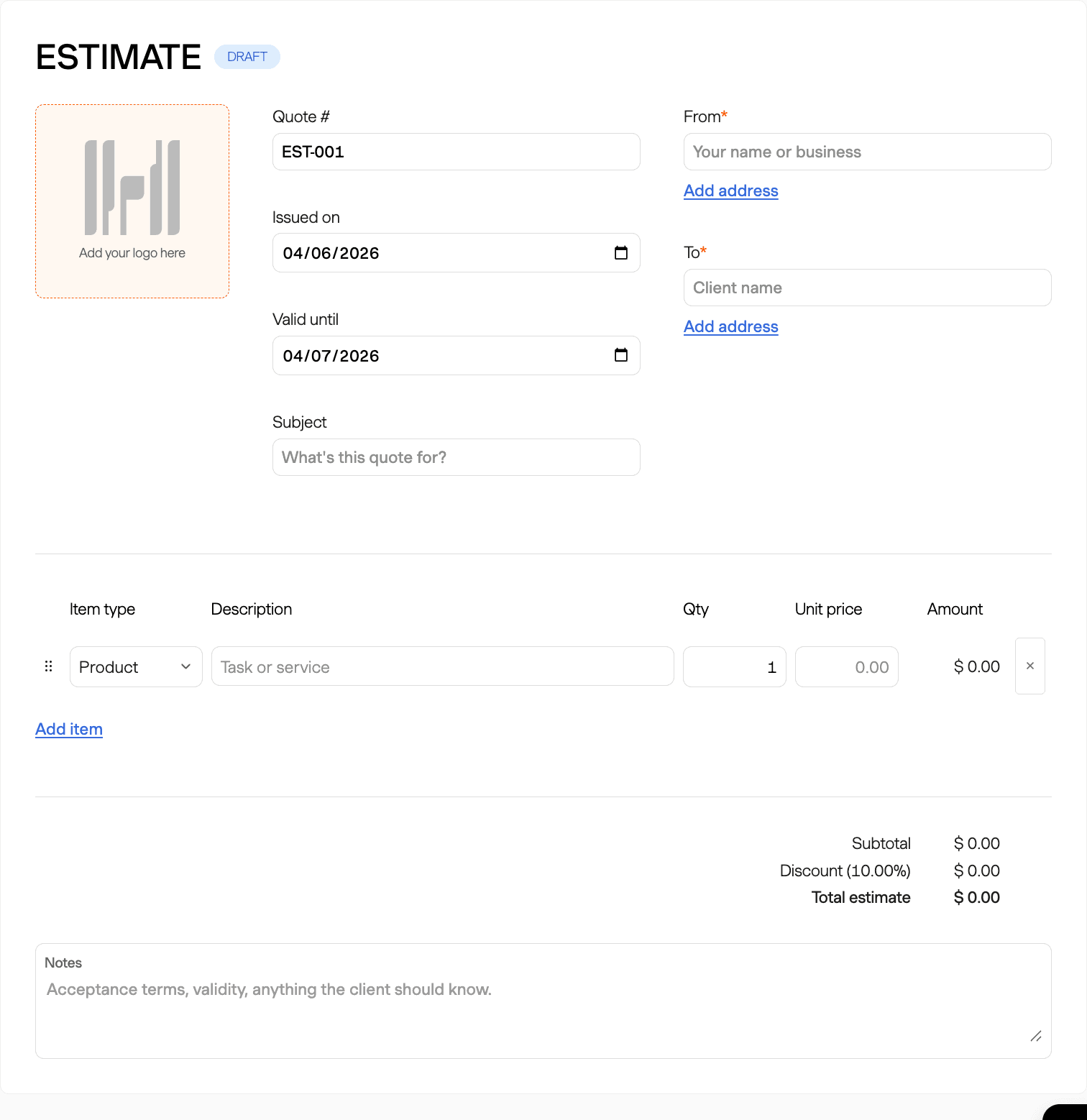
Harvest empowers contractors to create precise estimates by organizing job costs as billable expenses or invoice line items, addressing the need for accuracy and flexibility in estimating.

ESTIMATE DRAFT

Add your logo here
Item type
Description
Qty
Unit price
Tax
Amount
Subtotal
$0.00
Discount
$0.00
Total estimate
$0.00
Get paid via:
Credit card / Debit card
ACH
Wire transfer

Customize estimate

Appearance

Add a logo
Show estimate title

Quote settings

Tax Add up to 2 tax rates
%
Discount Apply a discount percentage
%

The Importance of Accurate Estimates for Contractors

Creating accurate estimates is pivotal for contractors to ensure project profitability and client satisfaction. Industry experts emphasize that precision in estimating can prevent budget overruns and enhance financial viability. For example, construction projects often involve significant costs related to labor, materials, and equipment. Using a detailed and data-driven approach to estimating can help contractors avoid common pitfalls. Inaccurate estimates can lead to cost overruns of up to 15-20%, jeopardizing project success and client relationships.

Moreover, the use of digital tools has become essential in modern estimating practices. Transitioning from manual calculations to specialized estimating software has been shown to improve accuracy and reduce errors. For instance, digital takeoff tools can cut takeoff time by 30-60% on mid-sized commercial bids. This efficiency allows contractors to focus more on strategic project outcomes rather than administrative tasks.

Challenges in Estimating for Contractors

Estimating challenges are numerous, especially with the volatility of material costs. In recent times, prices for materials like steel and lumber have swung by double-digit percentages within a single quarter. This volatility can pose significant financial risks if estimates are locked in too early without considering potential fluctuations. Contractors often need to update material prices weekly or monthly to maintain estimate accuracy.

Additionally, the iterative nature of modern construction projects adds complexity to the estimating process. With methods like Building Information Modeling (BIM) and design-build, project plans are frequently modified, necessitating continuous updates to estimates. This can lead to hundreds of iterations, particularly for large-scale projects. Harvest helps contractors manage these challenges by allowing them to organize job costs, including labor and materials, as billable expenses or invoice line items, thereby supporting dynamic and flexible estimating processes.

Leveraging Harvest for Estimating Success

Harvest provides essential tools for contractors to create detailed and accurate estimates tailored to their specific project requirements. By allowing contractors to organize job costs, including labor and materials, as billable expenses or invoice line items, Harvest enables precise and customizable estimates. This flexibility is crucial for accommodating unique project requirements and addressing client-specific needs.

While Harvest does not provide real-time market rates or pre-written contract language, it empowers contractors to input and manage their own cost data, facilitating accurate estimates and expense tracking. This user-driven approach ensures that contractors maintain control over their data, aligning estimates with actual project costs. Integrating estimating capabilities with Harvest's time tracking and invoicing features further streamlines workflows, enhancing project management efficiency.

Best Practices for Construction Estimating

To create successful estimates, contractors should follow a structured process that includes reviewing bid packages, conducting site visits, and performing material takeoffs. Soliciting pricing from suppliers, evaluating labor costs, and calculating overhead are also critical steps. Including a contingency fund of 10-15% is recommended to account for unexpected costs such as equipment failures or inclement weather.

Transparency is also key in building trust with clients. Providing an itemized breakdown of costs helps clients understand the value of the proposed work, reducing the likelihood of disputes. Harvest supports this transparency by allowing contractors to customize line items and create detailed, itemized estimates. By leveraging these best practices and utilizing tools like Harvest, contractors can improve the accuracy of their estimates and increase their competitive edge.

Create Estimates with Harvest

Harvest enables contractors to organize job costs into detailed estimates, ensuring precise project budgeting.

Screenshot of Harvest's estimating tool for contractors.

Create Estimates for Contractors FAQs

  • Contractors create accurate estimates by reviewing bid packages, conducting site visits, performing material takeoffs, and soliciting pricing from suppliers. Incorporating labor costs, overhead, and a contingency fund helps ensure comprehensive estimates.

  • Estimating software improves accuracy, reduces errors, and speeds up the estimating process. Digital tools can cut takeoff time by 30-60% on mid-sized bids, allowing contractors to focus on strategic project outcomes.

  • Harvest helps contractors create detailed estimates by organizing job costs, including labor and materials, as billable expenses or invoice line items. This flexibility allows for precise, customizable estimates.

  • Contractors face challenges such as material cost volatility and the iterative nature of project plans. Regularly updating cost data and using tools like Harvest can help manage these complexities.

  • An estimate is a good-faith approximation that can vary by ±10-15% without written approval. A bid is a binding price, and exceeding it without a change order could be a breach of contract.

  • Transparency builds client trust and reduces disputes. Providing an itemized breakdown of costs helps clients understand the work's value and aligns expectations.

  • Yes, Harvest integrates estimating with project management by tracking time, expenses, and invoices, creating a cohesive workflow for managing project budgets and profitability.