
Harvest
Contracts
Sign up

Contract Management for Contractors

Harvest helps contractors manage complex construction contracts by tracking project budgets, time, and expenses, reducing the risk of financial losses from poor contract management.

Start from a template

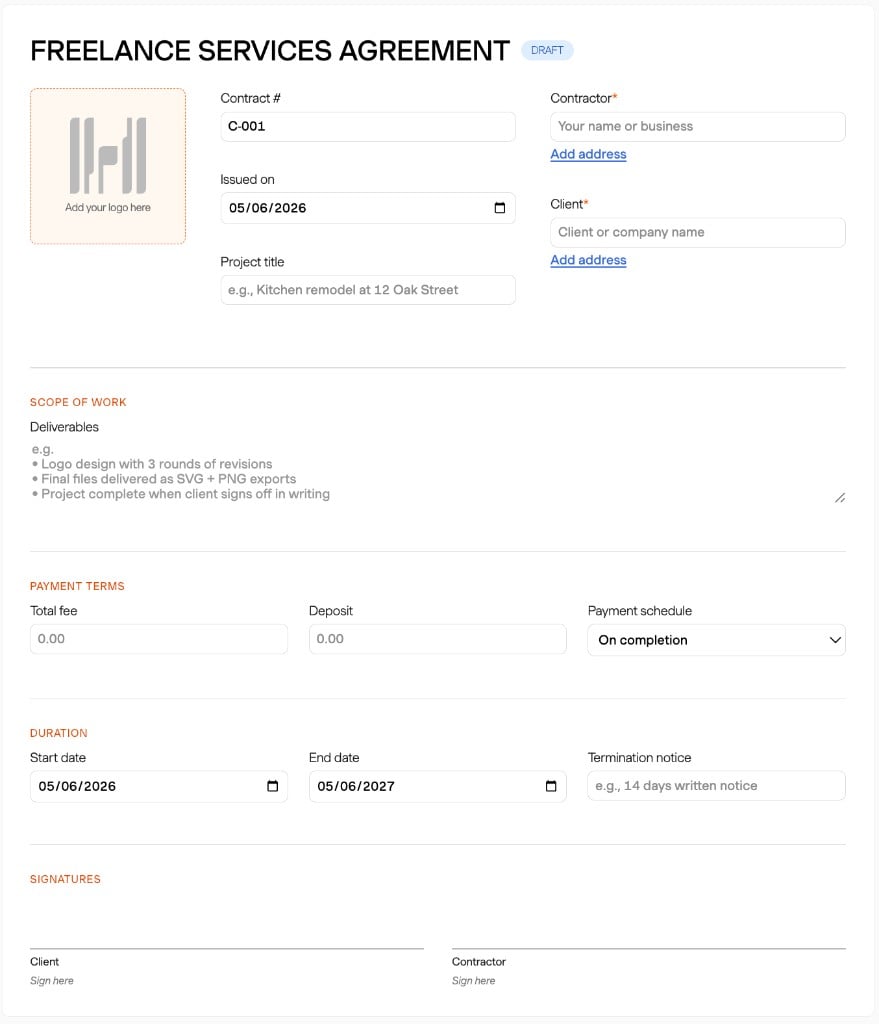
AGREEMENT DRAFT

Add your logo here

Scope of work

Payment terms

Duration

Signatures

Client

Sign here

Contractor

Sign here

Get paid via:
Credit card / Debit card
ACH
Wire transfer

Customize contract

Appearance

Add a logo
Show contract title

Contract settings

Include payment terms Total fee, deposit, and schedule
Include termination clause Notice required to end the contract
Include signature blocks Both parties sign at the bottom

Effective Contract Management Processes for Contractors

Effective contract management is crucial for contractors, particularly in the construction industry, as it encompasses the entire lifecycle of contractual agreements. This includes initial drafting, negotiation, performance monitoring, and eventual renewal or termination. Mismanagement in contract processes can be costly, with businesses losing an average of 9% of their annual revenue due to poor contract management practices. Additionally, companies often overpay by 30-50% for contracted services due to inefficient management. Implementing structured contract lifecycle management processes can mitigate these risks.

A comprehensive contract management strategy involves several key stages: contract generation, negotiation, approval, fulfillment, and renewal. Each stage should be approached with clarity and precision to maximize business outcomes. Professional associations recommend maintaining comprehensive documentation, involving stakeholders early, and continuously monitoring performance metrics as best practices.

While Harvest is not a dedicated contract lifecycle management tool, it supports contractors by helping manage project budgets, time, and expenses, which are integral to effective contract management. By utilizing these features, contractors can ensure that their projects remain on track financially and operationally.

Managing Change Orders and Their Impact

Change orders are a common aspect of construction projects, often leading to alterations in project timelines and costs. Efficient management of change orders is essential to avoid project delays and budget overruns. Industry reports suggest that automation in contract management can reduce cycle times by 50-70%, illustrating the efficiency gains attainable through technology integration.

Harvest aids in managing change orders by tracking their impact on project budgets and timelines. With Harvest, contractors can monitor changes in real-time, ensuring that any additional costs or time adjustments are accurately reflected in the project's financial plan. This proactive approach helps in maintaining control over project execution and preventing costly delays.

By documenting scope changes and variations effectively, Harvest provides contractors with the tools necessary to communicate these changes to stakeholders clearly, minimizing disputes and misunderstandings. This feature is crucial for maintaining a transparent and efficient contract management process.

Ensuring Compliance and Financial Accuracy

Compliance with contract terms is vital for contractors to avoid legal and financial repercussions. Misclassification of workers, for example, can lead to significant penalties, as seen in a case where a construction staffing agency had to pay $278,073 in damages for misclassifying workers. Regular compliance monitoring and accurate documentation are therefore essential parts of contract management.

Although Harvest does not offer compliance monitoring, it supports contractors by tracking payment schedules and documenting scope changes. This functionality helps ensure that all financial transactions align with contractual obligations, reducing the risk of compliance issues. Harvest’s invoicing and expense management features provide a clear record of payments and expenses, which is essential for maintaining financial accuracy.

By integrating these capabilities into their contract management process, contractors can better manage their financial obligations and avoid costly mistakes associated with non-compliance. This integration supports contractors in maintaining a structured and efficient workflow.

Streamlining Contract Management with Technology

Leveraging technology is essential for streamlining contract management processes. Automated systems can significantly reduce the time and resources spent on contract administration, freeing up legal and administrative capacities for more strategic tasks. Industry data shows that decreasing legal participation in contract processes by just 10% can save approximately $480,000 annually, highlighting the financial benefits of automation.

Centralizing contract documents in a digital repository is one effective way to enhance contract management. This approach reduces errors and ensures that all relevant parties have access to the most current contract information. Harvest, while not a dedicated contract management tool, supports contractors by providing a centralized platform for tracking project budgets, time, and expenses. This helps contractors maintain a comprehensive overview of their projects and facilitates smoother management of contract-related activities.

By integrating Harvest into their contract management practices, contractors can achieve greater operational efficiency, reduce the risk of errors, and enhance their ability to meet contractual deadlines and obligations.

Streamline Contract Management with Harvest

Harvest simplifies contract management by tracking budgets, time, and expenses, helping contractors manage projects efficiently.

Screenshot showing contract management features in Harvest.

Contract Management for Contractors FAQs

  • Best practices for managing construction contracts include maintaining clear documentation, involving stakeholders early, and continuously monitoring contract performance. Using centralized digital repositories and automated workflows can also enhance efficiency and reduce errors.

  • Contractors can ensure compliance by regularly reviewing contracts and contractor performance against legal and regulatory requirements. Integrating compliance obligations directly into contracts and maintaining accurate payment and scope records are crucial steps.

  • Common construction contracts include lump-sum contracts, cost-plus contracts, and unit pricing contracts. Each type serves different project needs and risk allocations, with lump-sum contracts being most prevalent for their simplicity and fixed price structure.

  • Change orders can significantly impact contract management by altering project timelines and costs. Efficiently managing these changes is crucial to avoid delays and budget overruns. Tools like Harvest help track these impacts on budgets and timelines.

  • Technology streamlines contract management by automating routine tasks, reducing errors, and providing centralized access to contract data. This leads to faster contract cycles and frees up resources for strategic activities.

  • Harvest supports construction contract management by tracking project budgets, time, and expenses. This helps contractors monitor financial performance and document scope changes, aiding in effective project execution.

  • Poor contract management can lead to significant financial risks, such as losing 9% of annual revenue and overpaying for services. Efficient management practices help mitigate these risks and optimize financial performance.

  • Centralization in contract management is important because it ensures all parties have access to the latest contract information, reducing the risk of errors and miscommunications. This facilitates more efficient contract administration.