
Harvest
Contracts
Sign up

Service Agreement Template in Hebrew

Service agreements in Hebrew require precision and clarity to ensure legal validity. Harvest helps you streamline contract management with ease.

Start from a template

AGREEMENT DRAFT

Add your logo here

Scope of work

Payment terms

Duration

Signatures

Client

Sign here

Contractor

Sign here

Get paid via:
Credit card / Debit card
ACH
Wire transfer

Customize contract

Appearance

Add a logo
Show contract title

Contract settings

Include payment terms Total fee, deposit, and schedule
Include termination clause Notice required to end the contract
Include signature blocks Both parties sign at the bottom

Understanding Service Agreements in Hebrew

Service agreements are essential contracts that outline the terms and conditions between service providers and their clients. In Israel, creating a service agreement in Hebrew is particularly important for legal validity and compliance with local laws. The Israeli Contracts Law (General Part), 5733-1973, provides a comprehensive framework for contract formation, interpretation, and enforcement. Moreover, the Consumer Protection Law, 1981, and the Standard Contracts Law, 5743-1982, govern specific agreements and consumer rights, ensuring that agreements are fair and not misleading.

When drafting a service agreement in Hebrew, clarity and specificity are paramount to avoid disputes. Recent amendments to the Israeli contract law emphasize the importance of precise wording, as courts are now more likely to interpret commercial agreements based solely on their textual content. This change underscores the need for well-defined terms, deadlines, and obligations within service agreements.

Key Elements of a Hebrew Service Agreement

To ensure that a service agreement in Hebrew is comprehensive and legally sound, it should include several key components. These include a detailed description of the services provided, timelines, payment terms, client responsibilities, confidentiality clauses, and liability provisions. Each of these elements helps protect both the service provider and the client by clearly defining expectations and obligations.

In Israel, the principle of "good faith" (תום לב) is a cornerstone of contract law, applying to all stages of a contract. This means that both parties must act honestly and fairly, even if specific obligations are not explicitly stated in the agreement. Additionally, service agreements should outline the consequences of a breach, providing a clear framework for dispute resolution.

Legal Considerations for Service Agreements

Creating a legally valid service agreement in Hebrew involves navigating various legal and compliance considerations. For instance, electronic signatures have been legally recognized in Israel since the Electronic Signature Law of 2001, with a 2018 amendment broadening their use for low-risk contracts, including service agreements. This reflects a growing trend towards digital documentation in legal processes.

It's crucial to seek professional legal counsel when drafting these agreements, particularly given the complexities of Israeli contract law and recent amendments. Legal experts can help ensure compliance, correct potential errors, and safeguard against future legal and financial risks. Moreover, for agreements involving Jewish parties, incorporating provisions like "heter iska" for interest payments can align contracts with both secular and Jewish legal principles.

Adapting Service Agreements for Digital Use

With the rise of digital contracting, service agreements in Hebrew can be effectively adapted for electronic use. The Israeli legal framework supports electronic signatures, making it easier for businesses to manage contracts digitally. This is particularly beneficial for international businesses targeting Israeli consumers, as they must comply with local consumer protection laws, regardless of their physical location.

Incorporating digital solutions for contract management can streamline the contracting process and reduce the risk of errors. For businesses engaging in online transactions with Israeli clients, understanding and adapting to these legal requirements is essential to maintain compliance and protect consumer rights. As digital adoption continues to grow, service agreements are likely to become more prevalent in electronic formats, enhancing accessibility and efficiency.

Streamline Hebrew Contracts with Harvest

Explore how Harvest simplifies creating service agreement templates in Hebrew, ensuring clarity and compliance.

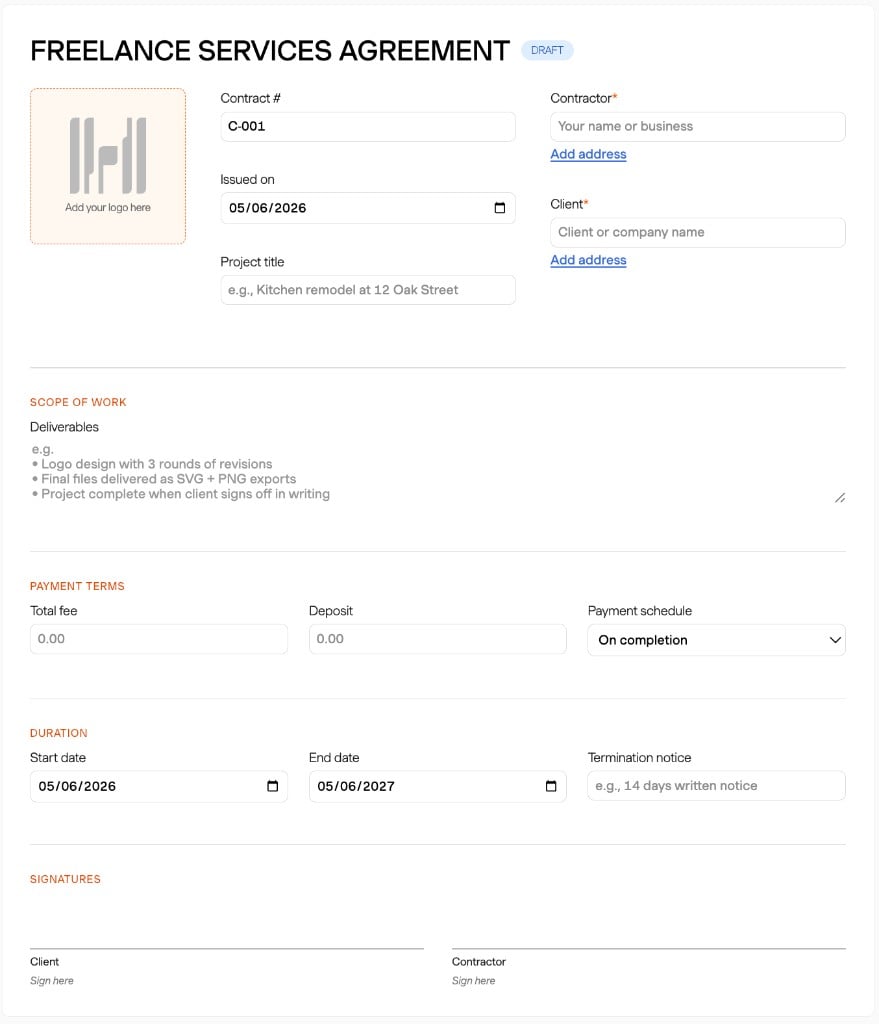
Screenshot of a Hebrew service agreement template using Harvest.

Service Agreement Template in Hebrew FAQs

  • A Hebrew service agreement should include a description of services, timelines, payment terms, client responsibilities, confidentiality clauses, and liability provisions. These elements help define clear expectations and protect both parties involved in the agreement.

  • Yes, electronic signatures have been legally recognized in Israel since the Electronic Signature Law of 2001. A 2018 amendment further broadened their acceptance, making them valid for low-risk contracts like service agreements.

  • Clarity is crucial because recent amendments to Israeli law prioritize contract interpretation based on written wording. Clearly defined terms reduce disputes and enhance the enforceability of the agreement.

  • Harvest helps streamline contract management by allowing users to organize and track time, expenses, and invoices associated with service agreements. This makes it easier to manage contractual obligations and financial aspects.

  • Service agreements in Israel must comply with the Contracts Law, Consumer Protection Law, and Standard Contracts Law. These laws ensure fair terms and protect consumer rights, requiring clear and specific contract provisions.

  • Yes, but they must comply with Israeli consumer protection laws if they actively target Israeli consumers. This includes providing Hebrew contracts and adhering to local legal standards.

  • The principle of "good faith" applies throughout the contract's lifecycle in Israel, requiring parties to act honestly and fairly, even if specific obligations aren't explicitly stated in the contract.

  • Yes, service agreements are legally binding in Israel when they meet the requirements of the Contracts Law, including mutual consent and clear, specific terms.