
Harvest
Contracts
Sign up

Freelance Contract Template in German

The German freelance market is booming, with 4.3 million self-employed professionals. Harvest helps freelancers manage projects, track time, and invoice clients, ensuring organized operations.

Start from a template

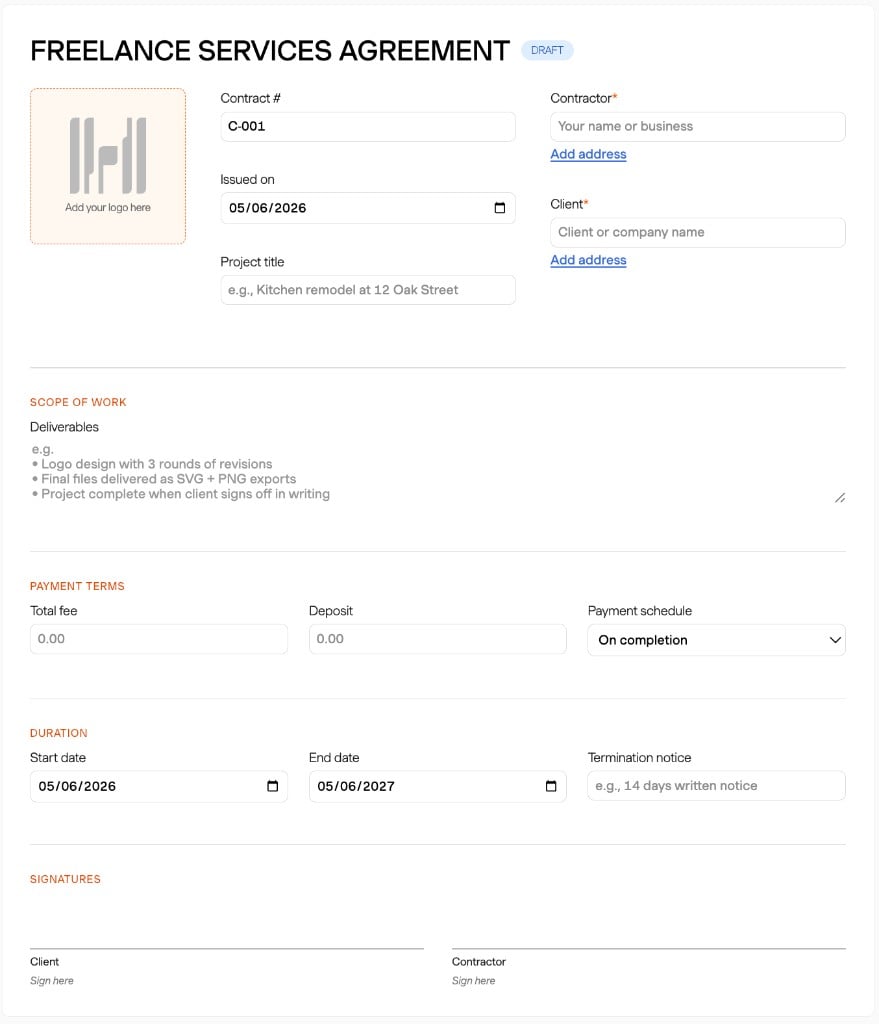
AGREEMENT DRAFT

Add your logo here

Scope of work

Payment terms

Duration

Signatures

Client

Sign here

Contractor

Sign here

Get paid via:
Credit card / Debit card
ACH
Wire transfer

Customize contract

Appearance

Add a logo
Show contract title

Contract settings

Include payment terms Total fee, deposit, and schedule
Include termination clause Notice required to end the contract
Include signature blocks Both parties sign at the bottom

Understanding German Freelance Contracts

Freelance contracts in Germany must adhere to specific legal requirements to ensure compliance and avoid the risk of false self-employment, known as Scheinselbstständigkeit. The German freelance market has seen significant growth, with approximately 4.3 million self-employed professionals contributing to the economy. This expansion highlights the need for comprehensive and legally sound contract templates. However, misclassification can lead to severe penalties, including retroactive social insurance contributions of up to 40% of the contract value.

Key components of a freelance contract include the scope of services, project duration, payment terms, intellectual property rights, confidentiality, liability, and termination conditions. Contracts must explicitly state the freelancer's independence, allowing them to choose their working hours and location, and the freedom to work for other clients. It's crucial to clearly define whether the contract is for specific work (Werkvertrag) or ongoing services (Dienstleistungsvertrag).

Harvest supports freelancers by offering tools to manage project details, track time, and invoice clients effectively. While Harvest does not provide legal contract templates or specific legal advice, it helps freelancers organize their work and maintain professional relationships.

Legal Compliance and Risks in German Freelancing

Ensuring legal compliance is paramount for freelancers operating in Germany to avoid the repercussions of false self-employment. In 2023 alone, there were approximately 42,000 cases of suspected false self-employment, leading to €487 million in penalties. This underscores the importance of structuring freelance contracts correctly. Amendments to the Gesetz zur Förderung der Selbständigkeit have tightened criteria, emphasizing the need for clear project-based engagements.

Freelancers should be mindful of GDPR compliance, especially if they process personal data of EU residents. The European General Data Protection Regulation applies to freelancers in Germany, requiring the secure handling of client information. It's also critical to stay updated with e-invoicing mandates, with new rules effective from January 2027.

Harvest can assist freelancers by providing tools for efficient project management and invoicing, ensuring that freelancers can focus on their work without falling afoul of complex legal requirements. While it doesn't offer legal compliance features, its project tracking and expense management capabilities are invaluable for maintaining organized, professional operations.

Practical Tips for Drafting Freelance Contracts in Germany

Drafting a freelance contract in Germany involves careful consideration of multiple factors to ensure legal compliance and clarity. Essential elements include a detailed description of the services, fixed or hourly payment terms, and clauses regarding confidentiality and intellectual property. Furthermore, contracts should explicitly declare the freelancer's independence from the client, avoiding any indications of employment-like relationships.

Freelancers should avoid common pitfalls, such as excessive control over working methods by clients, or the provision of company equipment without justification. Regular documentation and review of contracts are recommended to ensure they meet the criteria for independent status. Legal counsel can provide valuable guidance in drafting contracts that minimize risks and ensure compliance with German laws.

While Harvest does not provide contract templates, it aids freelancers in managing project details and tracking time and expenses, supporting a clear and organized approach to freelance work. This systematic workflow helps freelancers maintain records that reflect their independent status, an essential factor in avoiding false self-employment allegations.

Leveraging Technology for Freelance Contract Management

Digital advancements have revolutionized how freelance contracts are managed in Germany, with increasing emphasis on e-contracting and digital compliance. The move towards digitized employment contracts aims to eliminate paper-based processes, making digital versions legally equal and enforceable. This transition is particularly beneficial for freelancers, enabling more efficient management of contracts and client relationships.

Freelancers should leverage digital contract management solutions and e-signature services to streamline processes and enhance compliance with German and EU regulations. While templates offer a starting point, they should be tailored to specific engagements. Harvest, though not a provider of digital contract management solutions, offers tools that complement these processes by organizing project details and facilitating efficient time tracking and invoicing.

By integrating Harvest's capabilities with digital contract management tools, freelancers can maintain a professional and compliant operation. This synergy ensures that freelancers can focus on delivering quality work while managing their contractual obligations effectively.

Harvest Supports German Freelancers

See how Harvest helps manage projects, track time, and invoice clients in the German freelance market.

Harvest's project management interface tailored for German freelancers.

Freelance Contract Template in German FAQs

  • A German freelance contract should include the scope of services, project duration, payment terms, confidentiality clauses, and termination conditions. It must state the freelancer's independence and allow work for other clients.

  • Yes, German law requires that freelance contracts avoid characteristics of employment, such as directive authority or integration into the client's organization. Contracts must comply with GDPR if handling EU residents' personal data.

  • To avoid false self-employment, ensure contracts reflect genuine independence, with project-based engagements, clear deliverables, and the freedom to work for multiple clients.

  • Scheinselbstständigkeit refers to false self-employment, where a freelancer is treated as an employee under the law. It can result in significant penalties for both parties involved.

  • Freelancers in Germany must comply with GDPR when processing personal data of EU residents. This includes securing client information and ensuring proper data handling practices.

  • Harvest helps freelancers by providing tools for tracking time, managing project details, and invoicing clients, ensuring organized and efficient operations.

  • Common clauses include service scope, payment terms, confidentiality, liability, and intellectual property rights. Contracts must emphasize the freelancer's independence.

  • Ensure your contract clearly defines project scope, maintains freelancer independence, and complies with GDPR. Consulting a legal expert is advisable for compliance.