
Harvest
Contracts
Sign up

Contract Template in Turkish

Harvest helps contractors manage time tracking and invoicing efficiently. Ensure your contracts comply with Turkish law using tailored templates.

Start from a template

AGREEMENT DRAFT

Add your logo here

Scope of work

Payment terms

Duration

Signatures

Client

Sign here

Contractor

Sign here

Get paid via:
Credit card / Debit card
ACH
Wire transfer

Customize contract

Appearance

Add a logo
Show contract title

Contract settings

Include payment terms Total fee, deposit, and schedule
Include termination clause Notice required to end the contract
Include signature blocks Both parties sign at the bottom

Understanding Contract Templates in Turkey

Contract templates in Turkey are essential tools for ensuring legal compliance and operational efficiency. With the Turkish Code of Obligations setting the legal framework, companies often use professionally prepared templates to standardize their contractual practices. This not only helps in adhering to local laws but also saves time and reduces operational risks. For instance, using templates effectively can reduce transaction costs by minimizing redundant legal work and decreasing external counsel fees.

However, it's crucial to acknowledge the challenges in contract enforcement in Turkey. As of March 2025, Turkey ranked 90th worldwide in contract enforcement effectiveness. This ranking reflects judicial delays and other systemic issues that can complicate contract compliance. Therefore, having a well-drafted, legally sound contract template is vital to navigate these challenges.

Legal Requirements for Contracts in Turkey

In Turkey, contracts must align with mandatory legal provisions to be enforceable. The Turkish Code of Obligations governs these requirements, emphasizing the need for contracts to adhere to public order and sector-specific regulations. For instance, under Turkish data protection law, Standard Contractual Clauses (SCCs) for international data transfers must be signed by all parties involved and submitted to the Turkish Personal Data Protection Authority within five days of signing.

The principle of freedom of form allows contracts to be concluded orally, in writing, or through conduct, unless specified otherwise by law. However, certain agreements, such as real estate transactions, require notarization or specific formal procedures. As a result, tailored contract templates that incorporate these specific requirements are essential for legal compliance.

The Importance of Tailored Contract Templates

While generic contract templates are readily available online, they often fail to meet the specific needs of companies operating in Turkey. Tailored templates, designed by experienced legal professionals, are crucial for addressing unique business requirements and ensuring compliance with Turkish law. This is particularly important in cases where misclassification, such as confusing consultancy agreements with employment relationships, can lead to significant financial liabilities.

Experts recommend implementing strategic template governance, which involves categorizing contracts by complexity and establishing clear thresholds for legal review. This approach not only helps maintain consistency and compliance but also mitigates the risk of using outdated or non-compliant templates.

Best Practices for Contract Management in Turkey

Effective contract management involves establishing robust internal systems for drafting, updating, and enforcing contracts. This proactive approach ensures long-term corporate stability and reduces exposure to legal disputes. In Turkey, written contracts are essential, as verbal agreements are difficult to prove in court. Courts and arbitration panels primarily rely on documentary evidence to establish the terms of an agreement.

For international contracts involving Turkish parties, a bilingual format is recommended. This should include a notarized Turkish translation and a clear statement of which language version prevails in case of discrepancies. Additionally, integrating contract templates with Contract Lifecycle Management (CLM) software can enhance efficiency by centralizing updates and automating approval processes.

Navigating Digital and Electronic Signatures

With the enactment of the Electronic Signature Law (Law No. 5070) in 2004, Turkey has embraced digital transformation in contract management. This law grants qualified electronic signatures the same legal weight as handwritten signatures for most transactions, allowing for quicker and more efficient contract execution. However, certain agreements still require traditional signatures or notarization.

As digital practices continue to evolve, businesses must stay informed about the latest legal developments to ensure ongoing compliance. Regularly reviewing and updating contract templates is a best practice, especially in fast-moving industries, to mitigate the risk of using outdated terms and ensure alignment with current regulations.

Contract Template in Turkish with Harvest

Explore how Harvest can help you manage time tracking and invoicing efficiently while ensuring your contracts comply with Turkish law.

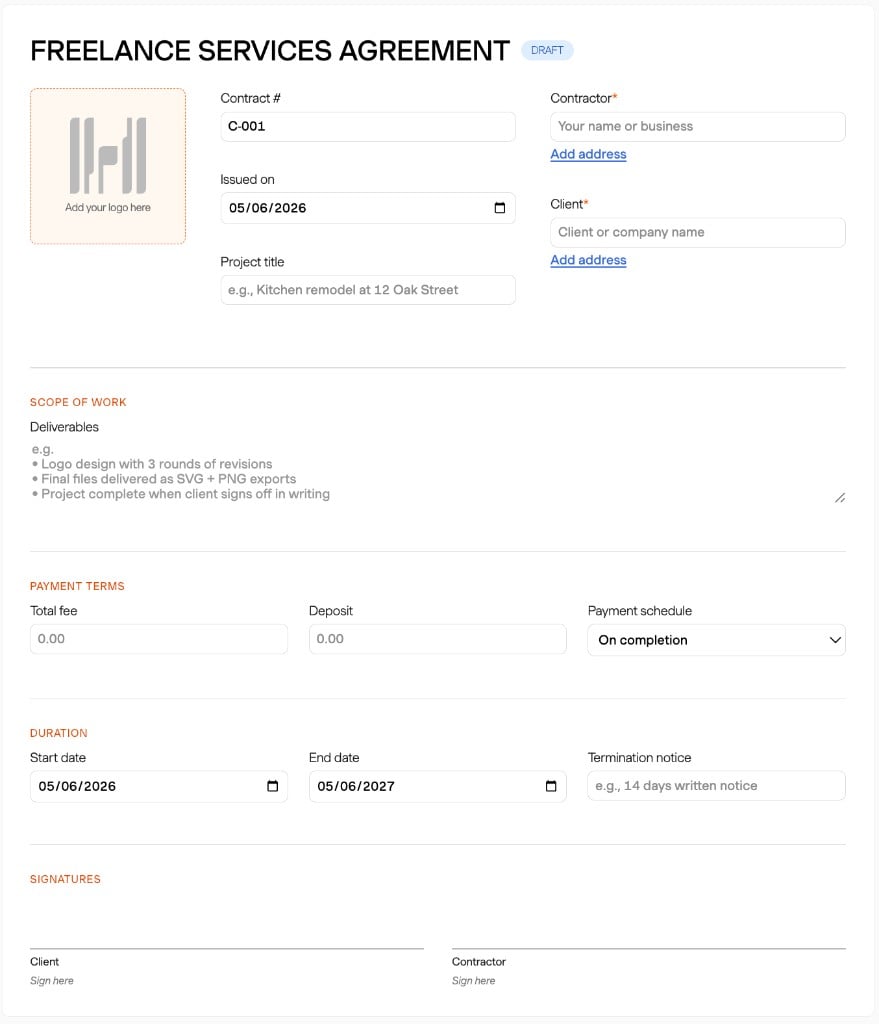
Harvest contract template in Turkish screenshot

Contract Template in Turkish FAQs

  • Contracts in Turkey must comply with the Turkish Code of Obligations, which includes mandatory legal provisions and public order rules. Contracts must be meticulously aligned with these requirements to be enforceable.

  • Yes, the Electronic Signature Law (Law No. 5070) allows electronic signatures in Turkey. Qualified electronic signatures hold the same legal weight as handwritten ones for most transactions.

  • Tailored contract templates are crucial because generic templates may not comply with the specific legal nuances of Turkish law. Tailored templates ensure legal protection and meet unique business needs.

  • For international contracts, a bilingual format (Turkish and another language) is advisable. It should include a notarized Turkish translation and specify which version prevails in case of discrepancies.

  • Contract templates save time and reduce costs by minimizing redundant legal work. They standardize contractual practices, ensuring critical legal protections are not overlooked.

  • The Electronic Signature Law allows for electronic signatures, which are legally equivalent to handwritten signatures, thus facilitating quicker contract execution. However, some contracts still require traditional signatures.

  • A comprehensive employment contract in Turkey should cover probation periods, duties, wages, leave entitlements, confidentiality obligations, and termination conditions, in line with Turkish Labor Law.