Harvest
Invoices
Sign up

Add Logo to Invoice

Harvest simplifies the invoicing process by allowing users to upload a company logo, enhancing brand visibility on invoices.

INVOICE DRAFT

Add your logo here
Item type
Description
Quantity
Unit price
Tax
Amount
Subtotal
$0.00
Discount
$0.00
Amount Due
$0.00
Get paid via:
Credit card / Debit card
ACH
Wire transfer

Customise invoice

Appearance

Add a logo
Show invoice title

Invoice settings

Tax Add up to 2 tax rates
%
Discount Apply a discount percentage
%

Understanding Image Requirements for Invoice Logos

To ensure your logo appears crisp and professional on invoices, understanding image requirements is crucial. The ideal image size for an invoice logo can vary significantly depending on the invoicing platform or template used, but generally, a high-resolution image is preferred for clarity. For digital display on screens, a resolution of 72-96 DPI (dots per inch) is common, while for print, a minimum of 300 DPI is recommended to avoid blurriness or pixelation. Some platforms might suggest specific pixel dimensions, such as 150px x 150px with 20px margins for optimal display, or 280 x 200 pixels for business logos. For PDF print-outs, a high-resolution 300 DPI image is often required, with some systems defaulting to a lower 70 DPI, necessitating a much higher source resolution to compensate for quality.

Supported image formats typically include JPG, PNG, and GIF. JPG is suitable for detailed or full-bleed logos without transparency, while PNG is excellent for logos with simple colors and transparency. PNGs support higher color depths, displaying millions of colors, but can result in larger file sizes. For professional print applications, vector formats like EPS, AI, and PDF are highly recommended because they can scale infinitely without losing clarity, supporting both CMYK and Pantone spot colors for consistent branding. TIFF is another lossless format suitable for high-resolution print, supporting up to 32-bit color depth. Color depth for invoice logos is generally recommended to be 24-bits or less. It's also important to use the correct color space: RGB for digital displays and CMYK for printed materials, as using RGB for print can lead to color discrepancies.
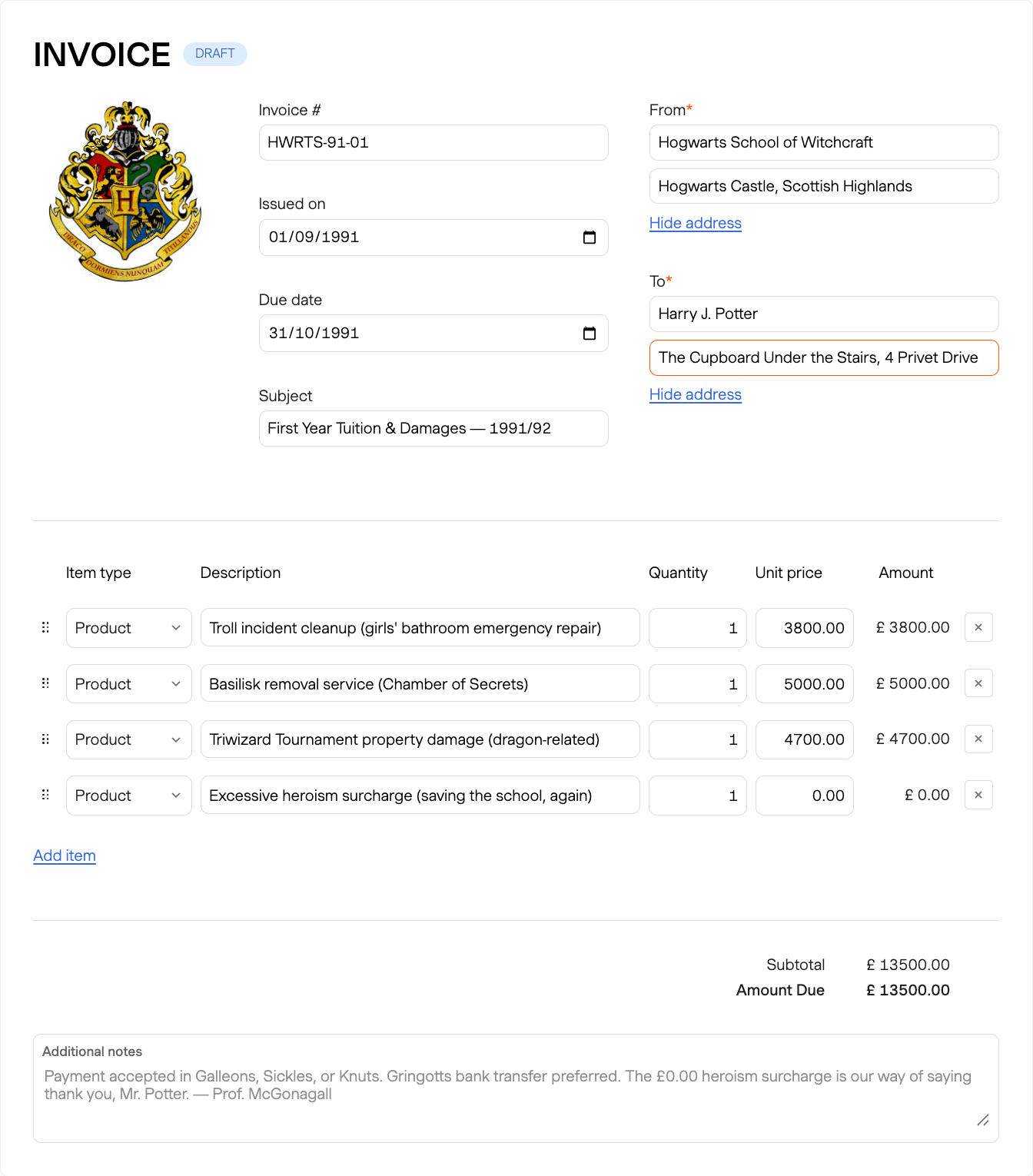
Customizing Logo Placement on Invoices

Effective logo placement on invoices enhances readability and reinforces brand recognition without distracting from essential information. The most common and often expected placements for a logo are the top-left or top-center of the invoice. These positions ensure the logo is immediately visible and establishes the sender's identity from the outset. However, depending on the invoice layout, you can also consider placing your logo at the bottom, or even centrally at the top.

  • Visibility and Legibility: The logo must be clearly visible and large enough to be recognizable, but not so large that it overwhelms the page or obscures critical text.
  • Consistent Spacing: Maintain adequate margins and spacing around your logo to give it "room to breathe" and appear professional. A 20px margin around the logo is often recommended.
  • Balance and Alignment: The logo should be properly balanced and aligned within the overall design of the invoice, paying attention to symmetry and other design elements.
  • Brand Color Integration: Use your brand's color palette throughout the invoice to create a cohesive and professional look.

Creative logo placements can significantly enhance invoice design. For instance, some designs opt for a vertical placement, positioning the logo and contact information along the left-hand side of the page, which can allow for a taller table for line items. Another approach is a "flipped" header, where the logo is on the right side and company details are left-aligned, with the word "Invoice" still prominent in the center. Even subtle choices, like using an off-white paper tone with a bronze foiled logo, can add a touch of sophistication and uniqueness to the invoice design. The goal is to make the logo catch the eye without distracting from the invoice's primary purpose: conveying billing information clearly.

Troubleshooting Logo Display Issues

Encountering logo display issues on invoices can be frustrating, but many common problems have straightforward solutions. One frequent issue is the logo appearing distorted, blurry, or pixelated. This often stems from using an image with insufficient resolution for the output medium; for print, a logo should ideally be 300 DPI, and 150 DPI for digital screens. If your logo appears cut off or too large, the first step is to resize the image using a photo editor to meet the platform's recommended dimensions, such as 280 x 200 pixels. Ensure the aspect ratio is locked during resizing to prevent distortion.

Common logo upload errors also include using unsupported file formats or exceeding file size limits. Most invoicing systems accept JPG, PNG, or GIF files, with some specifying a maximum file size, such as under 10 MB or 3 MB. If a logo fails to upload, verify its format and size against the platform's requirements. If the logo isn't appearing at all, especially in document previews, check if the system is in "preview mode," as some platforms may not display logos until the document is printed or saved as a PDF. For templates edited in word processing software, ensure the image is set to "In Line with Text" to prevent it from disappearing upon printing or merging.

For persistent logo display issues, advanced troubleshooting might be necessary. If your logo appears correctly in the template but distorted in the final output (e.g., PDF), some invoicing systems may have hardcoded dimensions that override your uploaded image settings. In such cases, you might need to adjust internal configuration files (e.g., a `setting.php` file for `logo_size_width` and `logo_size_height`) if you have access to the system's backend. Additionally, for online invoicing platforms, clearing your browser's cache and cookies or trying an incognito/private browsing window can resolve display glitches caused by cached data. If a new or updated logo isn't appearing, you may need to manually refresh or re-upload the invoice template to ensure the changes are applied across all documents.

Enhancing Brand Identity with Invoice Logos

A logo on an invoice is far more than a decorative element; it's a critical component in enhancing brand identity and fostering client relationships. Logos serve as the visual representation of a company, instantly conveying its personality, values, and unique offerings. They are often the first visual cue people associate with a brand, building instant recognition and differentiating a business in a crowded market. Research indicates that strong logos can boost brand recognition by over 80 percent, and a significant 75% of purchase decisions are influenced by brand perception, where the logo plays a crucial role.

  • Consistent Application: Ensure your logo appears on every invoice and across all brand touchpoints, from websites to business cards, to reinforce brand recognition and build a unified brand image.
  • High-Resolution Quality: Always use a high-resolution version of your logo to maintain a polished and sophisticated appearance, preventing blurriness or pixelation.
  • Simplicity and Clarity: A simple, memorable logo is easier to recognize and recall. Test how your logo appears in both color and grayscale to ensure it remains effective in all contexts, including black-and-white print.
  • Brand Alignment: The logo's design, colors, and typography should align perfectly with your overall brand guidelines, creating a seamless and professional experience for clients.

Case studies consistently demonstrate the impact of strategic logo use on invoices. For example, a small graphic design firm that consistently added its logo to invoices observed new leads originating from departments that had processed their invoices, highlighting how invoices can act as an unexpected marketing channel. Furthermore, studies suggest that branded, well-designed invoices are paid up to 3 days faster than generic ones, underscoring the tangible benefits of a professional brand presentation. By transforming invoices from mere transactional documents into powerful brand assets, businesses can project professionalism, instill trust, and leave a memorable imprint on their clients, ultimately contributing to customer retention and business growth.

See Your Personalized Invoice with Logo

Preview your invoices with custom logo placements, ensuring brand visibility and professional presentation across all templates.

Add Logo to Invoice FAQs

  • To add a logo to an invoice, first ensure your logo meets the platform's size and format requirements, typically JPG or PNG. Access your invoicing tool's settings or the specific invoice template section. Look for an option labeled "Add Logo" or "Upload Logo." Select your logo file from your device and adjust its placement on the invoice as needed. Save your changes and preview the invoice to confirm the logo appears correctly.

  • Not all image formats are suitable for invoice logos. Commonly accepted formats include JPG, PNG, and GIF. These formats ensure compatibility and quality across most platforms. JPG is ideal for images without transparency, while PNG supports transparency and is preferred for logos with simple colors. Vector formats like EPS or AI are excellent for print but may not be supported by all invoicing systems.

  • Yes, you can export invoice data from Harvest. Note that bulk UBL export is limited to one invoice at a time.
  • To ensure your logo displays correctly across different invoice templates, use a high-resolution image that meets the system's recommended dimensions. Consistently use the same file format and resolution for all uploads. Check each template's preview to verify correct placement and appearance. Adjust margins and size to maintain clarity and avoid distortion, and ensure the logo file is not corrupted.

  • If your logo does not display correctly, first check if the image file is in the correct format (e.g., JPG, PNG) and within size limits. Ensure the logo file is not corrupted and try re-uploading it. If the logo appears distorted, adjust its resolution and dimensions to match the platform's requirements. Clear your browser's cache or try using a different browser to see if the issue persists in preview mode.