Harvest
Invoices
Sign up

Create Invoice for Czech Republic

Harvest offers flexible invoicing options, including support for multiple currencies and adding VAT information, making it adaptable for international invoicing needs.

INVOICE DRAFT

Add your logo here
Item type
Description
Quantity
Unit price
Tax
Amount
Subtotal
$0.00
Discount
$0.00
Amount Due
$0.00
Get paid via:
Credit card / Debit card
ACH
Wire transfer

Customise invoice

Appearance

Add a logo
Show invoice title

Invoice settings

Tax Add up to 2 tax rates
%
Discount Apply a discount percentage
%

Understanding Czech Invoice Requirements

To ensure your invoices in the Czech Republic are legally sound, you must include specific mandatory fields, which vary slightly depending on your VAT registration status. For VAT-registered businesses, a comprehensive set of details is required to facilitate VAT recovery and reporting. These include:

  • Unique Sequential Invoice Number: Each invoice must have a distinct number in consecutive, ascending order.
  • Supplier Information: Your full business name, registered address, Company Registration Number (IČO), and your Tax Identification Number (DIČ), which is your VAT number.
  • Customer Information: The customer's full name, address, and their DIČ/VAT number if they are also a VAT payer.
  • Date of Issue: The date the invoice was created.
  • Date of Taxable Supply: If different from the issue date, this is the date when the goods were supplied or services rendered.
  • Description of Goods/Services: A clear description of the quantity and type of goods supplied or the nature and extent of services rendered.
  • Unit Price and Discounts: The unit price of goods/services and any applicable discounts not already included in the unit price.
  • Net Taxable Value: The value of the supply before VAT.
  • VAT Rate Applied: The specific VAT rate for each item.
  • VAT Amount: The total VAT amount in Czech Koruna (CZK).
  • Total Amount Payable: The final amount including VAT.
  • Bank Details: Your bank name and account number for payment.
  • Payment Terms: Clearly state the due date and any variable symbol (reference number).

For non-VAT payers, the requirements are less extensive, primarily focusing on identifying the transaction and parties involved, without the VAT-specific details.
Navigating VAT Regulations in the Czech Republic

Understanding Czech VAT (DPH) regulations is fundamental for businesses operating within or with the Czech Republic, impacting invoicing, pricing, and compliance. The standard VAT rate in the Czech Republic is 21%, applicable to most goods and services. As of January 1, 2024, the previous reduced rates of 15% and 10% were consolidated into a single reduced rate of 12%. This 12% rate applies to items such as certain food products (excluding most beverages), water supplies, medical and social care, restaurant and catering services, admission to cultural and sporting events, and hotel accommodation. Notably, books (in printed or electronic form) have been subject to a 0% VAT rate since January 1, 2024.

Mandatory VAT registration for resident businesses occurs if their turnover exceeds CZK 2 million in a calendar year, requiring registration from January 1st of the following year. However, if turnover immediately surpasses CZK 2,536,500, registration is triggered the day after this threshold is exceeded. For non-resident companies, there is generally no registration threshold; they must register from their first taxable activity in the Czech Republic. An EU-wide distance selling threshold of €10,000 also applies for cross-border sales to consumers within the EU.

The reverse charge mechanism is a critical aspect, particularly for cross-border transactions. It shifts the responsibility for reporting and paying VAT from the supplier to the recipient. This applies to B2B services where the customer is located in the Czech Republic (for foreign suppliers) and for intra-EU supplies to VAT-registered businesses. In such cases, the supplier issues an invoice without VAT, and the recipient self-assesses the VAT. The reverse charge also applies to specific domestic supplies, including certain electronics exceeding CZK 100,000, construction work, and supplies of waste or raw metals. Certain supplies are entirely VAT exempt, such as health services, public education, and financial and insurance services.

Invoicing in Foreign Currencies

Invoicing in foreign currencies in the Czech Republic is permissible and offers flexibility for businesses engaged in international trade. While you are legally allowed to issue invoices in any currency, there are specific regulations to ensure compliance with Czech tax laws.

The most crucial aspect when invoicing in a foreign currency is the exchange rate. You must always calculate the exchange rate according to the Czech National Bank's (CNB) official exchange rate on the date of issue of the invoice. It is highly recommended to include a note on the invoice stating the applied exchange rate, for example, "Exchange Rate of the CNB on [Date]: 1 EUR = X CZK."

Furthermore, even if the invoice is issued in a foreign currency, the VAT amount must also be clearly stated in Czech Koruna (CZK). This is essential for VAT reporting and compliance with the Czech tax authorities. For businesses regularly dealing with foreign currency transactions, setting default and client-specific currencies within your invoicing system can streamline the process. However, always ensure that the CNB's official rate is used for conversion on the invoice date to avoid discrepancies during tax audits.

Simplified Invoicing for Non-VAT Payers

For small businesses and freelancers in the Czech Republic who are not registered for VAT, invoicing procedures are significantly simpler, offering a distinct advantage in terms of administrative burden. Non-VAT payers are those whose annual turnover does not exceed the mandatory VAT registration threshold of CZK 2 million in a calendar year.

The primary difference in requirements for non-VAT payers is the absence of VAT-specific details on their invoices. Unlike VAT payers, non-VAT invoices do not need to include the VAT rate, the net taxable value, or the VAT amount. This means less complex calculations and fewer fields to populate.

A typical invoice for a non-VAT payer should include:

  • Invoice Number: A unique, sequential number.
  • Supplier Information: Your full name/business name, registered address, and Company Registration Number (IČO).
  • Customer Information: The customer's full name/business name and address.
  • Date of Issue: The date the invoice was created.
  • Due Date: The date by which payment is expected.
  • Variable Symbol: A reference number for the client's record-keeping, often the invoice number itself.
  • Description of Goods/Services: A clear breakdown of the services or products provided, including rate and quantity.
  • Total Amount: The final amount due.

See Your Czech Invoice Template in Action

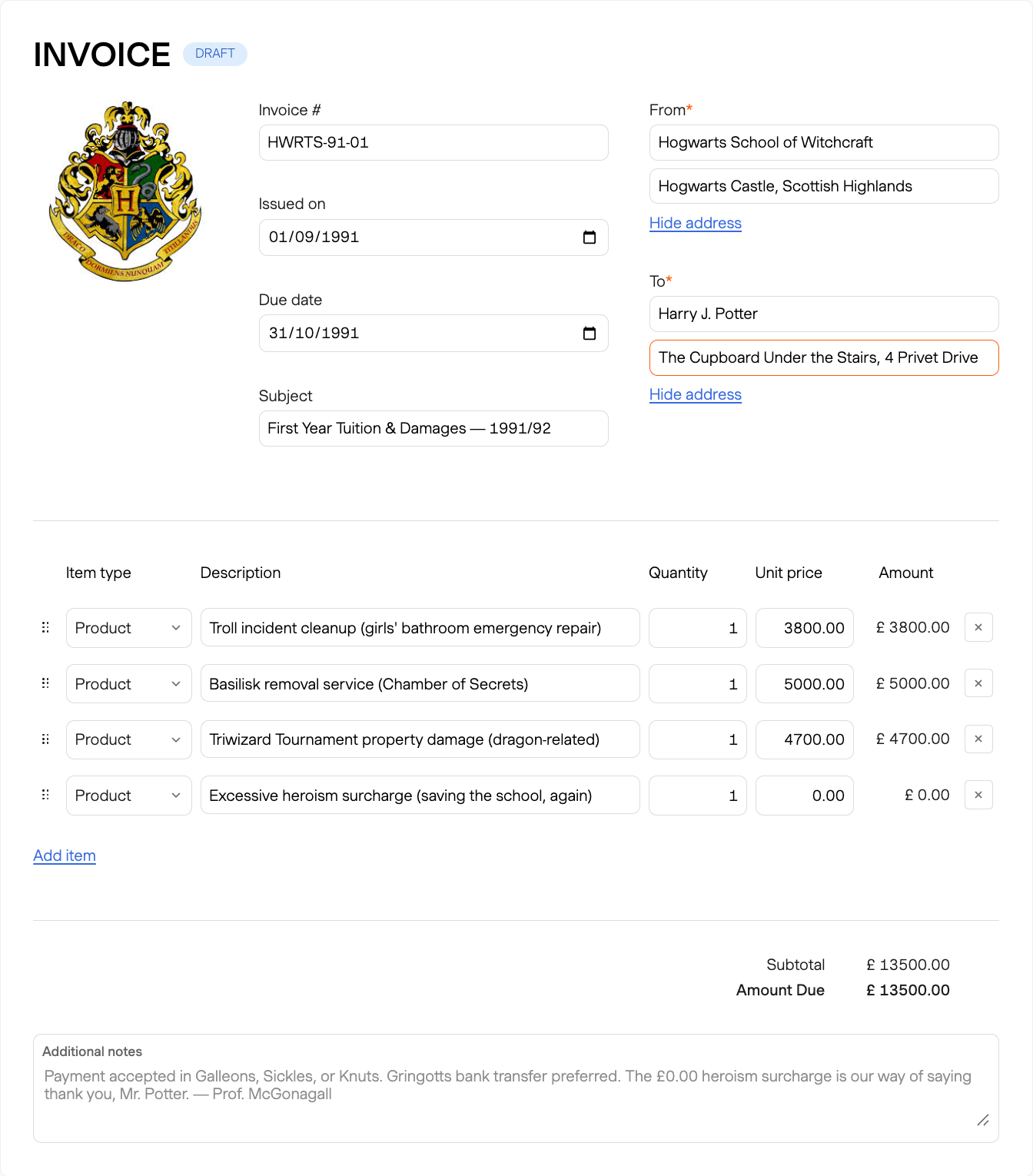
Preview how your invoice will include VAT numbers and foreign currency details, ready for Czech business transactions.

Create Invoice for Czech Republic FAQs

  • Harvest allows you to add specific tax information, including a VAT number, to your invoices through the account settings.
  • Harvest supports invoicing in foreign currencies by allowing you to set a default and client-specific currency, though it does not handle currency conversions.
  • Harvest allows you to set tax rates for different locations, helping you comply with various international tax regulations. However, it is advisable to consult with a tax professional to ensure compliance with local laws.
  • In the Czech Republic, legal invoicing requirements include providing a unique invoice number, supplier and customer details, and a clear description of goods or services. VAT-registered businesses must include VAT details, while non-VAT payers have fewer requirements.
  • Invoicing software generally does not automatically convert currencies; it requires manual input of exchange rates to ensure compliance with local regulations.