Harvest
Invoices
Sign up

Create Invoice for France

Harvest provides flexible invoicing tools that can be customized to meet various international requirements, including VAT handling and e-invoicing compliance.

INVOICE DRAFT

Add your logo here
Item type
Description
Quantity
Unit price
Tax
Amount
Subtotal
$0.00
Discount
$0.00
Amount Due
$0.00
Get paid via:
Credit card / Debit card
ACH
Wire transfer

Customise invoice

Appearance

Add a logo
Show invoice title

Invoice settings

Tax Add up to 2 tax rates
%
Discount Apply a discount percentage
%

Key Elements of a Legally Compliant French Invoice

To ensure your French invoices are legally compliant, they must include several mandatory elements. These include a unique, sequential invoice number, the invoice issue date, and the actual date of sale or service provision. Both the seller's and buyer's full identities are crucial, encompassing their names, addresses, legal forms, and, for businesses, their SIREN or SIRET numbers. If applicable, both parties' VAT identification numbers must also be present. Each item or service should be clearly described, detailing the unit price excluding tax (HT), quantity, applicable VAT rate, and the total amounts both excluding and including tax (TTC). Finally, payment terms, late payment interest rates, and the €40 indemnity for recovery costs in case of late payment are also required.
Applying VAT Rates on French Invoices

Applying the correct VAT rates on French invoices is critical for compliance. France utilizes a standard VAT rate of 20%, which applies to most goods and services. Additionally, there are reduced rates of 10% (e.g., for prepared food, passenger transport) and 5.5% (e.g., for most food products, books, electricity), and a super-reduced rate of 2.1% (e.g., for certain medicines and press publications). You must clearly state the applicable VAT rate for each item and the corresponding VAT amount. If your business benefits from a VAT exemption, the invoice must explicitly mention "TVA non applicable, art. 293 B du CGI". For B2B transactions within the EU, the reverse charge mechanism often applies, shifting VAT liability to the customer. In such cases, the invoice should state "autoliquidation" or "TVA due par le preneur – Article 283-2 du CGI" and include both the seller's and buyer's intra-community VAT numbers.

Preparing for Future Electronic Invoicing Requirements

France is implementing mandatory electronic invoicing (e-invoicing) and e-reporting for domestic B2B transactions, with a phased rollout. All businesses must be capable of receiving e-invoices by September 1, 2026. Large and medium-sized enterprises are required to issue e-invoices from this date, while small and micro-enterprises will follow on September 1, 2027. To ensure compliance, businesses must use approved structured digital formats like Factur-X, UBL, or CII. Invoices will be exchanged via certified "Approved Platforms" (PAs), formerly known as Partner Dematerialization Platforms (PDPs). The Public Invoicing Portal (PPF) will serve as a central directory and data hub, but direct invoice exchange will primarily occur between PAs. E-reporting will also be mandatory for B2C and cross-border B2B transactions.

See Your French Invoice Template in Action

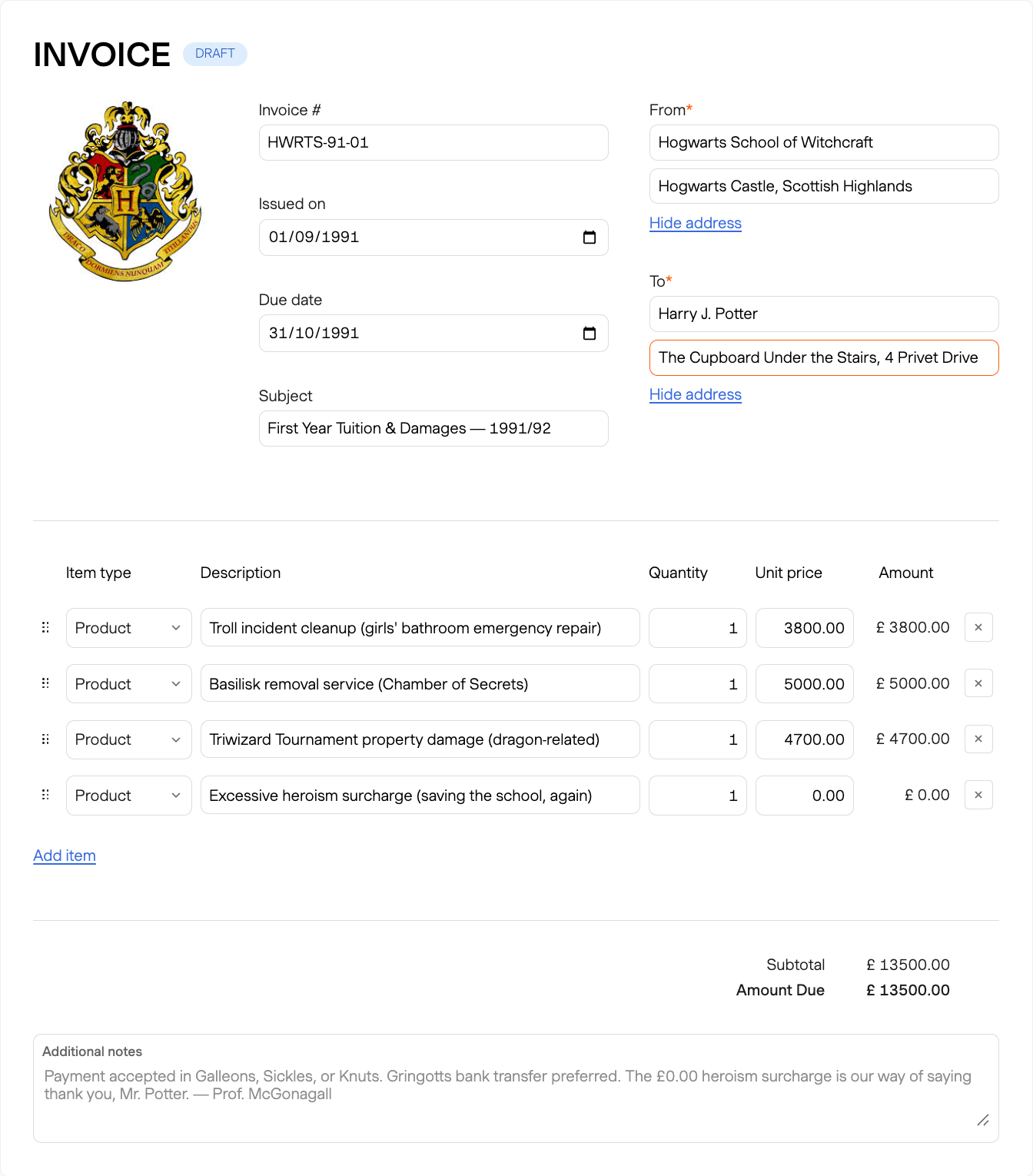
Preview how your invoice will look with French VAT rates, SIREN/SIRET numbers, and e-invoicing compliance — ready for local transactions.

Create Invoice for France FAQs

  • Harvest lets you enter and apply specific VAT rates on invoices, which can be customized for each line item. This ensures that the correct VAT is applied based on French regulations.

  • A legally compliant French invoice must include a unique, sequential invoice number, the issue date, and sale or service provision date. It should also have the seller's and buyer's full identities, including names, addresses, and SIREN or SIRET numbers for businesses. Additionally, it must list each item's description, unit price, applicable VAT rate, total amounts before and after tax, and payment terms.

  • Yes, Harvest offers a support system that includes a help center with articles, tutorials, and FAQs, as well as customer support via email and chat to assist you with any issues you may encounter.
  • While invoicing tools can be set up to handle current VAT rates, they may require manual updates to accommodate changes in VAT regulations. Users should stay informed about VAT changes to ensure compliance.

  • For B2B transactions within the EU, Harvest supports adding VAT numbers to invoices, which is essential. Additionally, the reverse charge mechanism often applies, requiring the invoice to indicate "autoliquidation" and include intra-community VAT numbers.