Harvest
Invoices
Sign up

Developers Invoice Template

Harvest provides flexible invoicing options for developers, allowing detailed service breakdowns and adaptable billing methods.

INVOICE DRAFT

Add your logo here
Item type
Description
Quantity
Unit price
Tax
Amount
Subtotal
$0.00
Discount
$0.00
Amount Due
$0.00
Get paid via:
Credit card / Debit card
ACH
Wire transfer

Customise invoice

Appearance

Add a logo
Show invoice title

Invoice settings

Tax Add up to 2 tax rates
%
Discount Apply a discount percentage
%

Key Elements of a Developer Invoice Template

A robust developer invoice template should clearly itemize all services rendered, ensuring transparency and professional billing for software projects. Essential components include your business and client details, a unique invoice number, issue date, and payment due date. For development work, it's critical to detail specific tasks, features implemented, or bugs resolved.

Consider these core elements:

  1. Detailed Service Breakdown: List each development task (e.g., "Frontend UI development," "API integration," "Database schema design") with corresponding hours or a fixed price.
  2. Project Milestones: For larger projects, clearly link payments to completed project phases or deliverables. This is especially important for fixed-rate contracts, where payments might be structured as 25% upon project start, 50% at a key milestone, and 25% upon completion.
  3. Billing Method: Clearly indicate if billing is hourly (e.g., "$100/hour for 40 hours") or a fixed-rate for a specific deliverable.
  4. Taxes and Discounts: Include applicable sales tax, VAT, or any agreed-upon discounts.
  5. Payment Terms: Specify accepted payment methods and terms, such as "Net 30" (payment due within 30 days).
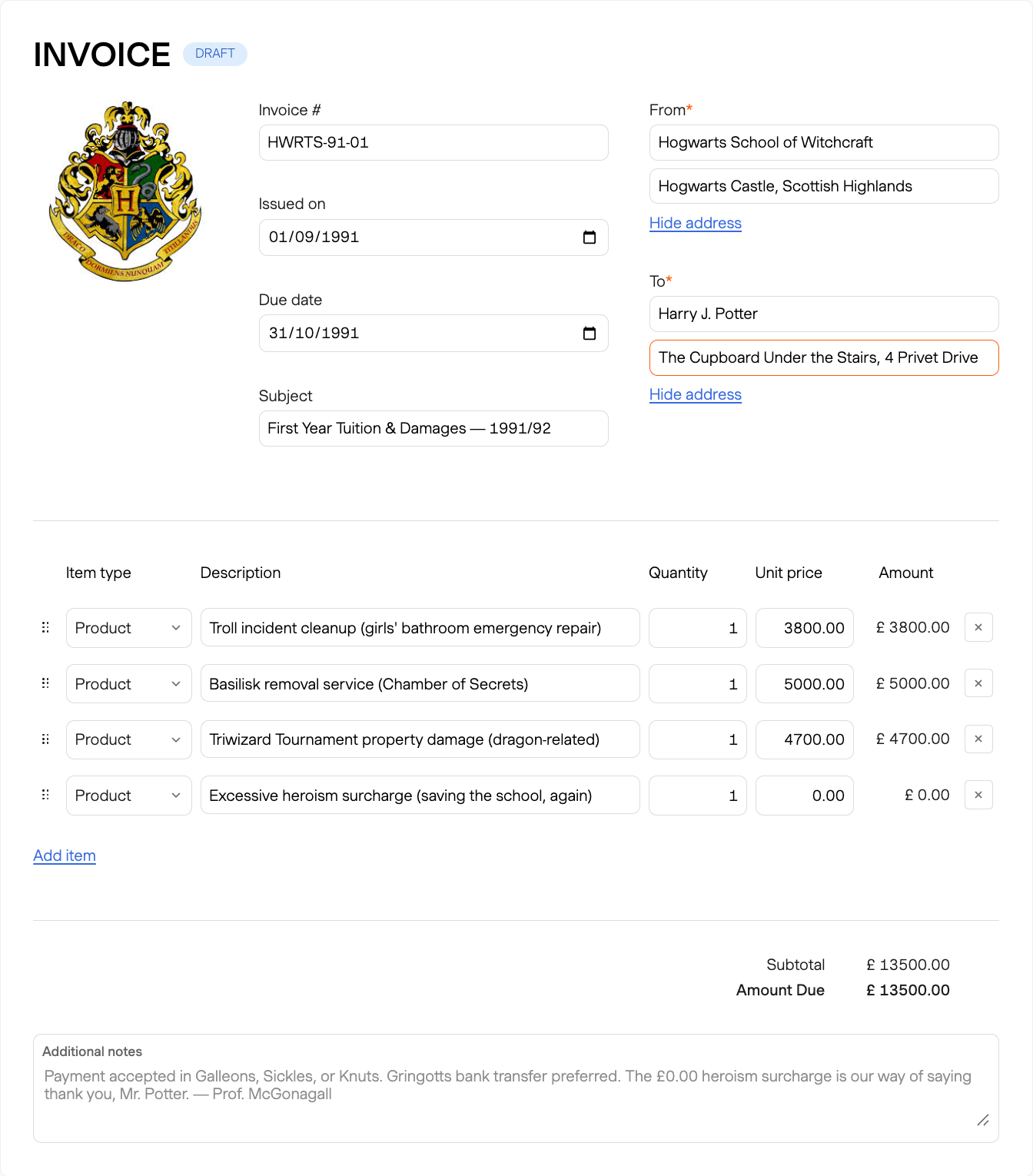
Customizing Your Developer Invoice Template

Personalizing your developer invoice template ensures it reflects your professional brand and accurately communicates project-specific details to clients. Start by selecting a template that allows for easy modification of text fields and layout.

To effectively customize your template:

  1. Incorporate Branding: Add your company logo, consistent brand colors, and contact information (website, email, phone number) to every invoice. This reinforces your professional identity.
  2. Add Project-Specific Details: Include a dedicated field for a project name or code, a brief project description, and any relevant client purchase order (PO) numbers. This helps both you and the client track invoices against specific work.
  3. Tailor Line Item Descriptions: Use clear, concise language that your client understands. Instead of generic "services," specify "Backend API development for user authentication module" or "Bug fix: Login page redirection error."
  4. Adjust Payment Instructions: Clearly state your preferred payment methods (e.g., bank transfer details, online payment gateway links) and any late payment policies.

A well-customized invoice not only looks professional but also streamlines the payment process.

Best Practices for Developer Invoicing

Adopting best practices for invoicing helps ensure accuracy, reduces payment delays, and maintains strong client relationships. One common pitfall is vague service descriptions, which can lead to client disputes or confusion.

Consider these practical tips:

  • Be Meticulous with Time Tracking: If billing hourly, use reliable time-tracking tools and provide a detailed breakdown of hours spent per task. This builds trust and justifies your charges.
  • Invoice Promptly and Consistently: Send invoices immediately upon project completion or milestone achievement. Establish a regular invoicing schedule, such as weekly, bi-weekly, or monthly, to maintain consistent cash flow.
  • Clearly Define Payment Terms: State your payment terms upfront in your contracts and reiterate them on every invoice. For example, "Payment due within 14 days of invoice date" or "Late payments may incur a 5% monthly fee."
  • Proofread Thoroughly: Always double-check all figures, dates, client details, and your banking information before sending. Errors can delay payment and undermine professionalism.
  • Follow Up Professionally: If an invoice becomes overdue, send a polite reminder email a few days after the due date. Maintain a professional tone to preserve client relationships.

See Your Developers Invoice Template in Action

Preview how your invoice can be customized with detailed breakdowns of coding, testing, and project management tasks — ready for any software project.

Developers Invoice Template FAQs

  • Harvest enables you to provide a detailed breakdown of services like coding, testing, and project management by including time entry notes on your invoice line items.

  • In software development, best practices for invoicing include providing detailed service descriptions, using reliable time tracking for hourly billing, and sending invoices promptly after project completion. Clearly define payment terms in contracts and on invoices, and follow up professionally on overdue payments to maintain client relationships.

  • Harvest offers features like mobile apps and browser extensions to help remote teams track their time efficiently from anywhere. Team members can log hours in real-time, making collaboration seamless.
  • Generally, most simple invoice templates do not automatically calculate taxes. Users typically need to manually enter tax rates and amounts, or use more sophisticated accounting software that offers automatic tax calculations.

  • Harvest supports both hourly and fixed-rate billing, enabling you to choose the most suitable billing method for your development work.