Harvest
Invoices
Sign up

Invoice Template for Developers

Harvest provides flexible invoicing solutions tailored for developers, ensuring detailed and project-specific billing.

INVOICE DRAFT

Add your logo here
Item type
Description
Quantity
Unit price
Tax
Amount
Subtotal
$0.00
Discount
$0.00
Amount Due
$0.00
Get paid via:
Credit card / Debit card
ACH
Wire transfer

Customise invoice

Appearance

Add a logo
Show invoice title

Invoice settings

Tax Add up to 2 tax rates
%
Discount Apply a discount percentage
%

Essential Features of Developer Invoice Templates

An effective invoice template for developers must support granular billing to accurately reflect the complexity of software projects. Look for templates that allow for detailed line items breaking down work into specific development phases, such as "Discovery & Planning," "UI/UX Design," "Backend API Development," "Frontend Implementation," "Database Architecture," "Quality Assurance & Testing," and "Deployment & Configuration." Each service should have a specific description, clearly outlining the work performed, for instance, "Developed user authentication module using OAuth 2.0" or "Implemented responsive design for mobile viewports." Furthermore, the template should accommodate project-specific details like project codes, version numbers, and links to relevant documentation or repositories, which help justify costs and provide context for the client. This level of detail ensures transparency and reduces client queries regarding charges.
Customizing Your Developer Invoice Template

Tailoring your invoice template is crucial for effectively billing diverse software services and maintaining professionalism. To customize, first, ensure the template allows you to clearly differentiate between various service types, such as web development, mobile application development, consulting, or ongoing support. For best practices in invoicing, always include a clear scope of work reference, agreed-upon rates (hourly, daily, or fixed-price), and unambiguous payment terms, typically net 15 or net 30 days. Consider adding a section for "Hours Logged" or "Milestone Completion Date" for time-and-materials or milestone-based projects, respectively. The most effective formats for developer invoices are typically PDFs for final delivery, ensuring consistency across different viewing platforms, while editable formats (like Word or Google Docs) are useful for internal preparation and record-keeping. Always include your professional branding, such as a logo and contact information.

Common Mistakes to Avoid When Invoicing as a Developer

Developers often encounter specific pitfalls when invoicing that can lead to payment delays or disputes. One common mistake in milestone-based billing is failing to clearly define what constitutes a completed milestone, leading to disagreements over partial payments. Ensure each milestone has objective, verifiable deliverables. For retainer agreements, a frequent error is not meticulously tracking hours against the retainer, which can result in scope creep or under-billing; implement a robust time-tracking system and provide regular usage reports. Another critical oversight is neglecting to track maintenance and support hours separately from development hours. These services often have different rates or contractual terms and should be itemized distinctly to avoid confusion and ensure proper compensation for ongoing efforts. Always double-check calculations and client details before sending to prevent easily avoidable errors.

Explore a Developer-Specific Invoice Template

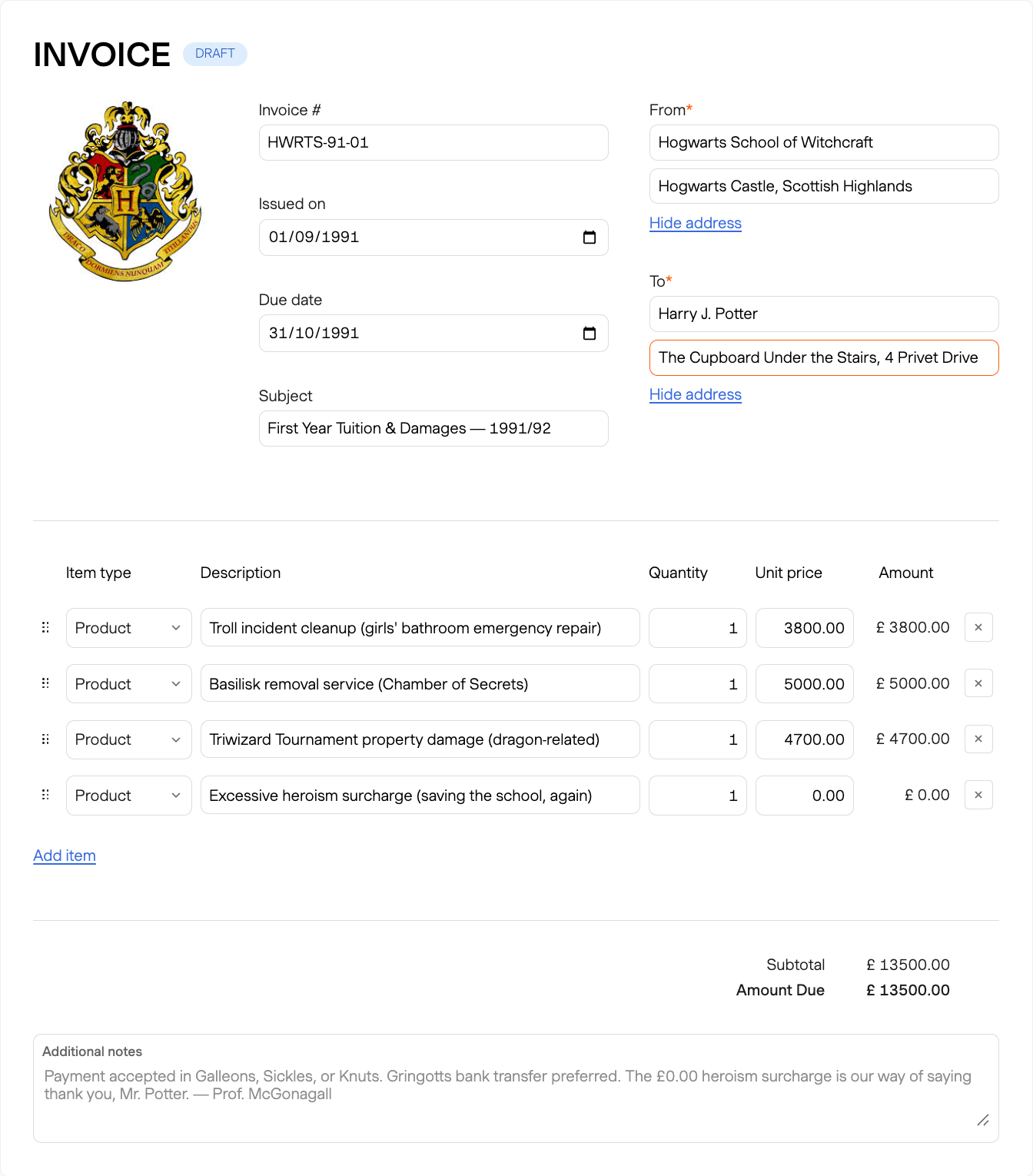
See how your developer invoice can include specific line items like coding and testing phases, with project-specific details to justify costs.

Invoice Template for Developers FAQs

  • Harvest allows you to link invoice line items to specific projects, enabling detailed tracking of different phases of software development projects.

  • Best practices include clearly defining project phases, setting clear payment terms, and itemizing all billable tasks. Always maintain transparency with clients by providing detailed descriptions of services rendered and agreed-upon rates. Additionally, using consistent formats such as PDFs ensures clarity and professionalism in your invoicing.

  • Harvest offers various reporting features that allow you to analyze your invoicing and payment data, including project profitability reports, invoice statuses, and detailed insights into time spent on billable and non-billable work.
  • Harvest can track maintenance and support hours separately by pulling specific timesheet data into invoices.

  • While templates can help structure milestone-based billing, they may not automatically enforce deliverable completion standards or handle disputes over milestone definitions. It's crucial to have clear, agreed-upon milestones with your clients to avoid misunderstandings.