Harvest
Invoices
Sign up

Email Invoice for Iran

Harvest ensures reliable delivery of invoices by sending them from a trusted domain, while allowing you to customize the reply-to address for direct client communication.

INVOICE DRAFT

Add your logo here
Item type
Description
Quantity
Unit price
Tax
Amount
Subtotal
$0.00
Discount
$0.00
Amount Due
$0.00
Get paid via:
Credit card / Debit card
ACH
Wire transfer

Customise invoice

Appearance

Add a logo
Show invoice title

Invoice settings

Tax Add up to 2 tax rates
%
Discount Apply a discount percentage
%

Understanding Iranian Invoicing Regulations

To ensure compliance and avoid potential issues, it's crucial to understand the specific legal framework governing invoicing in Iran. The Iranian Taxpayer System (Samaneh Modian) plays a central role in modern invoicing, particularly for Value Added Tax (VAT) processes, by enabling real-time verification of transactions and automated data matching. For foreign entities operating in Iran, obtaining an Iranian Financial Code, also known as an Economic ID, is mandatory for issuing invoices and fulfilling tax obligations.

Regarding tax implications, the standard Value Added Tax (VAT) rate in Iran is currently 10 percent, which includes a 6 percent tax for the government and a 3 percent levy for municipalities. Previously, the VAT rate was 9 percent, as noted in 2022 and 2023. Corporate income tax is applied at a flat rate of 25 percent on the taxable profits of both resident and foreign entities. Non-resident entities are taxed on a deemed profits basis, ranging from 10% to 40%, resulting in an effective tax rate of 2.5% to 10%. Certain goods and services, such as unprocessed agricultural products and the export of goods and services through official customs gates, are exempt from VAT. The Iranian calendar year, which runs from March 21st to March 20th of the following year, is generally used for tax purposes. Companies must file their annual corporate income tax returns, balance sheets, and profit and loss accounts within four months of their fiscal year-end.

Key components required on an invoice, as per Iranian commercial law, include clear identification of goods or services, quantities, unit prices, total amounts, payment terms, and shipping details. For imports, commercial invoices must be stamped and legalized by the government from the country of origin. The Commercial Code of Iran also mandates that merchants maintain chronological records of all sent invoices and file all received invoices.
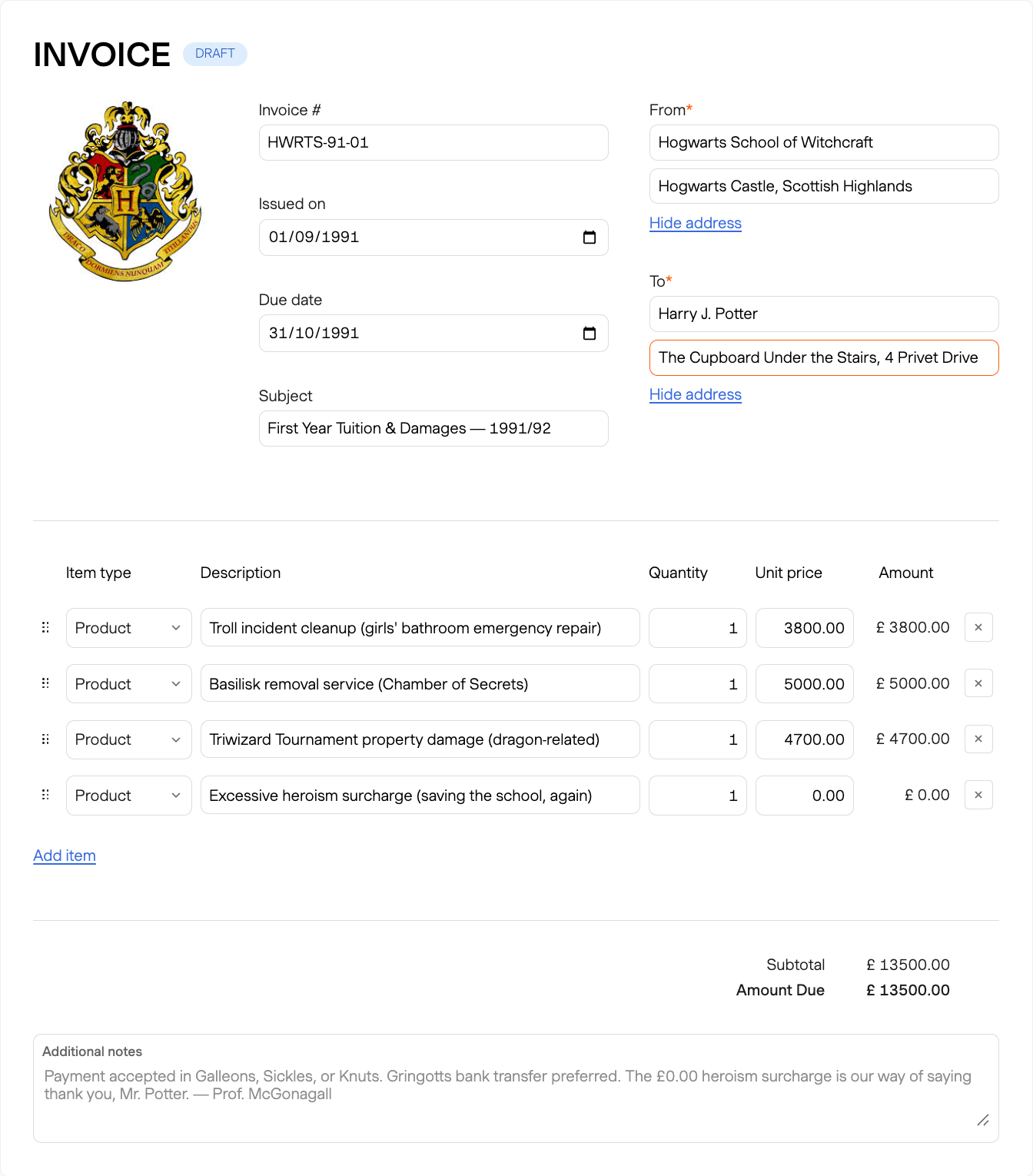
Best Practices for Creating Email Invoices

Creating professional and compliant email invoices for Iran goes beyond mere financial accuracy; it involves careful consideration of cultural and linguistic factors to foster clear communication and strong business relationships. A well-designed invoice template should be clear, concise, and easy to read, ensuring all necessary details are prominently displayed.

When preparing invoices, prioritize clarity and accuracy in all details. This is paramount for smooth processing by international buyers, customs authorities, and accounting teams. Double-check all figures, item descriptions, and totals to prevent discrepancies that could lead to delays or disputes.

Adapting invoices for cultural and linguistic considerations is a significant differentiator.

  1. Language: While English may be used for international business, including key invoice terms in Persian (Farsi) can significantly improve comprehension and demonstrate respect. The Persian terms for "invoice" are "فاکتور" (fāktor) or "صورت حساب" (sūrat hesāb).
  2. Dates: Given that the Iranian calendar year is used for tax purposes, consider including both the Gregorian and the corresponding Iranian calendar dates on your invoices to avoid confusion.
  3. Measurements: Ensure all measurements for goods are presented using the metric system, as this is the standard in Iran.
  4. Professionalism: Maintain a formal and respectful tone in all communications, including invoice emails.

By integrating these cultural and linguistic adaptations, you not only enhance the professionalism of your invoices but also streamline the communication process and minimize potential misunderstandings.

Ensuring Security in Email Invoicing

Protecting sensitive financial information when sending email invoices to Iran is paramount, as email remains a significant target for cyber threats. Email, by its nature, can be vulnerable, making robust security measures essential.

To protect sensitive information, implementing encryption is a critical first step. End-to-end encryption is highly recommended for securing email communications. Technologies like Transport Layer Security (TLS) encrypt emails as they travel between mail servers, safeguarding them from eavesdropping and tampering. Other robust encryption methods include S/MIME and OpenPGP for data in transit, and AES-256 for data at rest. Beyond encryption, employing anti-spam, anti-phishing, anti-malware, and anti-spoofing solutions can provide comprehensive protection. Data Loss Prevention (DLP) tools are also valuable for monitoring and preventing unauthorized transmission of sensitive data.

It's equally important to recognize and avoid common scams. Fraudsters frequently exploit geopolitical events, such as the Israel-Iran conflict, to launch advance-fee scams, often disguised as offers of large sums or urgent investment opportunities. Be wary of unsolicited contact, promises of unusually large sums, requests for personal details, and any pressure to act quickly. Spear-phishing attacks, often state-sponsored, are also a concern, where attackers impersonate trusted sources to steal credentials via fake login pages. Always verify the sender's identity and avoid clicking suspicious links or replying to messages that exhibit red flags like grammatical errors or inconsistent details.

Finally, implementing secure email practices involves more than just technology. Educate your team on recognizing phishing attempts and using strong, unique passwords combined with multi-factor authentication (MFA). When accessing business emails, especially from public Wi-Fi networks, using a Virtual Private Network (VPN) can add an extra layer of security by encrypting your browsing session.

Common Challenges and Solutions in Email Invoicing to Iran

Navigating email invoicing to Iran can present unique challenges, particularly due to the complex international financial landscape and specific local requirements. However, with proactive strategies, these can be effectively managed.

One common challenge is identifying and overcoming invoicing issues related to the Iranian Taxpayer System. Misunderstanding invoice statuses, such as "Approved," "Amendment," "Cancellation," or "Return," can lead to complications like the loss of tax credit or invalid sales recognition. The solution lies in thoroughly understanding the workflow within this system and ensuring that all invoices are correctly categorized and processed. Additionally, for imported goods, commercial invoices must be officially stamped and legalized by the government at the origin of export.

Handling payment delays and disputes is another significant hurdle. International banking complexities, often stemming from sanctions, frequently lead to reluctance among international banks to process transactions with Iran, making direct payments difficult. This can result in significant payment delays, with some Iranian importers resorting to using associate companies in countries like the UAE or Germany to facilitate payments in USD or Euros, which adds to the cost. To mitigate delays:

  1. Communicate and Track: Immediately contact both your bank and the sender's bank to trace the payment, providing all transaction details, including reference numbers, exact amounts, and dates.
  2. SWIFT GPI: Request a SWIFT GPI tracking number if the payment was sent via the SWIFT network, as this offers real-time tracking.
  3. Documentation: Maintain meticulous records of all communications and actions taken.
  4. Alternative Payment Methods: For urgent needs, explore alternative payment solutions while the primary issue is being resolved.

For disputes, arbitration is a favored method for resolving international commercial disagreements in Iran, governed by the Law for International and Commercial Arbitration (LICA), which is based on the Uncitral Model Law.

Finally, navigating cross-border invoicing challenges requires an awareness of the broader economic environment. Access to international financial systems and courier services can be severed, impacting the delivery of goods and services.

Preview Your Iranian Email Invoice Template

See how your invoice template adapts to Iranian tax fields, includes Farsi language options, and meets local compliance requirements.

Email Invoice for Iran FAQs

  • Harvest sends invoices via email from notifications@harvestapp.com, ensuring they reach your clients while setting your email as the reply-to address.
  • Legal requirements include issuing invoices through the Iranian Taxpayer System and obtaining an Iranian Financial Code for tax compliance. Invoices must detail goods or services, prices, and comply with local tax rates and calendar use.
  • Yes, Harvest provides mobile apps for both iOS and Android devices, allowing you to track time, log expenses, and manage invoices on the go.
  • Email invoicing systems can enhance security but cannot prevent all scams. Vigilance and robust security protocols, like encryption and phishing recognition, are essential to mitigate risks.
  • An invoice for Iranian clients should include a clear description of goods or services, quantities, unit prices, total amounts, payment terms, and applicable VAT details. For imports, official stamps and legalizations are needed.