Harvest
Invoices
Sign up

Email Invoice for Netherlands

Harvest offers robust support for UBL e-invoices, ensuring compliance with European and Dutch electronic invoicing standards. This helps you meet legal requirements efficiently.

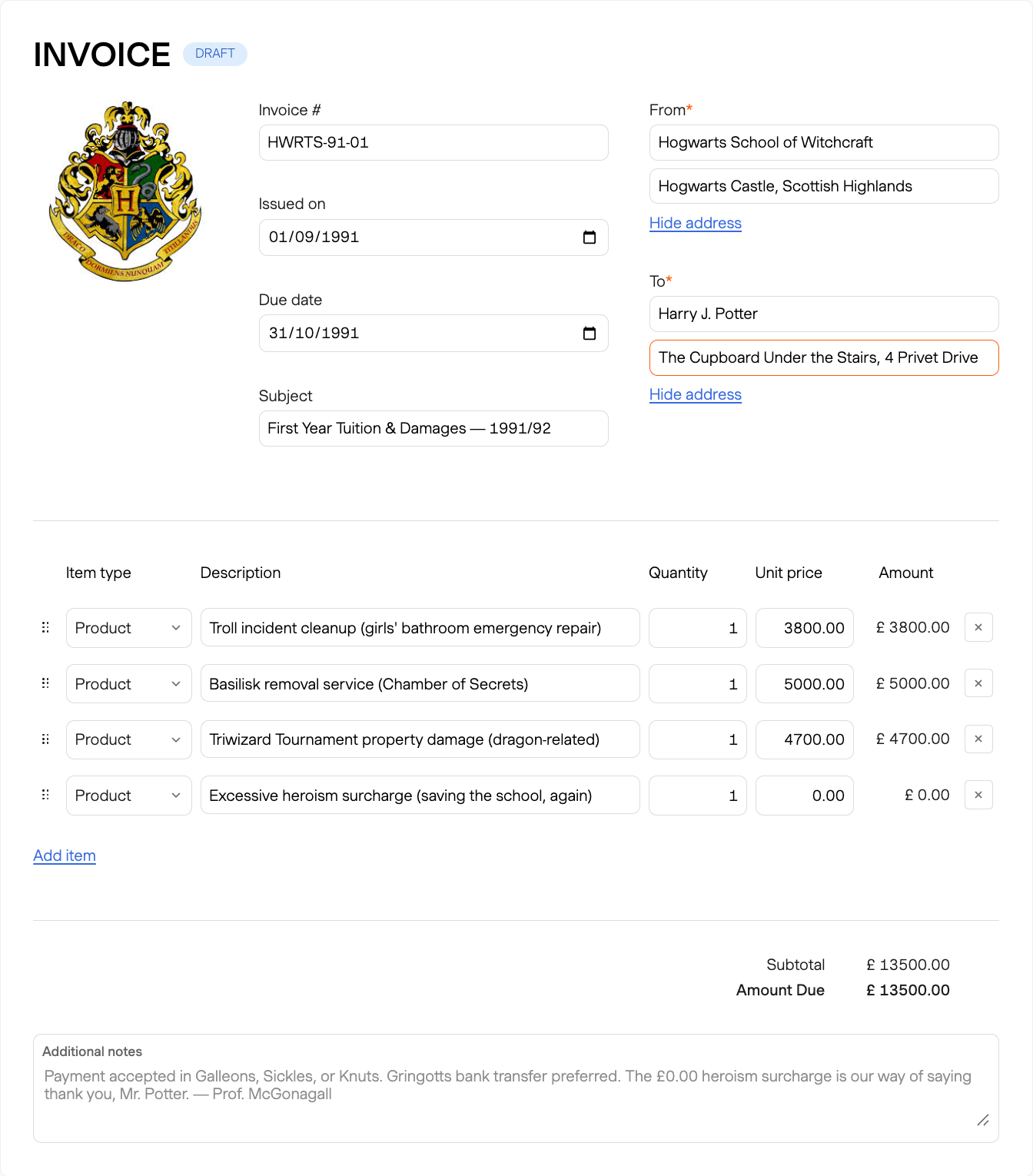
INVOICE DRAFT

Add your logo here
Item type
Description
Quantity
Unit price
Tax
Amount
Subtotal
$0.00
Discount
$0.00
Amount Due
$0.00
Get paid via:
Credit card / Debit card
ACH
Wire transfer

Customise invoice

Appearance

Add a logo
Show invoice title

Invoice settings

Tax Add up to 2 tax rates
%
Discount Apply a discount percentage
%

Understanding Legal Requirements for Email Invoicing in the Netherlands

To ensure legal compliance, email invoices in the Netherlands must contain specific information and adhere to strict timeframes and retention periods. Businesses operating in the Netherlands are legally required to include several key details on every invoice. These include the full name and address of both the supplier and the customer, the supplier's VAT identification number, and if applicable, their Dutch Business Register (KVK) number. Additionally, each invoice must have a unique, sequential invoice number and the date of issue. You must also specify the date of delivery (if different from the invoice date), a detailed description of the goods or services supplied, their quantity, and the unit price excluding VAT.

Regarding legal timeframes, invoices must be sent no later than the 15th day of the month following the month in which the goods or services were supplied. For instance, if a service was provided in April, the invoice must be issued by May 15th. Businesses must retain most financial records, including invoices, for a mandatory period of seven years. For invoices related to immovable property, this retention period extends to ten years. It's crucial that electronic invoices are kept in the same form they were sent and contain all the information of a paper invoice. Furthermore, under GDPR, personal data on invoices should not be kept longer than necessary, beyond the statutory retention period, without a valid reason.
VAT and Tax Compliance for Email Invoices

VAT compliance is a critical aspect of email invoicing in the Netherlands, especially concerning cross-border transactions. Every invoice issued by a Dutch business must clearly state the supplier's VAT identification number. For cross-border B2B transactions or when the reverse charge mechanism applies, the customer's VAT identification number must also be included. The Netherlands applies three main VAT rates:

  • Standard rate (21%): This applies to most goods and services.
  • Reduced rate (9%): Applicable to specific goods and services such as food, books, and certain medical products.
  • Zero rate (0%): Applies to international transactions, including exports and intra-Community supplies within the EU.

For cross-border VAT considerations, particularly for intra-Community supplies (goods or services to entrepreneurs in other EU countries), the 0% VAT rate applies in the Netherlands, but the customer is responsible for declaring and paying VAT in their own country. In such cases, the invoice must include a statement indicating it's an intra-Community supply and the customer's valid VAT identification number. The reverse charge mechanism shifts the VAT liability from the seller to the buyer, commonly used for intra-EU sales and specific domestic transactions like construction work or electronics sales over €10,000. When applying reverse charge, the seller issues an invoice without VAT, stating "VAT reverse-charged" or "btw verlegd," and the buyer calculates and remits the VAT.

Best Practices for Sending Email Invoices

Adopting best practices for email invoicing goes beyond legal compliance, enhancing professionalism and security. While the design and layout of an invoice are flexible, ensuring all mandatory information is clearly presented is crucial. Each invoice should have a unique and sequential number to prevent gaps or duplicates, which can trigger scrutiny during tax audits. It's also advisable to state clear payment terms on your invoice; a payment term of 30 days is standard for companies, with a maximum legal term of 60 days for businesses and 30 days for government organizations.

For electronic invoices, obtaining customer consent is a key best practice, especially for B2B and B2C transactions where e-invoicing is not mandated. This ensures your customers are willing and able to receive invoices electronically. Regarding security measures, email invoices, like all digital records, must be kept accessible, readable, and unaltered throughout their retention period. Implementing robust security protocols, such as encryption for sensitive data and secure storage solutions, can protect against unauthorized access and data breaches. Adhering to GDPR principles for personal data on invoices also forms a crucial part of maintaining trust and avoiding legal issues.

Technical Standards for Electronic Invoicing

Understanding the technical distinctions between different types of electronic invoices is vital for modern business operations in the Netherlands. It's important to differentiate between a "digital invoice" (like a PDF sent via email) and a true "e-invoice." An e-invoice is a structured, machine-readable document, typically XML-based, that can be automatically processed by accounting software, unlike a simple PDF.

The Netherlands has adopted the European e-invoicing standard (EN 16931) for public authorities. For domestic traffic to the Dutch government, the specific standard required is NLCIUS/SI-UBL 2.0, which is a Country Specific Application Rule (CIUS) of Peppol BIS Billing 3.0 and aligns with EN 16931. This means that not every EN 16931 compliant invoice automatically meets NLCIUS requirements.

Electronic invoicing to government bodies in the Netherlands has been mandatory for central government suppliers since January 1, 2017, and for all public sector entities for contracts above EU thresholds since November 1, 2019. The most common and recommended method for sending e-invoices to the Dutch government is through the Peppol network. Peppol is a secure, international network that facilitates the exchange of e-invoices, often routing them via Digipoort, the government's central system for electronic communication. For suppliers with lower invoice volumes, the Central Government e-Invoicing portal offers a user-friendly option for manual submission.

See Your Dutch Invoice Template in Action

Preview how your invoice will include VAT identification numbers and comply with Dutch e-invoicing standards, ready for seamless transactions.

Email Invoice for Netherlands FAQs

  • Harvest allows you to add your company's VAT number to invoices, ensuring compliance with mandatory tax information requirements.
  • Harvest supports UBL e-invoices, which are suitable for electronic invoicing to government bodies in the Netherlands.
  • Yes, Harvest allows you to set custom payment terms for each invoice, specifying due dates and payment conditions that suit your business needs.
  • Failure to comply with email invoicing regulations in the Netherlands can lead to fines, legal disputes, and delays in payment processing. Businesses must ensure invoices include all mandatory information and adhere to legal retention periods to avoid these issues.
  • While email invoices can facilitate compliance, businesses must ensure manual checks for legal requirements are in place. Automated systems can help, but human oversight is crucial to ensure all regulations are met.