Harvest
Invoices
Sign up

Invoice Generator for Spain

Harvest provides flexible e-invoicing tools that can be adapted to meet various European requirements, including UBL and Peppol formats. This ensures compliance with Spanish regulations while allowing for customization to specific business needs.

INVOICE DRAFT

Add your logo here
Item type
Description
Quantity
Unit price
Tax
Amount
Subtotal
$0.00
Discount
$0.00
Amount Due
$0.00
Get paid via:
Credit card / Debit card
ACH
Wire transfer

Customise invoice

Appearance

Add a logo
Show invoice title

Invoice settings

Tax Add up to 2 tax rates
%
Discount Apply a discount percentage
%

Key Features for Spanish Invoice Compliance

A compliant invoice generator for Spain must include specific mandatory fields, adhere to Spanish VAT regulations, and support electronic invoicing requirements. To ensure your invoices are legally valid, look for features that cover these essential elements:

  • Mandatory Fields:
    • Invoice number: Unique and sequential, with no gaps or duplicates.
    • Date of issue: The date the invoice is created.
    • Full details of issuer and recipient: This includes the full name or company name, address, and the appropriate tax identification number (NIF/VAT ID).
    • Description of goods or services: Clear details of what was provided, including quantity and unit price.
    • Taxable base: The amount before VAT.
    • Applicable VAT rate and amount: Spain's standard VAT rate is 21%, with reduced rates of 10% and 4% for specific goods and services.
    • Total amount payable: The final gross amount.
    • Reason for VAT exemption or reverse charge: If applicable, this must be clearly stated.
  • Spanish VAT Regulations: The generator should accurately calculate and display VAT in euros, even if the invoice is issued in another currency.
  • Electronic Invoicing (e-invoicing): For B2G (business-to-government) transactions, e-invoicing in the FacturaE XML format with an XAdES electronic signature has been mandatory since 2015 for invoices over €5,000. While B2B e-invoicing is not yet mandatory, it is expected to be phased in starting in 2025 or 2027, initially for large companies.
Avoiding Common Pitfalls in Spanish Invoicing

To avoid non-compliance, be aware of common mistakes in Spanish invoice generation, particularly regarding reverse charge VAT and accurate tax identification numbers. Errors can lead to delays, corrections, and potential penalties.

  • Incorrect VAT Rates: Applying the wrong VAT rate is a frequent error. Ensure the generator supports Spain's standard 21%, reduced 10%, and super-reduced 4% rates, and that these are correctly applied based on the goods or services provided.
  • Missing Mandatory Fields: Invoices lacking essential information, such as a unique sequential number or complete tax details for both parties, are non-compliant.
  • Handling Reverse Charge VAT: For cross-border B2B transactions within the EU, the reverse charge mechanism often applies, meaning the recipient accounts for VAT in their own country. The invoice must explicitly state "Inversión del sujeto pasivo" (reverse charge) and indicate that VAT is not charged by the supplier.
  • Ensuring Correct Tax Identification Numbers: Always verify the NIF (Número de Identificación Fiscal) for Spanish entities and the VIES VAT number for EU entities. An incorrect or missing NIF/VAT number can invalidate the invoice for tax purposes. The NIF is the general tax identification number for individuals and legal entities in Spain. For foreigners, the NIE (Número de Identificación de Extranjero) serves as their NIF.

Customization Options for Spanish Invoices

Effective invoice generators offer robust customization options to align with your business needs and ensure professional, compliant invoices, including specific formats for B2B transactions in Spain. Flexibility in design and data fields can significantly improve efficiency and brand image.

  • Customizing for Business Needs:
    • Branding: The ability to add your company logo and customize the layout ensures a professional appearance.
    • Payment Terms: Include specific payment terms, bank details (IBAN and SWIFT/BIC), and contact information to facilitate timely payments.
    • Custom Fields: Options to add custom fields for internal references, project codes, or other relevant business data can streamline your accounting processes.
  • Specific Formats for B2B Transactions: While PDF invoices are generally acceptable, for B2G transactions, the FacturaE XML format is mandatory. As B2B e-invoicing becomes mandatory in Spain (expected to start in 2025 or 2027), generators supporting formats like FacturaE, UBL, or EDIFACT will be crucial for compliance. These structured formats ensure interoperability and adherence to the EN 16931 standard.

See Your Spanish Invoice Template in Action

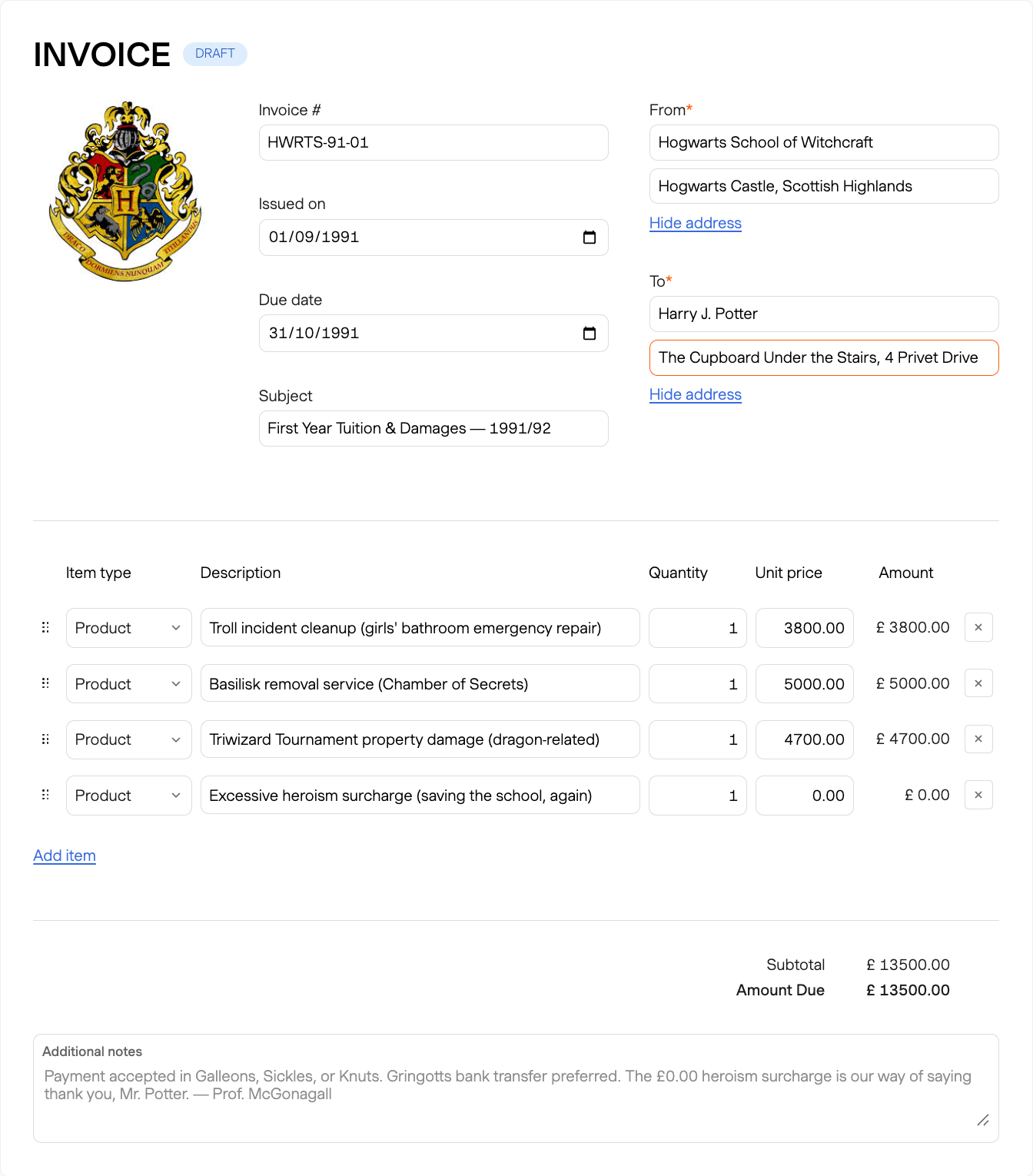
Preview how your invoice will look with Spanish VAT rates, mandatory fields, and compliance with electronic invoicing standards — ready to send to your Spanish clients.

Invoice Generator for Spain FAQs

  • Mandatory fields for an invoice in Spain include a unique invoice number, the date of issue, full details of the issuer and recipient, a description of goods or services, the taxable base, applicable VAT rate and amount, total amount payable, and a reason for VAT exemption or reverse charge if applicable.

  • Yes, Harvest allows you to include tax identification numbers, like VAT numbers, on invoices to ensure compliance with Spanish invoicing regulations.

  • Yes, Harvest allows you to set custom payment terms for each invoice, specifying due dates and payment conditions that suit your business needs.
  • Invoice generators may not always be updated with the latest Spanish regulations, and they might lack the ability to adapt to specific legal formats like FacturaE for B2G transactions. Additionally, some tools may not support all required languages or currency conversions accurately.

  • Harvest provides flexible e-invoicing tools that can be adapted to meet various European requirements, ensuring that VAT regulations, including the inclusion of tax identification numbers, are accurately adhered to.