Harvest
Invoices
Sign up

Invoice Template for Designers

Harvest offers robust customization for invoices, making it an ideal tool for designers to clearly communicate project details and costs.

INVOICE DRAFT

Add your logo here
Item type
Description
Quantity
Unit price
Tax
Amount
Subtotal
$0.00
Discount
$0.00
Amount Due
$0.00
Get paid via:
Credit card / Debit card
ACH
Wire transfer

Customise invoice

Appearance

Add a logo
Show invoice title

Invoice settings

Tax Add up to 2 tax rates
%
Discount Apply a discount percentage
%

Essential Elements of a Graphic Design Invoice

A well-structured invoice is crucial for graphic designers, serving not just as a payment request but also as a professional representation of your brand and a vital record for tax compliance. Choosing the right template and understanding best practices can significantly streamline your financial operations and improve client relationships.

  1. Detailed Project Descriptions: Clearly itemize each service, such as "Logo Design - Initial Concepts," "Website UI/UX - Homepage & 3 Subpages," or "Social Media Graphics - 10 Posts for Instagram/Facebook." Vague descriptions like "consulting" should be avoided.
  2. Timelines: While not always a line item, the invoice should reflect the period of work, with the date of issue and a clear payment due date.
  3. Usage Rights and Licensing Fees: Explicitly state any licensing fees for fonts, stock imagery, or software, and clarify the usage rights granted for the final designs. This prevents future misunderstandings.
  4. Service Rates: Clearly present your rates, whether hourly (e.g., "$75/hour for design work") or project-based (e.g., "Flat fee of $X for logo package"). Include quantities, such as hours worked or number of deliverables.
  5. Client and Business Information: Include your full business name, address, contact information, and a unique invoice number. Similarly, provide the client's name, business name, and address.
  6. Total Amount and Taxes: Clearly show the subtotal, any applicable taxes (e.g., sales tax, VAT), and the grand total due.

An invoice also acts as a legal agreement and aids in accurate income and expense tracking for tax purposes.
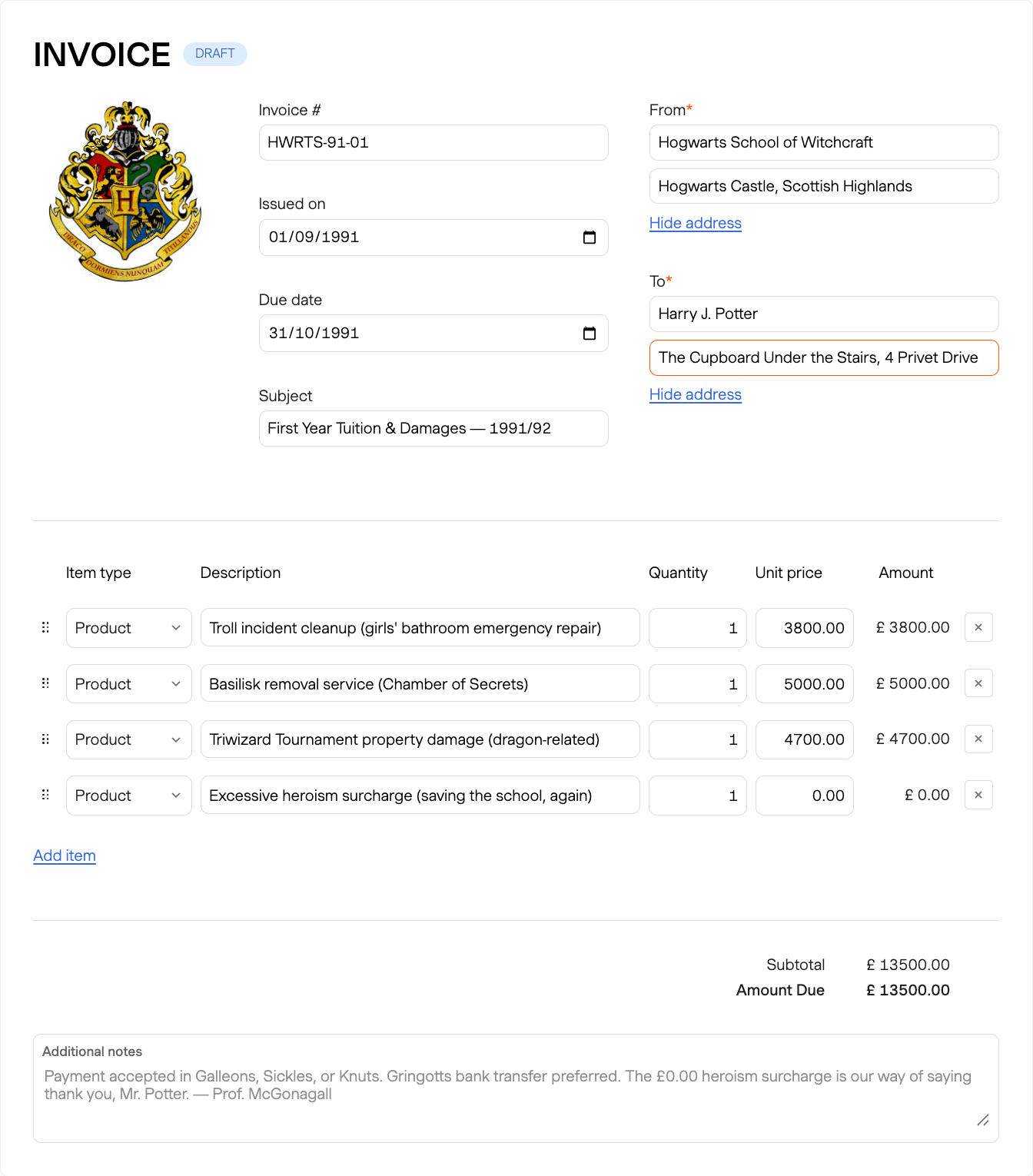
Customizing Your Invoice Template for Maximum Impact

Your invoice is an extension of your brand; customizing your template reinforces professionalism and leaves a lasting impression.

Personalization goes beyond just adding your logo. Consider these tips:

  • Branding Elements: Incorporate your logo, brand colors, and consistent typography. A clean, organized layout with legible fonts enhances readability and professionalism.
  • Client-Specific Adjustments: Tailor the invoice to the client's preferences where possible, such as including their internal purchase order (PO) number or job reference code. This can significantly speed up their internal processing.
  • Professional Appearance: Even if using a basic template, ensure it looks polished. A visually attractive invoice can stand out and prompt quicker responses. Delivering invoices as PDFs helps preserve the design.
  • Custom Fields: Utilize templates that allow for custom fields to include specific project details or notes relevant to the client. Many invoicing tools offer options to customize layout, typography, and content blocks.

The goal is to create a document that is not only functional but also reflects your unique design style and attention to detail.

Tips for Ensuring Timely Payments

Timely payments are critical for a healthy cash flow. Proactive strategies and clear communication are key to avoiding delays.

  1. Set Clear Payment Terms Upfront: Always define payment terms in your contract before starting any project. Common terms include "Net 30" (payment due in 30 days), but shorter terms like 7 or 15 days can improve cash flow. Clearly state the due date prominently on the invoice.
  2. Client Communication: Discuss payment expectations with your client early on. Understand their preferred billing methods and timelines. For larger projects, consider requesting an upfront deposit, often 50% of the total, to secure the project and cover initial costs.
  3. Follow-Up Strategies: Don't hesitate to follow up immediately if an invoice becomes overdue.
    • Send a polite reminder email the day after the due date.
    • If no response, follow up with a phone call.
    • Automated reminders can be set up a week before and on the due date.
  4. Make Payments Easy: Offer multiple convenient payment options, such as bank transfers, credit cards, or digital wallets.
  5. Send Invoices Promptly: Issue invoices as soon as a project is completed or a milestone is reached. Delays in sending invoices can lead to delays in payment.

Explore Your Designer Invoice Template

See how the template highlights project details, usage rights, and custom branding elements — perfect for designers billing their clients.

Invoice Template for Designers FAQs

  • Harvest allows you to attach detailed project descriptions and timelines to invoices, providing clarity on the scope of work for your clients.

  • A graphic design invoice should include detailed project descriptions, timelines, usage rights, licensing fees, service rates, and client/business information. Additionally, it should have the total amount due, including any applicable taxes, and payment terms.

  • If you exceed your project budget in Harvest, you will receive notifications, allowing you to review spending and make adjustments if necessary to keep the project on track.
  • Generally, invoice templates are not designed to automate client feedback and approval processes. These tasks typically require separate project management tools or manual follow-up to ensure client approvals and feedback are captured effectively.

  • Harvest allows you to track revisions and additional charges by attaching detailed reports to your invoices.