Harvest
Invoices
Sign up

Track Payments

Harvest excels in simplifying payment reconciliation through its Stripe integration, ensuring payments are automatically recorded without manual intervention. This streamlines operations for businesses handling numerous transactions efficiently.

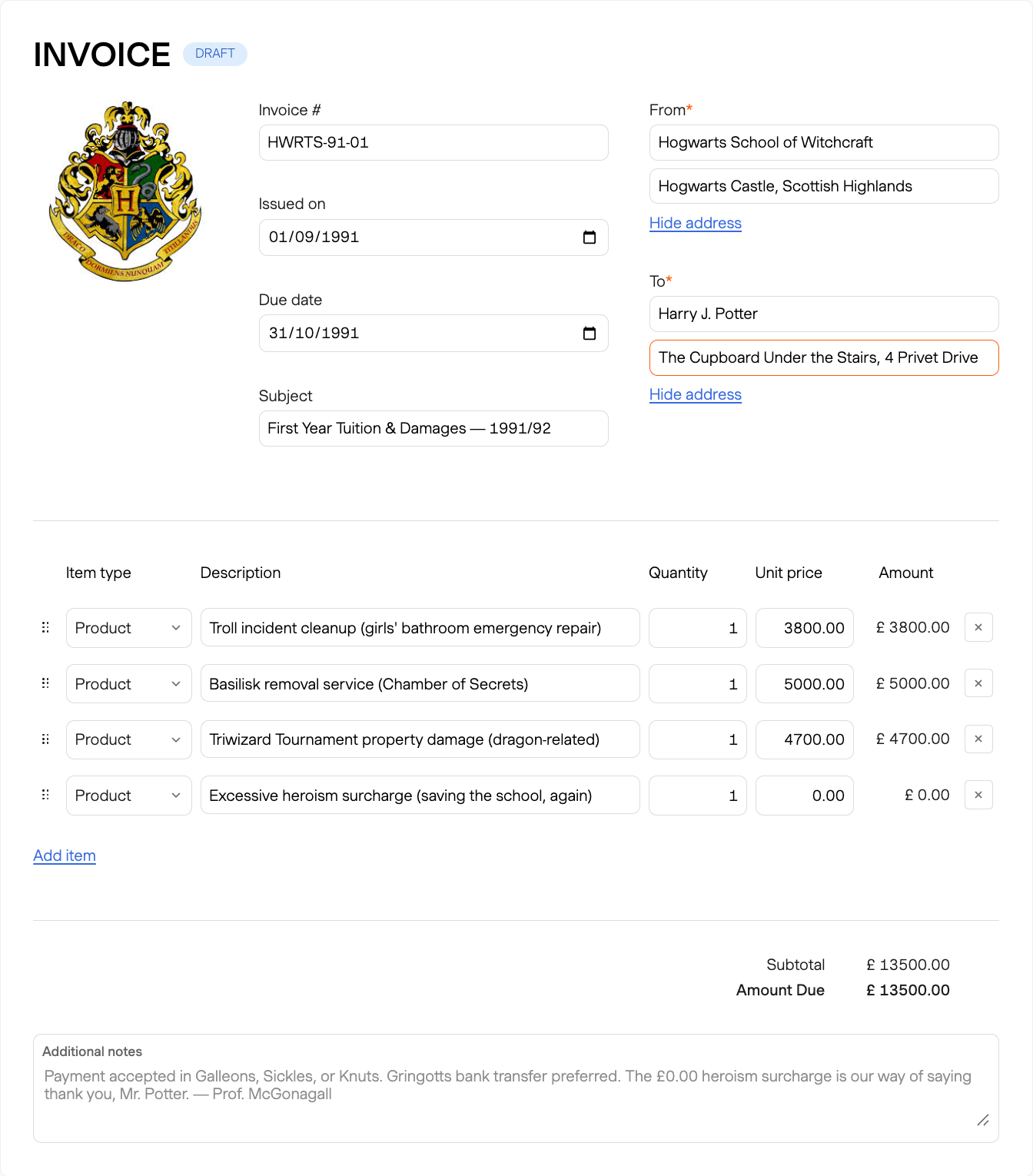
INVOICE DRAFT

Add your logo here
Item type
Description
Quantity
Unit price
Tax
Amount
Subtotal
$0.00
Discount
$0.00
Amount Due
$0.00
Get paid via:
Credit card / Debit card
ACH
Wire transfer

Customise invoice

Appearance

Add a logo
Show invoice title

Invoice settings

Tax Add up to 2 tax rates
%
Discount Apply a discount percentage
%

Understanding the Fundamentals of Payment Tracking

Payment tracking is the process of monitoring and managing financial transactions from their initiation to their final execution or failure. This comprehensive oversight provides businesses with critical insights into the flow of funds, ensuring accuracy and transparency in financial records. The importance of diligently tracking payments cannot be overstated, as it directly impacts a business's financial clarity, cash flow management, budgeting, and forecasting capabilities. By knowing precisely when payments are due and received, organizations can manage their liquidity more effectively and make informed financial decisions.

Furthermore, robust payment tracking is vital for accurate tax preparation, helping businesses identify tax-deductible expenses and reduce the risk of audits. It also plays a significant role in fraud prevention by enabling the identification of discrepancies and potential illicit activities.

Basic components of an effective payment tracking system typically include:

  1. A Robust Payment System: This foundational element should integrate seamlessly with existing accounting tools and be capable of handling diverse payment methods, such as credit cards, bank transfers, and digital wallets.
  2. Organized Financial Documents: Maintaining a systematic filing system for all invoices, receipts, and related financial documents, often leveraging digital storage for easy retrieval.
  3. Regular Reconciliation: Consistently comparing internal payment records with external statements, such as bank accounts, to identify and resolve any discrepancies promptly.
  4. A Centralized Transaction Database: This serves as the single source of truth, recording every transaction and its lifecycle status, providing a complete audit trail.
  5. Notification Services: Automated alerts and updates to inform relevant stakeholders about payment successes, failures, or delays.

These components collectively form the backbone of a system that ensures financial accuracy and operational control.
Best Practices for Efficient Payment Tracking

To achieve truly efficient payment tracking, businesses should adopt several key best practices that streamline operations and enhance financial visibility. A primary strategy is to implement centralized payment processing, which consolidates all payment requests and transactions into a single point of contact. This approach reduces complexity, improves data consistency, and provides a unified view of all financial movements, which is particularly beneficial for businesses handling high volumes of transactions.

Another critical best practice is real-time transaction monitoring. This involves analyzing financial transactions as they occur to detect potentially fraudulent or suspicious activity instantly. Unlike batch processing, which reviews data after the fact, real-time monitoring allows for immediate flagging and intervention, preventing losses before they materialize. Modern solutions often leverage AI and behavioral analysis to set dynamic thresholds, reducing false positives and focusing efforts on genuine risks.

Automated reconciliation processes are also indispensable. Manual reconciliation is time-consuming and prone to human error, which can lead to significant financial discrepancies. Automation, through software that matches internal records with bank statements, can drastically improve accuracy and efficiency, often reducing the time spent on these tasks by a substantial margin. This frees up financial teams to focus on more strategic activities.

Finally, effective chargeback management is crucial. Chargebacks, which occur when a customer disputes a transaction with their bank, can be costly and impact revenue. Implementing clear policies, robust fraud detection, and efficient dispute resolution processes can help minimize chargeback rates, which can range from 0.5% to 1% across various industries, though some high-risk sectors may see higher rates. Promptly addressing chargebacks and understanding their root causes are vital for protecting revenue and maintaining merchant account health.

Challenges in Payment Tracking and How to Overcome Them

Despite the clear benefits, businesses often encounter significant challenges in payment tracking. One prevalent issue is data silos and integration complexities. Data silos occur when information is stored in isolated repositories or systems, often managed by different departments, without seamless integration or communication. This fragmentation leads to incomplete data sets, inconsistencies, and a disjointed view of customer information, hindering effective decision-making. To overcome this, businesses should invest in integrated payment systems that consolidate data from all sources into a single platform, using APIs or ETL (Extract, Transform, Load) tools to ensure data flows freely across departments.

Manual reconciliation complexities also pose a significant hurdle. Relying on manual processes for matching transactions with bank statements is not only labor-intensive but also highly susceptible to human error, which can be costly. The average cost of manual errors in accounting can be substantial, leading to financial inaccuracies and delays. The solution lies in adopting automated reconciliation software that can match transactions quickly and accurately, often reducing reconciliation time by over 50% and minimizing errors.

Achieving real-time visibility challenges is another common problem, especially with non-instant payments that can take up to 2-3 business days to execute fully. Many legacy systems or batch processing methods only provide updates once a day, making it impossible to respond quickly to issues. Implementing modern payment tracking solutions designed for real-time monitoring, which continuously scan transactions and integrate with dynamic risk models, is essential to gain immediate insights and proactively address any payment failures or delays.

Finally, regulatory compliance hurdles add another layer of complexity. The evolving landscape of payment regulations requires continuous adaptation. Overcoming this involves staying informed about regulatory changes, investing in compliance infrastructure, and leveraging technology that has built-in compliance features, such as automated reporting and audit trails.

Regulatory Considerations in Payment Tracking

Navigating the regulatory landscape is a critical aspect of payment tracking, as non-compliance can lead to severe financial penalties, reputational damage, and operational disruptions. Several key regulations significantly impact how businesses must track and manage payments.

One of the most prominent is the Payment Card Industry Data Security Standard (PCI DSS). This is a set of information security standards mandated by major payment card brands (like Visa, Mastercard) for any organization that accepts, processes, stores, or transmits payment card information. Compliance with PCI DSS requires maintaining secure networks, encrypting cardholder data, using updated anti-virus software, and regularly monitoring transactions for unauthorized access. Non-compliance can result in hefty fines from acquiring banks, increased transaction fees, and even the loss of card processing privileges.

The General Data Protection Regulation (GDPR), applicable in the European Union and the UK, governs the processing of personal data, including payment data. GDPR mandates strict measures for collecting and storing customer payment data, emphasizing explicit consent, data minimization (collecting only necessary data), transparency, and robust security measures like advanced encryption and two-factor authentication. Penalties for GDPR non-compliance can be substantial, reaching up to €20 million or 4% of annual global turnover, whichever is higher.

Anti-Money Laundering (AML) regulations are also crucial, requiring payment processors to implement policies and procedures to prevent financial systems from being used for illicit activities. This includes Know Your Customer (KYC) protocols to verify customer identities, ongoing transaction monitoring to detect suspicious patterns, risk assessments, and regulatory reporting. Regulators worldwide, including FinCEN in the U.S. and the FCA in the UK, are increasing scrutiny on payment companies to meet stringent AML controls.

Compliance strategies for businesses should include:

  1. Regular Risk Assessments: Identifying and evaluating potential compliance risks specific to their payment operations.
  2. Implementing Robust Internal Controls: Establishing clear policies, procedures, and technologies to ensure adherence to regulations.
  3. Continuous Monitoring: Utilizing automated systems for real-time transaction monitoring and data security.
  4. Staff Training: Regularly educating employees on compliance requirements and best practices.
  5. Maintaining Detailed Records: Ensuring comprehensive audit trails for all transactions and compliance activities.

The impact of non-compliance extends beyond fines, encompassing legal actions, reputational damage, loss of customer trust, increased regulatory scrutiny, and potential business disruptions or even closure. Proactive and comprehensive compliance is therefore not just a legal obligation but a strategic imperative for long-term success.

See Your Payment Tracking in Action

Preview how your payment tracking system manages real-time transaction monitoring and automated reconciliation, ensuring seamless business operations.

Track Payments FAQs

  • Harvest, through its integration with Stripe, automatically reconciles payments when funds arrive, eliminating the need for manual matching.
  • When tracking payments, businesses need to consider several key regulations, including the Payment Card Industry Data Security Standard (PCI DSS), which mandates secure handling of cardholder data. The General Data Protection Regulation (GDPR) emphasizes data protection and privacy for individuals in the EU and UK. Additionally, Anti-Money Laundering (AML) regulations require stringent measures to prevent financial systems from being used for illegal activities.
  • Yes, Harvest can send automated email reminders to clients when invoices are overdue, helping you get paid without awkward follow-up emails.
  • While payment tracking systems significantly reduce the need for manual reconciliation, they may not fully eliminate it. Certain complex scenarios, exceptions, or discrepancies might still require human intervention to resolve. Automated systems are highly effective for standard reconciliation tasks but having a manual backup ensures thoroughness and accuracy.
  • When selecting payment tracking software, look for features such as real-time transaction monitoring, automated reconciliation, integration capabilities with accounting systems, and robust security measures. Additionally, the software should offer customizable reporting and analytics tools to provide insights into payment trends and performance.