
Harvest
Time Tracking
Sign up free

How to Increase Billable Hours

Harvest helps professionals increase billable hours by providing real-time time tracking and detailed reporting tools, preventing up to 50% revenue loss from delayed entries.

Try Harvest Free

How much revenue is your team leaving on the table?

Most agencies run at 55-60% utilization. Even a small improvement means significant revenue. See what closing the gap looks like for your team.

Number of people who track billable time
$
Blended rate across roles (junior, senior, lead)
55%
Percentage of total hours that are billable. Industry average is 55-60%.
75%
A realistic target for service businesses is 70-80%.
Monthly revenue gap $0
Revenue at current utilization $0/mo
Revenue at target utilization $0/mo
Extra billable hours needed per person/day 0h
Annual revenue opportunity $0

Start tracking team utilization

Walk through the entire flow below. Start a timer, check your reports, and create a real invoice — all in three clicks.

Go ahead — start tracking!

One click and you're timing. Try it right here: start a timer, add an entry, edit the details. This is exactly how it feels in Harvest.

  • One-click timer from browser, desktop & mobile
  • Works inside Jira, Asana, Trello, GitHub & 50+ tools
  • Duration or start/end — your call
  • Day, week & calendar views to stay on top of it all
  • Friendly reminders so no hour gets left behind
Acme Corp
Website Redesign
Homepage layout revisions
1:24:09
Content Strategy
Blog calendar planning
1:30:00
SEO Audit
Technical audit report
0:45:00
Brand Guidelines
Color system documentation
2:15:00
Logo Concepts
Initial sketches round 1
1:00:00

Understanding the Importance of Billable Hours

Maximizing billable hours is crucial for profitability in professional services such as legal and consulting fields. Billable hours directly impact revenue; for instance, lawyers typically bill approximately 1,693 hours annually, often below firm requirements of 1,800 to 2,200 hours. Inefficient tracking can result in significant revenue losses, with up to 50% of potential earnings lost if time is not recorded promptly. The utilization rate — the percentage of time spent on billable work — is key, with a target rate of 65-75% being ideal for maintaining profitability without risking burnout.

Understanding the distinction between billable and non-billable hours is essential. Non-billable activities such as administrative tasks and business development can consume nearly 60% of a professional's workday. To combat this, Harvest offers tools to track both billable and non-billable hours, helping professionals focus on revenue-generating activities.
Best Practices for Accurate Time Tracking

Accurate time tracking is the cornerstone of maximizing billable hours. Real-time tracking is essential; professionals who delay recording their time risk losing over 10% of their billable hours daily. To mitigate this, implementing a "track as you go" principle is recommended. Harvest facilitates this with one-click timers, allowing for immediate time entry and reducing memory decay.

Billing in consistent increments, such as 6-minute blocks, ensures precision. Harvest supports this with manual time entries, making it easy to capture even short tasks. Detailed descriptions of tasks, enabled by Harvest’s note-adding feature, further enhance transparency and client trust. Regular audits of time entries, supported by Harvest's detailed reports, help identify and rectify errors, ensuring accuracy before invoicing.

Strategies to Minimize Non-Billable Activities

Reducing non-billable activities is key to increasing billable hours. Common non-billable tasks include administrative duties and internal meetings, which can occupy 48% of a professional's workday. Automation is a powerful tool here; automating repetitive tasks like invoicing and document generation can free up time for billable work. Harvest integrates with tools like QuickBooks and Xero, streamlining financial processes.

Delegation of non-core tasks to support staff and virtual assistants can also reduce non-billable hours. Additionally, strategic scheduling of non-client tasks during slower periods can maximize billable hours during peak demand. By using Harvest to track project progress and budgets, teams can ensure that they stay focused on revenue-generating activities.

Setting Realistic Billable Hour Targets

Setting achievable billable hour targets is essential for maintaining productivity and profitability. Industry benchmarks, such as 1,700 to 2,300 billable hours annually for legal professionals, provide a starting point. Breaking these down into monthly or weekly goals helps in managing workloads effectively. For instance, mid-sized firms often target 150-165 hours per month.

Factoring in non-billable time, holidays, and professional development is crucial in setting realistic targets. Harvest's reporting features allow professionals to analyze historical data and adjust targets based on past performance and resource allocation. This data-driven approach helps in setting informed and attainable goals.

Ensuring Ethical Billing Practices

Ethical billing is crucial in maintaining client trust and avoiding disputes. The ABA Model Rules of Professional Conduct emphasize reasonable and transparent billing practices. Harvest supports ethical billing by enabling detailed task descriptions and time entry audits, ensuring that all billed time reflects actual work performed.

Common mistakes such as overbilling and underreporting can be avoided with diligent tracking and regular reviews. Harvest’s comprehensive reports provide insights into billing patterns, helping professionals identify discrepancies and improve accuracy. By maintaining ethical standards and utilizing efficient time tracking tools, professionals can enhance their reputation and profitability.

Increase Billable Hours with Harvest

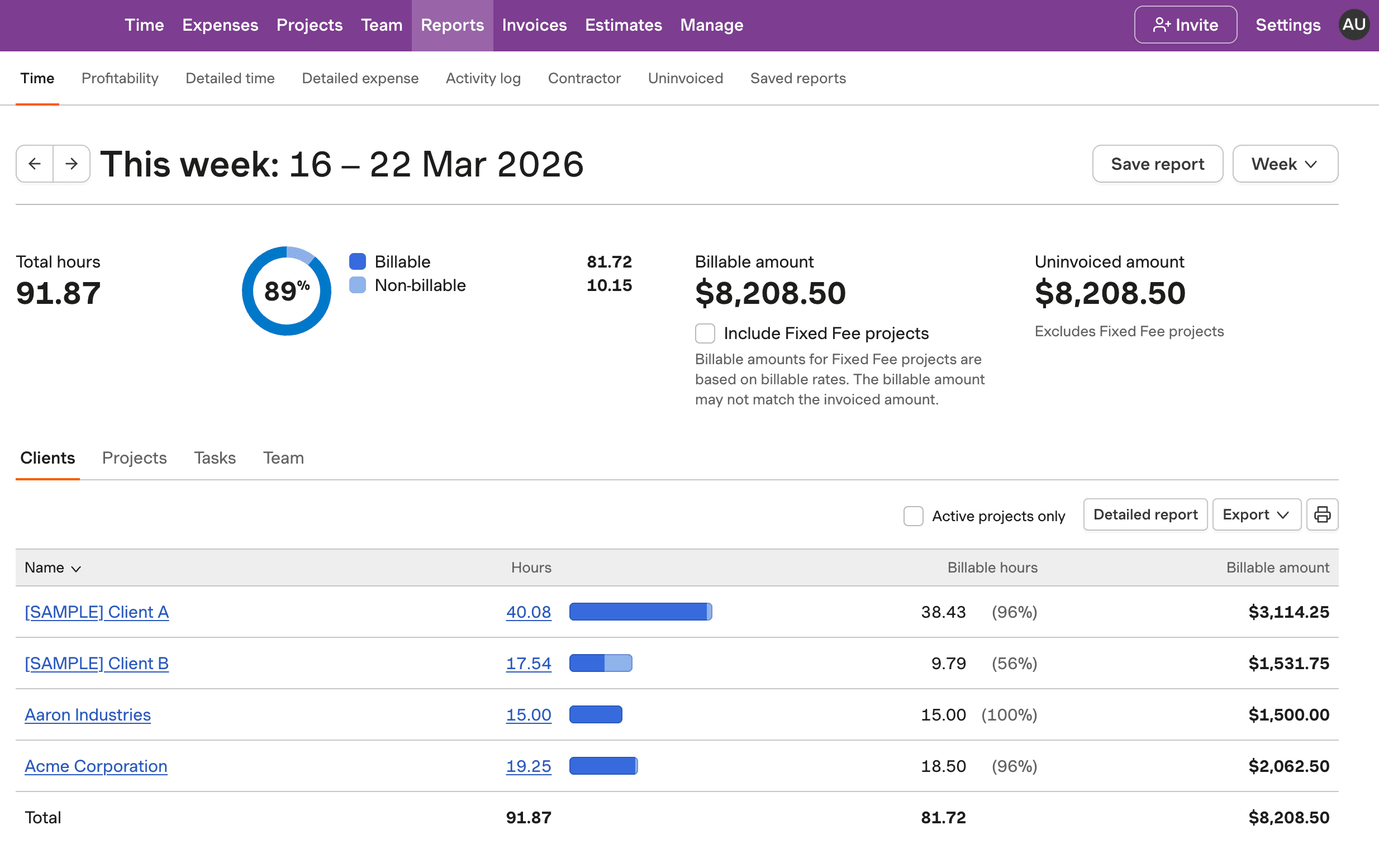
See how Harvest's real-time tracking and detailed reporting boost billable hours. Increase productivity and prevent revenue loss.

Screenshot of Harvest's time tracking interface for increasing billable hours.

How to Increase Billable Hours FAQs

  • Accurate tracking involves real-time logging and using detailed descriptions. Harvest offers one-click timers for immediate time entry, reducing errors from memory decay. Detailed reports further enhance billing accuracy.

  • Tools that offer real-time tracking and detailed reporting, like Harvest, are essential. They help prevent underreporting and automate tracking, ensuring all billable work is captured efficiently.

  • Minimize non-billable activities by automating repetitive tasks, delegating non-core duties, and using tools like Harvest to track and manage tasks effectively. Strategic scheduling during downtime also helps focus on billable work.

  • A strong utilization rate typically falls between 65% and 75%. This balance ensures profitability without risking burnout. Harvest's tracking tools can help monitor and improve utilization rates.

  • Set targets by understanding industry benchmarks and using historical data. Harvest's reporting features allow you to analyze past performance and adjust targets for better workload management.

  • Harvest provides one-click timers and manual time entry options, ensuring accurate tracking of both short and long tasks. Its detailed reporting helps maintain billing accuracy and transparency.

  • Yes, Harvest tracks both billable and non-billable hours, providing valuable insights into time allocation. This feature aids in distinguishing and managing tasks effectively.