
Harvest
Time Tracking
Sign up free

Calculate Overtime Rate

Overtime pay miscalculations can lead to costly compliance issues. Harvest helps manage time entries accurately, ensuring you meet federal and state regulations effortlessly.

Try Harvest Free

What will your overtime pay be?

Calculate regular and overtime earnings based on your hours and rate. Supports standard time-and-a-half and double-time multipliers.

$
Standard is 40 hours/week (FLSA threshold)
1.5x
1.5x = time and a half (most common). 2x = double time (CA after 12h, holidays).
Some states require 2x pay after 12 hours/day or on 7th consecutive day.
Total gross pay $0
Regular pay $0
Overtime pay (1.5x) $0
Double-time pay (2x) $0
Effective hourly rate $0

Track overtime hours with Harvest

Walk through the entire flow below. Start a timer, check your reports, and create a real invoice — all in three clicks.

Go ahead — start tracking!

One click and you're timing. Try it right here: start a timer, add an entry, edit the details. This is exactly how it feels in Harvest.

  • One-click timer from browser, desktop & mobile
  • Works inside Jira, Asana, Trello, GitHub & 50+ tools
  • Duration or start/end — your call
  • Day, week & calendar views to stay on top of it all
  • Friendly reminders so no hour gets left behind
Acme Corp
Website Redesign
Homepage layout revisions
1:24:09
Content Strategy
Blog calendar planning
1:30:00
SEO Audit
Technical audit report
0:45:00
Brand Guidelines
Color system documentation
2:15:00
Logo Concepts
Initial sketches round 1
1:00:00

Understanding the Basics: Federal Overtime Law (FLSA)

The Fair Labor Standards Act (FLSA) establishes the federal standard for overtime pay, mandating that non-exempt employees receive overtime for hours worked beyond 40 in a workweek. This overtime rate must be at least 1.5 times the employee's regular rate of pay. A workweek under the FLSA is defined as a fixed, recurring period of 168 hours, and employers must consistently adhere to this timeframe without averaging hours over multiple weeks.

Employees are classified as either exempt or non-exempt based on their salary level and job duties. As of January 2020, the salary threshold for exemption was set at $684 per week, equating to $35,568 annually. This classification determines eligibility for overtime, with most hourly workers and certain salaried employees qualifying as non-exempt. Understanding these fundamentals helps ensure compliance with FLSA regulations and accurate overtime calculations.
Determining the "Regular Rate of Pay"

Calculating overtime correctly begins with determining the "regular rate of pay," which includes more than just the hourly wage. Non-discretionary bonuses and commissions must be included in this calculation. For hourly employees, the regular rate is simply their hourly wage. However, for salaried non-exempt employees, it involves dividing the weekly salary by the total hours worked to ascertain this rate.

For example, if a salaried employee earns $1,200 for a 40-hour week, their regular rate is calculated as $30 per hour. It's crucial to account for variable pay components like bonuses to ensure the overtime rate reflects the true earnings. This comprehensive approach ensures fair compensation and aligns with both federal and state regulations.

Step-by-Step Overtime Calculation Examples

Let's delve into practical examples to clarify overtime calculations. For an hourly employee earning $15 per hour who works 46 hours in a week, the regular pay is $600 (40 hours x $15). The additional 6 hours qualify as overtime, calculated at 1.5 times the regular rate, resulting in an overtime pay of $135 (6 hours x $22.50). Their total weekly pay amounts to $735.

For salaried non-exempt employees, the process differs slightly. Consider an employee with a $1,200 weekly salary who works 42 hours. Their regular rate is $30 per hour, and the 2 overtime hours are paid at $45 per hour, leading to $90 in overtime pay. Thus, their total pay for the week is $1,290.

State-Specific Overtime Laws and Exceptions

While the FLSA sets a federal standard, various states impose stricter overtime regulations. For instance, California requires overtime pay after 8 hours in a day and double time after 12 hours. Similarly, states like Alaska and Colorado mandate overtime for daily hours exceeding 8 and 12, respectively.

Employers must adhere to the law most favorable to employees when federal and state laws differ. Understanding state-specific rules is crucial for compliance and preventing miscalculations that could lead to legal and financial repercussions. It's essential to regularly review both federal and state requirements to ensure adherence and fair employee compensation.

Calculate Overtime Rate with Harvest

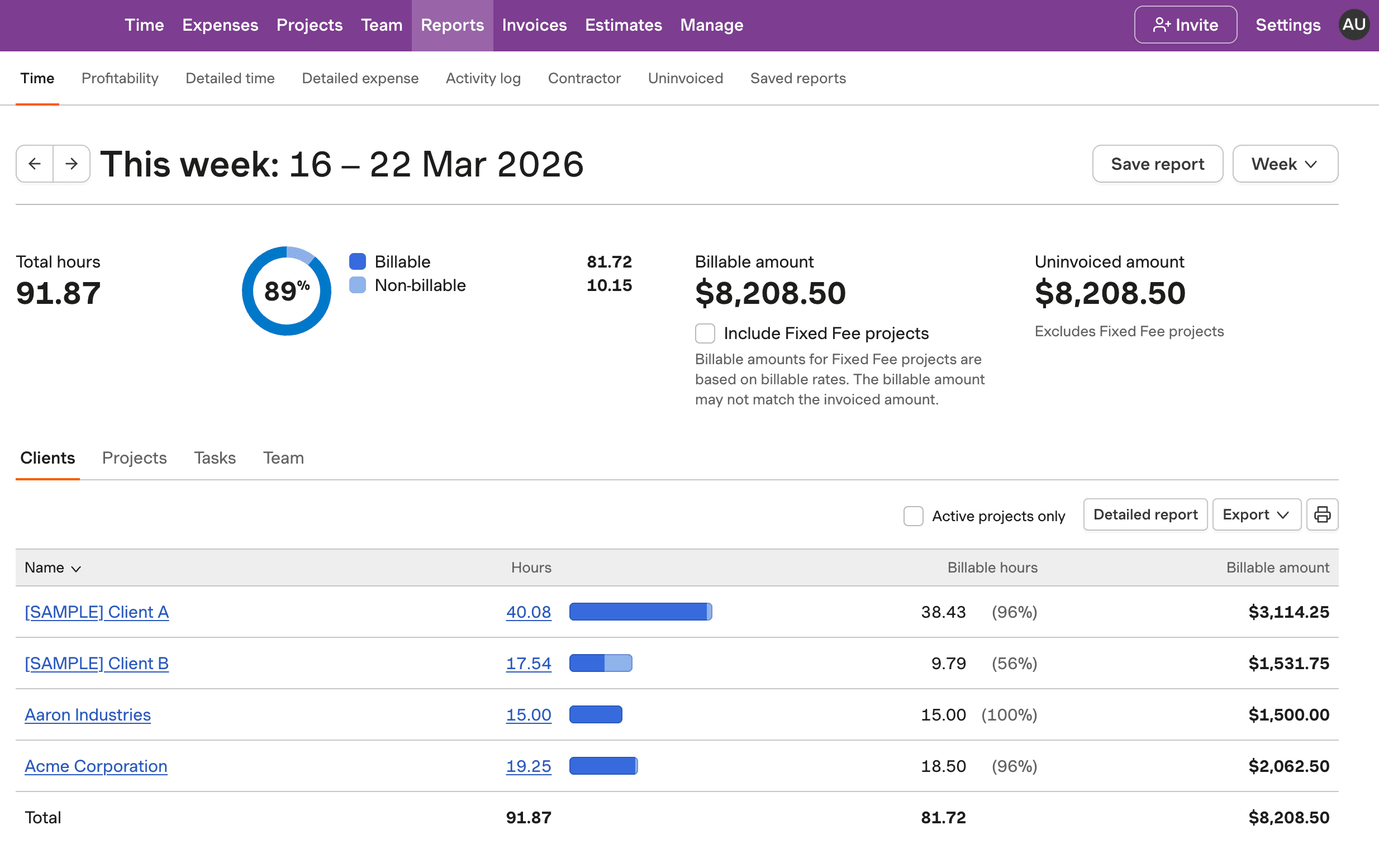
Explore how Harvest tracks hours and calculates overtime, ensuring compliance with federal standards.

Harvest time tracking for calculating overtime rate.

Calculate Overtime Rate FAQs

  • Overtime pay is calculated by multiplying the employee's regular rate of pay by 1.5, then by the number of overtime hours worked beyond 40 in a week. This ensures employees are compensated fairly for extra hours worked.

  • Generally, non-exempt employees are eligible for overtime. This includes most hourly workers and some salaried employees who do not meet exemption criteria or whose salary falls below the federal threshold of $35,568 per year.

  • Harvest provides flexible time tracking and billing solutions, allowing manual setup for overtime calculations. While it requires initial setup, it helps ensure compliance with pay structures.

  • The regular rate of pay includes the hourly wage plus any non-discretionary bonuses and commissions. This comprehensive rate ensures fair overtime compensation according to federal guidelines.

  • Yes, many states have their own overtime laws that may be more stringent than federal standards. For example, California requires overtime pay after 8 hours of work in a day. Employers must comply with the law most favorable to employees.

  • Yes, salaried non-exempt employees can receive overtime. Their regular rate is determined by dividing their weekly salary by the total hours worked, and overtime is calculated accordingly.

  • The salary threshold for exemption is $35,568 per year, or $684 per week. Employees earning below this amount are generally eligible for overtime pay if their job duties do not qualify them for exemption.