
Harvest
Contracts
Sign up

Contract Template in Arabic

Harvest helps contractors manage time tracking and invoicing, crucial for businesses using Arabic contract templates to stay compliant and efficient.

Start from a template

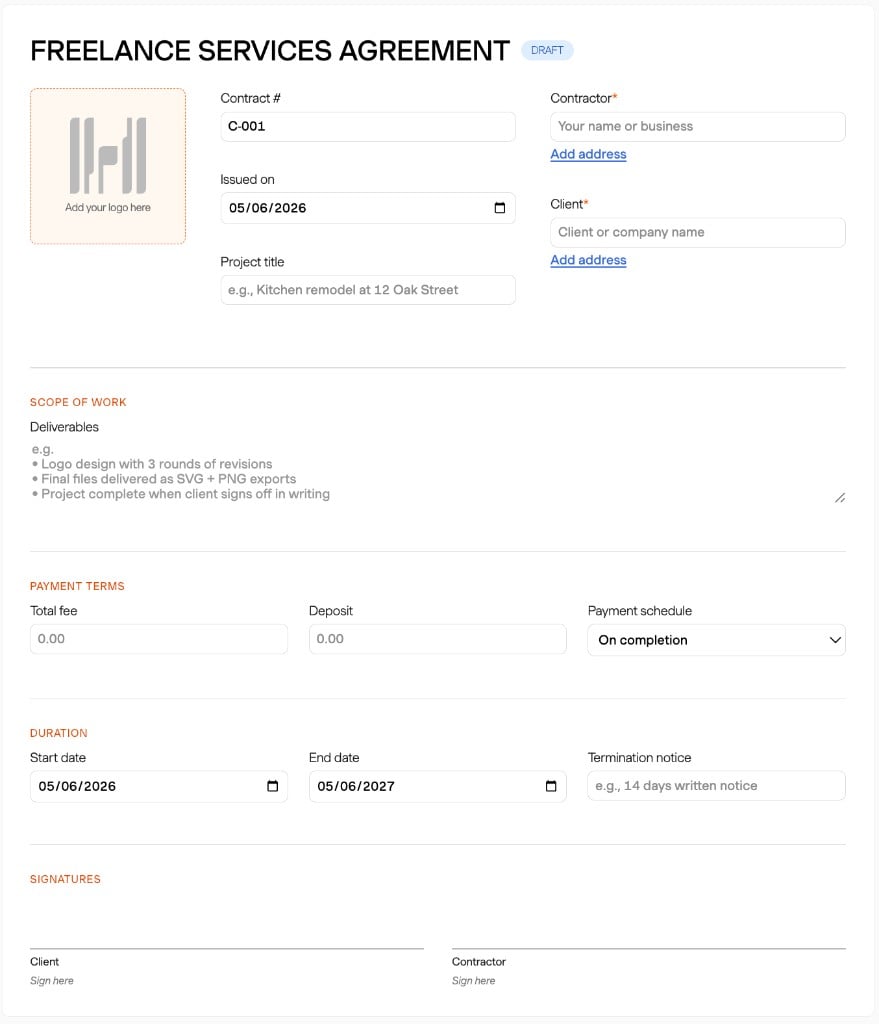
AGREEMENT DRAFT

Add your logo here

Scope of work

Payment terms

Duration

Signatures

Client

Sign here

Contractor

Sign here

Get paid via:
Credit card / Debit card
ACH
Wire transfer

Customize contract

Appearance

Add a logo
Show contract title

Contract settings

Include payment terms Total fee, deposit, and schedule
Include termination clause Notice required to end the contract
Include signature blocks Both parties sign at the bottom

Understanding the Need for Arabic Contract Templates

The growing demand for Arabic contract templates is fueled by the rapid digital transformation and evolving legal frameworks in the Middle East and North Africa (MENA) region. Countries like the UAE and Saudi Arabia are leading initiatives to digitize legal processes, making it crucial for businesses to adapt by using standardized contract templates. This digital shift not only enhances transparency but also reduces processing times significantly. For instance, adopting best practices in contract management can lead to cost savings of 20-25% and shorten contract cycle times by up to 80%.

Arabic contract templates are essential for ensuring compliance with local laws, which often require documents to be in Arabic. In the UAE, any contract in another language must be accompanied by a certified Arabic translation, with the Arabic version taking precedence in legal disputes. Similarly, Saudi Arabia mandates that contracts under its Government Tenders and Procurement Law be drafted in Arabic, though bilingual options are increasingly available.

Types of Contract Templates Available in Arabic

In Arabic-speaking regions, various contract templates cater to different industries and needs. Construction agreements, for example, must adhere to specific legal requirements such as the UAE's Civil Code or Saudi Arabia's Labor Law. These contracts often include provisions for scope of work, payment terms, and safety regulations. As the construction industry grows, having a robust, legally compliant contract template is vital for project success.

Beyond construction, digital transformation projects also necessitate customized contracts. These templates must address regulatory compliance, intellectual property rights, and risk management, reflecting the unique legal environments of countries like the UAE. Real estate is another critical sector where Arabic contract templates are used, with recent reforms allowing bilingual contracts to streamline transactions and reduce misunderstandings.

Customizing Arabic Contract Templates for Your Needs

Customizing a contract template in Arabic involves understanding both the legal context and the specific requirements of your business. It is crucial to use Modern Standard Arabic (MSA) for drafting, as it is the formal language used across legal documents in the Arab world. This ensures clarity and consistency, reducing the risk of disputes arising from misinterpretation.

To effectively customize a template, businesses should establish clear workflows for contract review and approval. This process may include setting up digital contract management systems that support both Arabic and English, enabling seamless integration with existing business operations. Leveraging technology to monitor contract performance and manage data securely can lead to better compliance and operational efficiency.

Legal Considerations When Using Arabic Contract Templates

Using Arabic contract templates requires awareness of several legal considerations, especially regarding language and compliance. In the UAE and Saudi Arabia, Arabic is the official language for legal documents, and any inconsistencies between translations default to the Arabic version. This makes accurate translation and understanding of local legal contexts essential.

Moreover, electronic contracts and signatures are recognized in both countries, provided they meet specific legal standards. This includes mutual consent, lawful subject matter, and valid offer and acceptance. Businesses must ensure their processes comply with local electronic transaction laws, such as Saudi Arabia's Electronic Transactions Law, to avoid legal complications.

Best Practices for Managing Arabic Contracts

Managing Arabic contracts effectively involves adopting best practices that align with both legal requirements and business goals. This includes centralizing contract repositories to ensure easy access and standardizing templates to streamline workflows. Automating approval processes can significantly reduce administrative burdens, while tracking key performance indicators (KPIs) helps maintain contract health.

For businesses operating in the GCC region, supporting dual-language documentation is crucial. This not only facilitates smoother international transactions but also adheres to local legal standards. Additionally, integrating contract management with other business processes, such as finance and operations, can enhance overall efficiency and decision-making. Continuous improvement through regular audits and leveraging analytics for cost savings are also key to successful contract management.

Discover Harvest for Arabic Contracts

See how Harvest aids in managing Arabic contract templates with efficient time tracking and invoicing.

Harvest interface showing Arabic contract management

Contract Template in Arabic FAQs

  • Arabic contract templates are used for legally binding agreements in Arabic-speaking regions. They ensure compliance with local laws and facilitate clear communication in industries like construction, real estate, and digital transformation.

  • Customizing an Arabic contract template involves using Modern Standard Arabic and understanding local legal contexts. Establish clear review workflows and leverage digital contract management systems for customization.

  • Legal considerations include ensuring the contract is in Arabic, as it is the official language for legal documents in countries like the UAE and Saudi Arabia. Additionally, electronic contracts must meet specific legal standards to be enforceable.

  • Yes, electronic contracts are valid in countries like Saudi Arabia and the UAE, provided they meet conditions for contract formation such as mutual consent and valid offer and acceptance.

  • Digital transformation projects in the UAE often require contracts that address regulatory compliance and intellectual property rights. These contracts must be carefully structured to reflect local legal environments.

  • In the construction industry, contracts often include detailed provisions for scope of work, payment terms, and safety regulations. They must comply with local laws, such as the UAE's Civil Code or Saudi Arabia's Labor Law.

  • Modern Standard Arabic is essential for drafting contracts as it is the formal language used in legal documents across the Arab world. It ensures clarity and reduces the risk of misinterpretation.

  • Best practices include centralizing contract repositories, standardizing templates, and integrating contract management with business processes. Supporting dual-language documentation is crucial for international transactions.

  • Technology can enhance contract management by automating approval workflows, tracking KPIs, and integrating contract management with finance and operations for better decision-making and efficiency.