
Harvest
Contracts
Sign up

Hvac Contract Template

Navigating complex HVAC service agreements is challenging, but Harvest offers a solution by providing easily customizable contract templates, ensuring clarity and compliance.

Start from a template

AGREEMENT DRAFT

Add your logo here

Scope of work

Payment terms

Duration

Signatures

Client

Sign here

Contractor

Sign here

Get paid via:
Credit card / Debit card
ACH
Wire transfer

Customize contract

Appearance

Add a logo
Show contract title

Contract settings

Include payment terms Total fee, deposit, and schedule
Include termination clause Notice required to end the contract
Include signature blocks Both parties sign at the bottom

Understanding HVAC Contract Templates

HVAC contract templates are essential tools for contractors and service providers, offering a structured approach to defining service agreements with clients. These templates are becoming increasingly sophisticated as they incorporate technology and address complex compliance mandates. This evolution is driven by the HVAC industry's growth, which saw the U.S. market valued at $30.41 billion in 2023, with a projected annual growth rate of 7.4% through 2030. Such growth underscores the importance of having a robust portfolio of service contracts, ideally around 500, to ensure business sustainability.

Modern HVAC contracts are integrating technology to enhance transparency and efficiency. This includes remote monitoring for performance tracking and smart scheduling for automated reminders. These technological advancements not only improve service delivery but also align with market demands for increased efficiency and sustainability. Furthermore, smart contracts are emerging, offering automated execution of obligations upon meeting predefined conditions, such as releasing payments after work verification.

Key Elements of an Effective HVAC Contract

An effective HVAC contract template should clearly define several core elements to ensure clarity and prevent disputes. These elements include the parties involved, the specific equipment covered, the services performed during each visit, the payment terms, and the contract's duration and renewal conditions. For example, preventive maintenance should be distinct from repair calls to avoid misunderstandings and ensure clear service expectations.

Additionally, contracts should capture essential administrative details such as the contractor's license number, the customer's billing and service addresses, and a detailed inventory of the equipment covered, including make, model, serial number, and age. By outlining these details, the contract mitigates the risk of scope creep and unbilled diagnostics, ultimately protecting both parties.

Navigating Legal and Compliance Aspects

HVAC contracts must comply with a web of federal and state regulations that govern licensing, environmental standards, and record retention. For instance, the American Innovation and Manufacturing (AIM) Act mandates the phase-out of certain refrigerants by 2025, requiring contractors to update their practices and contracts accordingly. Additionally, state-specific requirements such as those in Texas necessitate contractors to possess an Air Conditioning and Refrigeration (ACR) license, with violations leading to fines ranging from $500 to $5,000 per infraction.

Moreover, federal regulations often require HVAC companies to maintain records for several years, with installation records needing to be kept for at least 48 months in some states. Compliance with these regulations is crucial, as non-compliance can result in significant penalties, including fines of up to $60,000 per day for violations of the AIM Act. Thus, staying informed and adhering to these legal frameworks is imperative for contractors managing HVAC contracts.

Harnessing Technology for Contract Efficiency

Technology is revolutionizing HVAC contract management, offering significant productivity and cost-saving benefits. AI-driven HVAC systems, for instance, can reduce energy consumption by 15-20% in residential buildings and up to 30% in commercial settings. This not only enhances energy efficiency but also extends the lifespan of equipment, saving businesses from premature replacements.

Mobile technology further enhances technician productivity by integrating field and office workflows, allowing for real-time updates and access to customer records. This seamless integration enables technicians to focus on complex projects without needing to leave the field for information, thus streamlining service delivery and improving overall efficiency. By leveraging these technologies, HVAC contracts can evolve to meet modern demands, ensuring better service outcomes and client satisfaction.

Preventing Common HVAC Contract Mistakes

A well-structured HVAC contract template should avoid common pitfalls such as unclear scope and coverage. To prevent these issues, the contract must precisely outline the scope of services and any exclusions, ensuring clarity in what parts and labor are covered. This prevents disputes and ensures both parties have a clear understanding of the agreement.

Another frequent mistake is reactive maintenance, leading to costly emergency repairs. Instead, proactive maintenance contracts should be used to schedule regular, preventive maintenance, reducing the need for emergency services. Furthermore, integrating service management software can streamline processes, allowing for efficient invoice creation and payment collection, ultimately enhancing the overall service experience.

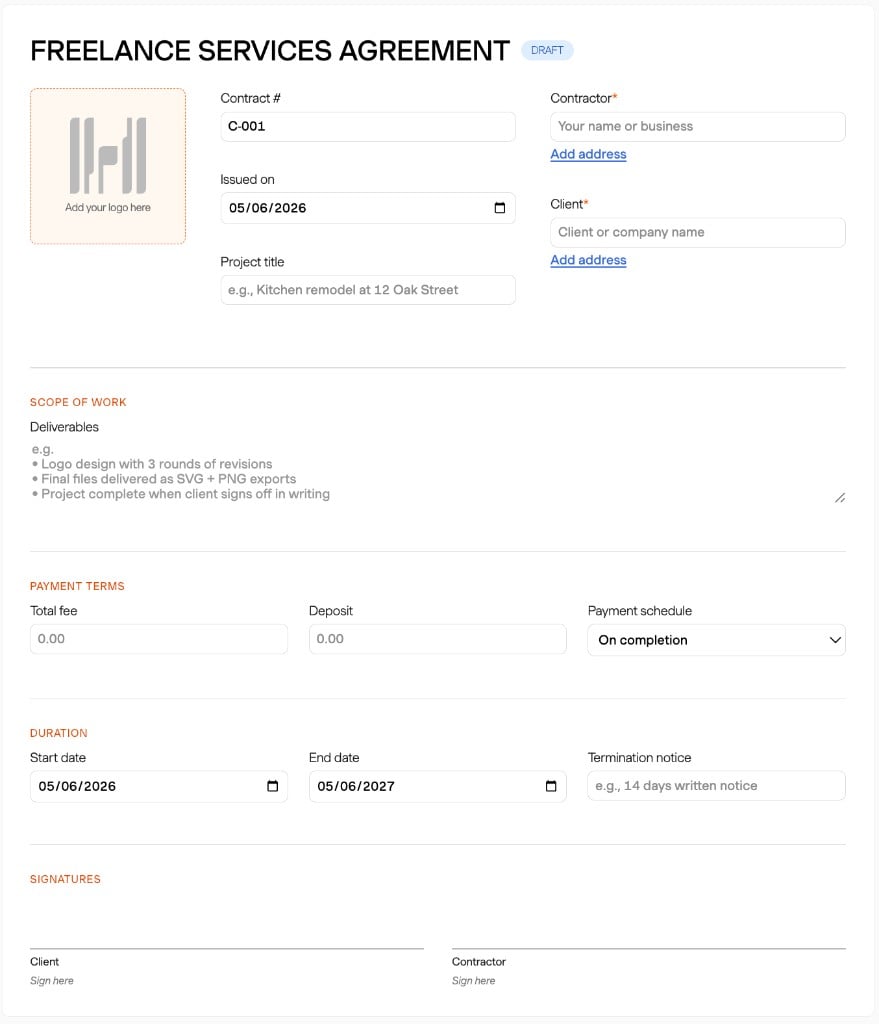
Explore Harvest's HVAC Contract Template

Harvest provides an HVAC contract template, offering customization for clear and compliant service agreements.

Screenshot of Harvest's HVAC contract template interface.

Hvac Contract Template FAQs

  • An HVAC contract should include the parties involved, equipment covered, services provided, payment terms, and contract duration. Clearly defining these elements prevents misunderstandings and ensures smooth operations.

  • Customizing an HVAC contract template involves tailoring sections to specify equipment details, service frequency, and terms. Tools like Harvest offer customizable templates that streamline this process, ensuring clarity and compliance.

  • Yes, HVAC contracts can vary based on service scope, such as preventive maintenance, repair agreements, and comprehensive service plans. Each type addresses specific client needs and compliance requirements.

  • HVAC contracts must comply with federal and state regulations, including licensing and environmental standards. For example, the AIM Act impacts refrigerant use, necessitating updates to contracts for compliance.

  • Technology integrates remote monitoring, smart scheduling, and AI-driven systems into HVAC contracts, enhancing efficiency and service delivery. These advancements reduce energy consumption and extend equipment lifespan.

  • Common mistakes include unclear scope and coverage, leading to disputes. To avoid this, contracts should explicitly outline services, exclusions, and preventive maintenance schedules.

  • Service agreements provide stable revenue, enhance cash flow, and reduce emergency repairs. They also offer clients assurance with regular maintenance, improving system efficiency and longevity.