
Harvest
Contracts
Sign up

Independent Contractor Agreement Template in Russian

In Russia's growing freelance market, misclassifying independent contractors can lead to significant penalties. While Harvest doesn't offer legal templates, it excels in managing time, expenses, and invoices for contractors.

Start from a template

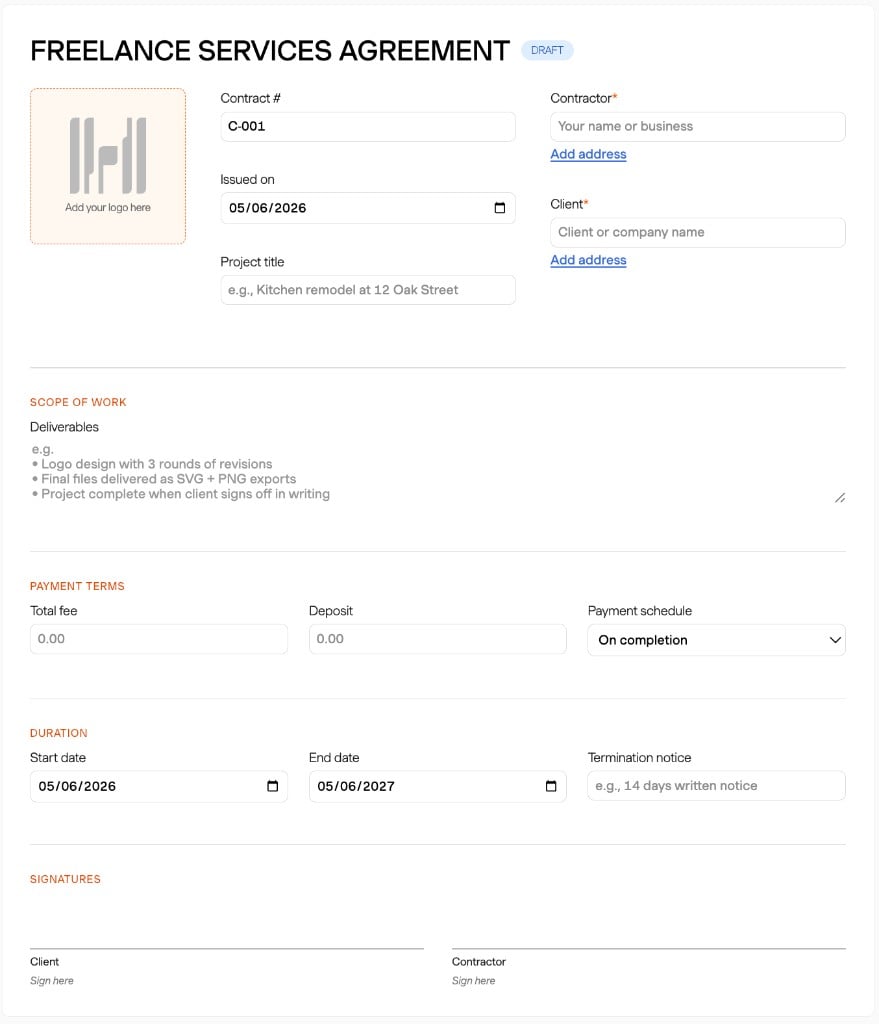
AGREEMENT DRAFT

Add your logo here

Scope of work

Payment terms

Duration

Signatures

Client

Sign here

Contractor

Sign here

Get paid via:
Credit card / Debit card
ACH
Wire transfer

Customize contract

Appearance

Add a logo
Show contract title

Contract settings

Include payment terms Total fee, deposit, and schedule
Include termination clause Notice required to end the contract
Include signature blocks Both parties sign at the bottom

Understanding Key Clauses in a Russian Contractor Agreement

When drafting an independent contractor agreement in Russia, it's essential to include specific clauses to ensure compliance with local laws and to clearly define the relationship. Key clauses should articulate the scope of work, deliverables, and deadlines, avoiding any terms that suggest an employment relationship. For instance, payment should be structured around the completion of specific tasks or milestones, rather than a regular salary, to maintain the distinction between independent contractors and employees. Industry experts highlight the importance of specifying the contractor's independence in choosing work methods and schedules to prevent reclassification risks.

Misclassification risks are significant, with potential fines ranging from RUB 50,000 to 100,000 for organizations. Additionally, companies may owe back taxes and social contributions if contractors are deemed employees. Therefore, contracts should emphasize the contractor's ability to work for other clients and dictate their own work processes. This approach not only aligns with Russian legal standards but also helps to safeguard businesses from costly compliance issues.

Ensuring Compliance with Russian Contracting Laws

Compliance with Russian contracting laws is a critical consideration for businesses engaging independent contractors. The legal framework is primarily governed by Federal Law No. 422-FZ, which outlines the Professional Income Tax (NPD) regime. This regime simplifies tax compliance for self-employed individuals, who must not have formal employees and should not exceed an annual income of 2.4 million rubles. Tax rates under this system are 4% for income from individuals and 6% from legal entities, remaining stable through 2028.

To avoid legal pitfalls, it's crucial to draft agreements that reflect the true nature of the independent contractor relationship. Legal experts recommend using pre-approved templates that focus on deliverables and the contractor's freedom in executing tasks. Regular audits of contractor relationships can further ensure compliance and mitigate the risk of reclassification. While Harvest does not provide legal compliance features for Russian contracts, it can aid in managing project budgets and tracking expenses efficiently.

The Role of Harvest in Contractor Management

While Harvest does not provide legal templates for Russian contractor agreements, it excels in helping contractors and service businesses manage their operational tasks. For contractors, time tracking, expense management, and invoicing are crucial components of their workflow. Harvest supports these needs by offering tools that streamline the tracking of billable hours and manage expenses, facilitating accurate invoicing and payment collection.

By focusing on these operational aspects, Harvest allows independent contractors to efficiently manage their work without getting bogged down in administrative details. This capability is particularly beneficial for contractors who need to keep their business operations seamless, even as they navigate the complexities of Russian contracting laws. Although Harvest does not replace legal counsel, it provides the necessary tools to manage the business side effectively, allowing contractors to focus on delivering quality work.

Mitigating Risks of Contractor Misclassification

Misclassification of independent contractors as employees is a prevalent risk that can lead to significant financial penalties. In Russia, the distinction between an employee and a contractor hinges on the actual working conditions rather than the contract's label. Companies must ensure that their contracts do not contain elements typical of employment, such as fixed schedules or subordination to internal regulations.

To mitigate these risks, experts suggest regular training for managers on distinguishing between employment and contractor relationships, and implementing internal policies that guide the classification and engagement of contractors. While Harvest does not directly address these legal distinctions, its tools for project management and expense tracking can indirectly support businesses in maintaining clear operational boundaries between contractors and employees.

Manage Contractor Workflows with Harvest

Harvest helps Russian contractors track time, manage expenses, and invoice clients efficiently, though it doesn't provide legal templates.

Harvest dashboard showing time tracking and expense management for Russian contractors

Independent Contractor Agreement Template in Russian FAQs

  • Key clauses include the scope of work, specific deliverables, deadlines, and payment based on completed tasks. It's crucial to state the contractor's independence and avoid terms that suggest employment.

  • Use agreements that reflect genuine contractor relationships, focusing on deliverables. Regular audits and understanding of Federal Law No. 422-FZ, governing the NPD regime, are essential to staying compliant.

  • Misclassification can lead to fines between RUB 50,000 to 100,000, back taxes, and social contributions. Contracts should avoid employment terms like fixed schedules to mitigate these risks.

  • Harvest helps contractors by managing time tracking, expenses, and invoicing efficiently, allowing them to focus on delivering quality work without getting bogged down in administrative details.

  • The NPD regime allows self-employed individuals to simplify tax compliance with a 4% tax rate for income from individuals and 6% from legal entities, capping annual income at 2.4 million rubles.

  • The freelance market in Russia is projected to reach $102 billion by 2025, growing from $41 billion in 2020, driven by shifts to remote work and geopolitical factors.

  • Avoid terms suggesting employment: fixed work schedules, adherence to internal company rules, and regular salary-like payments. Focus on deliverables and independence instead.