
Harvest
Contracts
Sign up

Independent Contractor Agreement Template in Hindi

Harvest supports contractors by offering robust tools for time tracking, project budget management, and invoicing, ensuring efficiency in the gig economy.

Start from a template

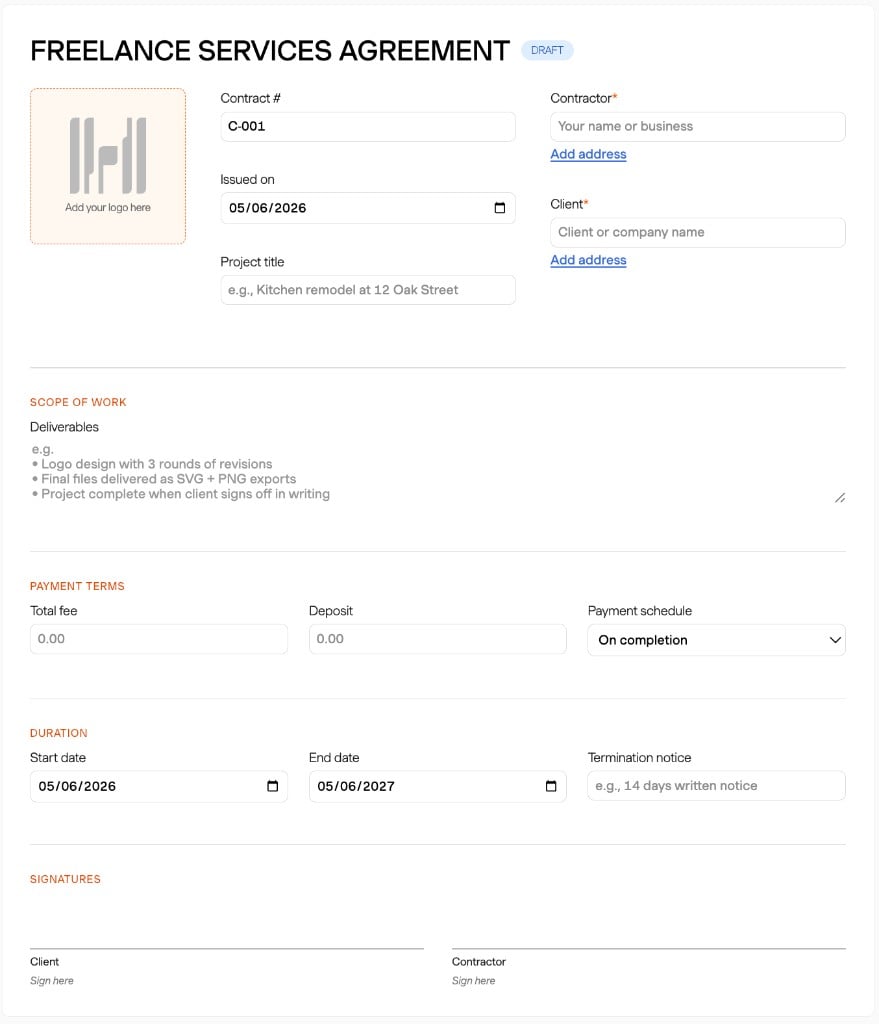
AGREEMENT DRAFT

Add your logo here

Scope of work

Payment terms

Duration

Signatures

Client

Sign here

Contractor

Sign here

Get paid via:
Credit card / Debit card
ACH
Wire transfer

Customize contract

Appearance

Add a logo
Show contract title

Contract settings

Include payment terms Total fee, deposit, and schedule
Include termination clause Notice required to end the contract
Include signature blocks Both parties sign at the bottom

Understanding Independent Contractor Agreements in India

Independent contractor agreements are vital for defining the working relationship between a contractor and a business. In India, these agreements distinguish between a "contract of service" and a "contract for service," the latter being applicable to contractors. The Indian gig economy is experiencing rapid growth, with projections showing an increase from 7.7 million workers in 2020-21 to 23.5 million by 2029-30. This growth underscores the importance of having clear and legally sound agreements, particularly in a landscape where misclassification can lead to significant liabilities, including back payment of wages and penalties.

These agreements typically need to cover several key elements: the scope of work, payment terms, intellectual property rights, and dispute resolution mechanisms. However, businesses must avoid common mistakes like using vague contracts and misclassifying workers, which can result in legal complications. Indian courts apply a multi-factor test to assess a worker's status, focusing on the nature of the working relationship rather than the contract's label.

Drafting an Effective Contractor Agreement in Hindi

For many contractors and businesses in India, using an agreement template in Hindi ensures clarity and compliance. A well-drafted agreement should outline the scope of work, payment terms, confidentiality obligations, and termination conditions. Using a Hindi template can be beneficial, particularly in regions where Hindi is prevalent, as it facilitates better understanding and adherence to the terms.

Templates should also address the potential for disputes and include a resolution mechanism. As the gig economy in India grows, particularly in Tier II cities, having a clear and concise agreement is vital. Nearly 39% of India's gig workforce is expected to be based in these cities by FY27, emphasizing the need for accessible legal documentation.

Legal Considerations and Compliance for Contractors

Legal compliance is crucial for businesses engaging independent contractors in India. A clear understanding of the distinction between an employee and a contractor is necessary to avoid misclassification. Indian law differentiates between a contract of service (for employees) and a contract for service (for contractors), with the latter offering more autonomy. Misclassification can result in penalties, including back payment of benefits and taxes.

Contractors are responsible for managing their own tax obligations, such as filing income taxes and registering for Goods and Services Tax (GST) if required. Companies must deduct Tax Deducted at Source (TDS) at prescribed rates. This legal framework highlights the importance of having a robust agreement that clearly defines the parties' obligations and protects against potential liabilities.

Challenges in the Indian Gig Economy

The gig economy in India is both a boon and a challenge, offering flexibility but also presenting issues such as income volatility. Approximately 40% of gig workers earn less than ₹15,000 per month. The economy is shifting towards high-skill, project-based roles, with large enterprises accounting for 42% of gig hiring. This shift requires contractors to have clearly defined agreements to protect their rights and ensure fair compensation.

Businesses can mitigate common challenges by using Employer of Record (EOR) services to handle employment contracts and benefits. This approach helps in managing legal compliance and reducing risks associated with worker misclassification. By clearly outlining the terms of engagement, businesses and contractors can avoid disputes and focus on delivering high-quality work.

How Harvest Supports Contractors

While Harvest does not provide legal templates for contractor agreements, it plays a crucial role in supporting contractors with time tracking, project budget management, and invoicing. These tools are essential for managing the operational aspects of gig work efficiently. Harvest helps contractors keep track of billable hours, monitor project budgets, and streamline invoicing processes, ensuring they receive timely payments.

For businesses, using Harvest can facilitate better project management and financial oversight, allowing them to focus on compliance and strategic growth. By integrating time tracking and invoicing solutions, contractors can maintain clear records and improve their overall workflow, reducing administrative burdens and enhancing productivity.

Harvest for Contractors

Harvest helps contractors in India track time, manage budgets, and invoice clients, ensuring efficient workflow in the gig economy.

Screenshot of Harvest's interface for contractors in Hindi context.

Independent Contractor Agreement Template in Hindi FAQs

  • An independent contractor agreement is a legal document that outlines the terms of a working relationship between a contractor and a business. It defines the scope of work, payment terms, intellectual property rights, and dispute resolution mechanisms. In India, clear agreements help prevent misclassification and legal liabilities.

  • Using a Hindi template ensures that all parties clearly understand the agreement terms, particularly in regions where Hindi is prevalent. This clarity helps prevent misunderstandings and ensures compliance with legal requirements.

  • Key elements include the scope of work, payment terms, confidentiality obligations, intellectual property rights, and dispute resolution mechanisms. These elements protect both the contractor's and the business's interests.

  • Misclassification can lead to significant liabilities for businesses, including back payment of wages and benefits, tax penalties, and legal disputes. Indian law uses a multi-factor test to determine a worker's status, focusing on the working relationship.

  • Independent contractors in India must file their own income taxes and may need to register for GST if their income exceeds ₹20 lakh annually. Companies must deduct TDS at prescribed rates for payments to contractors.

  • Businesses can ensure compliance by drafting clear agreements, using Employer of Record (EOR) services, and avoiding treating contractors like full-time employees. These practices help mitigate the risks of misclassification and legal liabilities.

  • Harvest supports contractors by providing tools for time tracking, project budget management, and invoicing. These tools help contractors manage their work efficiently, ensuring timely payments and streamlined project management.