
Harvest
Contracts
Sign up

Service Agreement Template in Hindi

Harvest helps businesses streamline time tracking and invoicing, but if you're drafting a service agreement in Hindi, understanding legal terms and compliance is crucial. Use clear language and consult a lawyer for legal review.

Start from a template

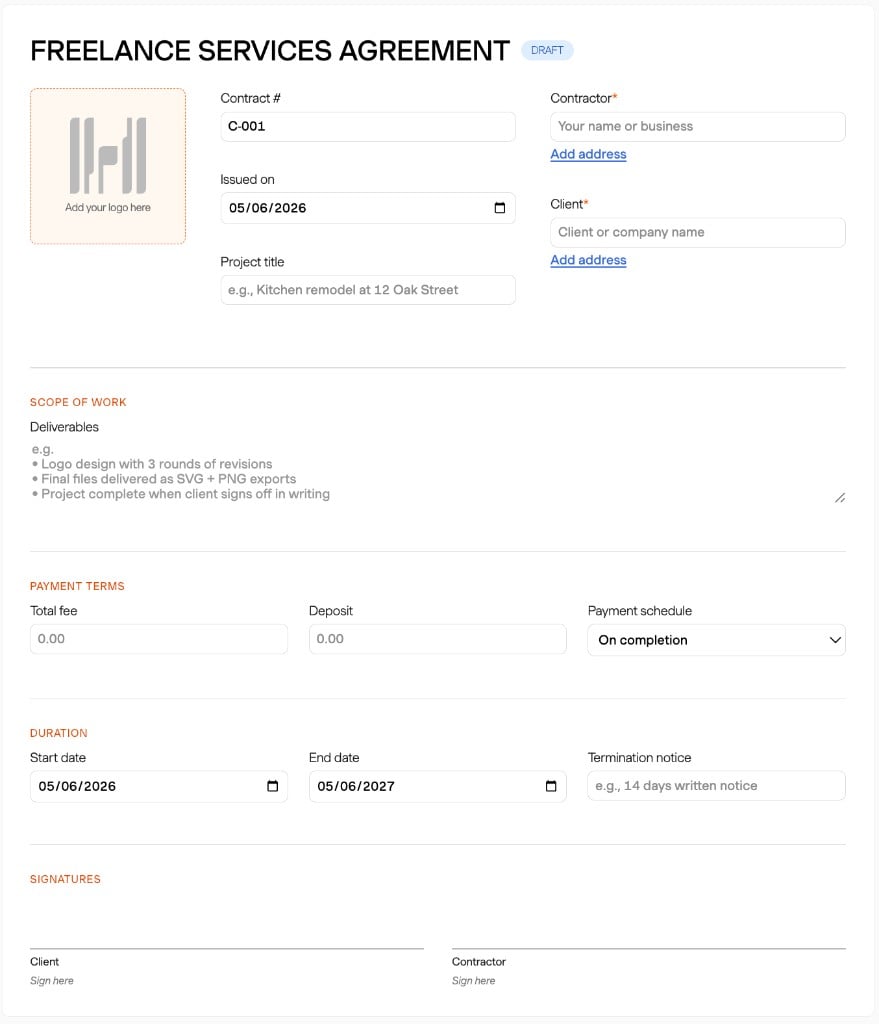
AGREEMENT DRAFT

Add your logo here

Scope of work

Payment terms

Duration

Signatures

Client

Sign here

Contractor

Sign here

Get paid via:
Credit card / Debit card
ACH
Wire transfer

Customize contract

Appearance

Add a logo
Show contract title

Contract settings

Include payment terms Total fee, deposit, and schedule
Include termination clause Notice required to end the contract
Include signature blocks Both parties sign at the bottom

Understanding Essential Clauses in a Hindi Service Agreement

Creating a comprehensive service agreement in Hindi requires understanding its essential clauses. A key aspect is the scope of services, which should clearly outline the tasks and deliverables. Ambiguity here is the leading cause of disputes, as service providers often perform additional work based on verbal requests, lacking proper written change orders. To avoid such conflicts, explicitly define each task and its completion criteria.

Payment terms are another critical component. These should include the payment schedule, mode of payment, and any penalties for late payments. For instance, specifying payments in phases can prevent misunderstandings and ensure smooth financial transactions. Additionally, include clauses on confidentiality and intellectual property to safeguard sensitive information and define ownership of work products.

Finally, termination conditions and dispute resolution mechanisms must be clearly stated. This ensures both parties understand the grounds for contract termination and the process for resolving disagreements, whether through negotiation, mediation, or arbitration.

Customizing Your Hindi Service Agreement

Customizing a service agreement in Hindi involves tailoring it to specific needs while ensuring compliance with Indian laws. Begin by identifying all parties involved and their contact details. Clearly define the services to be provided, including tasks, deliverables, and timelines. This clarity is crucial as vague language can lead to disputes.

When establishing compensation and payment terms, use concrete numbers for deliverables and payment milestones. For example, instead of saying "website development will be completed by 50%", specify the stages of completion. This approach helps prevent misunderstandings and ensures both parties are aligned on expectations.

It is also essential to address tax compliance within the agreement, including aspects like Goods and Services Tax (GST) and Tax Deducted at Source (TDS). Furthermore, ensure that the agreement is reviewed by a lawyer to confirm its legality and enforceability, protecting all parties involved.

Navigating Legal Terminology in Hindi Service Agreements

When drafting a service agreement in Hindi, understanding legal terminology is essential for clarity and compliance. In India, service agreements are governed by the Indian Contract Act, 1872, which outlines the basic principles for contract formation. Key terms such as free consent, competent parties, and lawful consideration are critical for ensuring the agreement's enforceability.

It's important to be aware of limitations on certain clauses. For example, post-termination non-compete clauses are generally void under Section 27 of the Indian Contract Act. Additionally, Section 74 limits penalty recovery to "reasonable compensation," impacting how penalty clauses should be drafted. Understanding these legal nuances helps in creating a robust and enforceable contract.

While English remains the official language for most High Court proceedings, some courts allow Hindi, which highlights the growing acceptance of regional languages in formal legal processes. However, it's advisable to consult a legal expert to ensure that the Hindi version of the agreement aligns with its English counterpart, especially in jurisdictions where translations may lead to conflicting interpretations.

Avoiding Common Mistakes in Hindi Service Agreements

Common mistakes in drafting service agreements in Hindi can lead to significant legal challenges. One frequent error is using vague language, which can create confusion and lead to disputes. To avoid this, clearly define deliverables and payment milestones with precise numbers and terms.

Another mistake is failing to retain original signed copies of the agreement. In India, each party should hold an original signed copy, which is crucial for admissibility as evidence in court. Printing the agreement on two separate stamp papers and having both parties sign both copies ensures each party has an original.

Lastly, overlooking tax and dispute resolution clauses can lead to compliance issues and unnecessary litigation. Ensure the agreement explicitly addresses tax obligations, such as GST and TDS, and outlines clear dispute resolution mechanisms. This strategic foresight can prevent future legal complications and ensure smoother business operations.

Ensuring Compliance with Local Laws in Hindi Service Agreements

Ensuring compliance with local laws is vital when drafting a service agreement in Hindi. The agreement must meet the requirements of the Indian Contract Act, 1872, which includes essentials such as free consent, competent parties, and lawful consideration. Proper stamping of the agreement is also required for it to be admissible in court.

Incorporating regional language is increasingly important, as reflected in government initiatives to enhance accessibility. However, only a few High Courts currently allow Hindi in legal proceedings, underscoring the importance of aligning the Hindi version with its English counterpart.

For greater assurance, it is recommended to have the agreement reviewed by a legal professional. This step not only helps in compliance but also ensures that the agreement accurately reflects the intentions of both parties, reducing the risk of disputes and enhancing enforceability.

Create Service Agreements with Harvest

Explore how Harvest supports businesses with time tracking and invoicing, crucial for service agreements in Hindi.

Screenshot of Harvest's time tracking and invoicing interface in Hindi context.

Service Agreement Template in Hindi FAQs

  • Essential clauses in a service agreement include the scope of services, payment terms, confidentiality, intellectual property rights, and dispute resolution mechanisms. Clear definitions and expectations in these areas help prevent misunderstandings and disputes.

  • Using Hindi for service agreements in India enhances accessibility and understanding, especially for parties more comfortable with regional languages. This aligns with government efforts to incorporate Hindi in legal and official documents.

  • Customize a service agreement template by clearly defining the services, deliverables, and payment terms. Include necessary legal clauses and review the draft with a legal professional to ensure compliance and enforceability.

  • Service agreements in India are governed by the Indian Contract Act, 1872. This law outlines principles for contract formation, performance, and breach, ensuring agreements are legally binding and enforceable.

  • To ensure a service agreement is enforceable, it must meet the essentials of a valid contract under the Indian Contract Act, including free consent, competent parties, and lawful consideration. Proper stamping is also required for court admissibility.

  • Common mistakes in service agreements include using vague language and failing to retain original signed copies. Clearly define terms and ensure each party holds an original signed agreement for legal protection.

  • Having a legal professional review your service agreement ensures it complies with Indian laws and reduces the risk of disputes. This step helps clarify terms and enhances the agreement's enforceability.