
Harvest
Contracts
Sign up

Statement of Work Template in Hindi

Harvest offers tools to manage project time and budgets, complementing the planning in a Statement of Work. While not directly creating SOWs, Harvest aids in project execution.

Start from a template

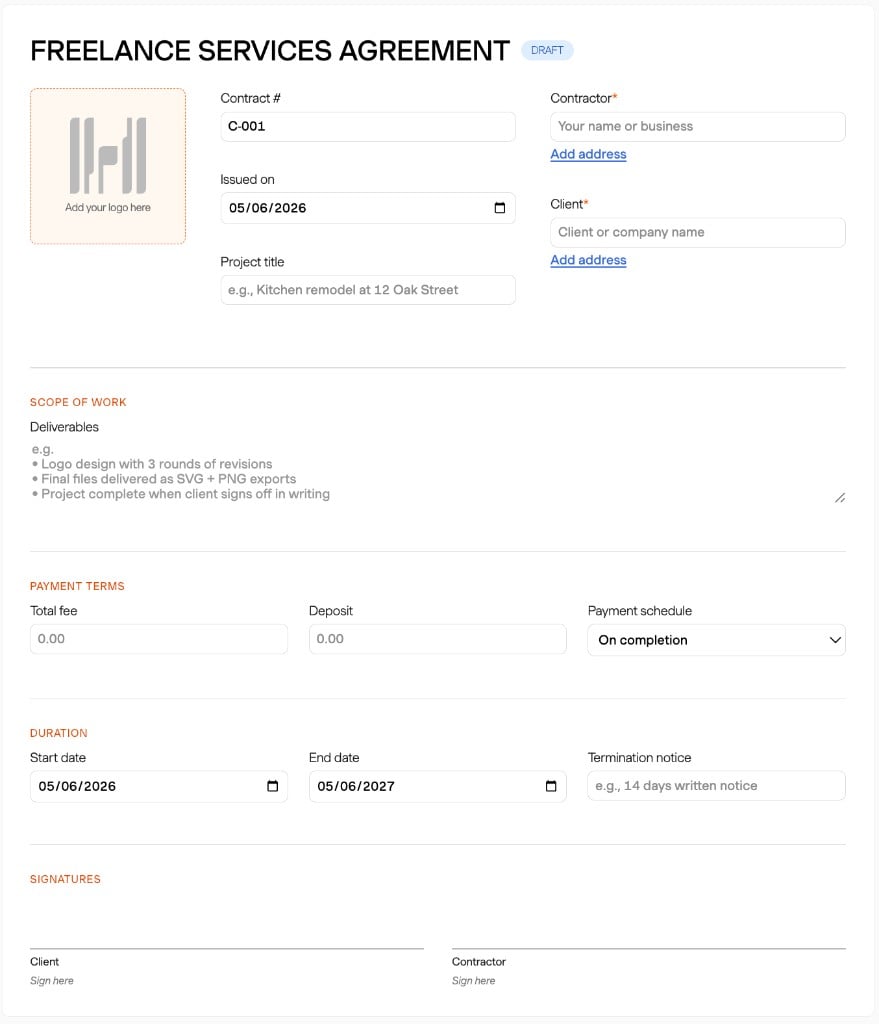
AGREEMENT DRAFT

Add your logo here

Scope of work

Payment terms

Duration

Signatures

Client

Sign here

Contractor

Sign here

Get paid via:
Credit card / Debit card
ACH
Wire transfer

Customize contract

Appearance

Add a logo
Show contract title

Contract settings

Include payment terms Total fee, deposit, and schedule
Include termination clause Notice required to end the contract
Include signature blocks Both parties sign at the bottom

Understanding the Importance of a Statement of Work (SOW)

A Statement of Work (SOW) is a critical document that outlines the project scope, deliverables, timelines, and payment terms. It serves as a blueprint for project execution and significantly reduces the risk of miscommunication by clearly defining expectations and responsibilities. In India, SOWs are becoming increasingly important for project success, with well-defined scopes leading to higher on-time and on-budget project completion rates. This is particularly true in sectors like IT, construction, and consulting, where precise language helps avoid disputes and scope creep.

Localization is key when crafting an SOW, especially in diverse markets like India. Adapting the SOW to Hindi ensures that it aligns with cultural and legal expectations, facilitating better communication among stakeholders. Moreover, the Indian Contract Act, 1872, governs these contracts, emphasizing the need for clear and enforceable language. Therefore, using Hindi can enhance the document's effectiveness, ensuring all parties fully understand the terms and conditions.

Key Components of an SOW Template in Hindi

Creating a Statement of Work template in Hindi involves several essential components. At the outset, the SOW should include an introduction and purpose, clearly stating the project's objectives. Following this, it should detail the scope of work, highlighting both included and excluded tasks. Deliverables, timelines, and milestones must be clearly defined to provide a structured project roadmap.

Additionally, roles and responsibilities should be assigned to ensure accountability. This includes performance standards and acceptance criteria, which are crucial for measuring project success. Payment terms and schedules must also be laid out in detail, alongside a change management process to accommodate any necessary adjustments during the project lifecycle. In India, where the Indian Contract Act governs contracts, ensuring these components are in Hindi can facilitate understanding and compliance.

Legal Considerations for SOWs in India

In India, the Indian Contract Act, 1872, sets the legal framework for contracts, including Statements of Work (SOWs). For an SOW to be legally binding, it must fulfill criteria such as mutual agreement, lawful consideration, and competent parties. The clarity of terms is crucial, as vague language can weaken a contract's enforceability. Therefore, drafting an SOW in Hindi can enhance clarity and ensure that all parties understand the contract terms.

Legal validity in the local language is supported by Indian law, although written contracts are preferred for clarity and proof. This is particularly important as the Indian courts focus on the written language when assessing contract enforceability. Additionally, localization to Hindi can align the SOW with cultural expectations and legal nuances, strengthening its legal standing.

Best Practices for Crafting an SOW in Hindi

Crafting an SOW in Hindi requires attention to detail and cultural sensitivity. Experts recommend using specific and measurable language to avoid misinterpretations. For instance, instead of using phrases like "high quality," it is better to set quantifiable criteria, such as "achieve a 95% customer satisfaction rate." This precision is vital for projects involving multilingual teams, ensuring clear communication and mutual understanding.

Incorporating stakeholder input during the drafting process is also crucial. This fosters alignment and ensures that all parties are committed to the project's objectives. Additionally, integrating digital tools for SOW management can enhance visibility and compliance, offering features like cloud-based storage and AI-powered analysis, which are increasingly adopted in India's document management landscape.

Leveraging Harvest for Project Management

While Harvest does not provide direct SOW creation tools, it plays a pivotal role in managing the project lifecycle post-SOW. Once the SOW is established, Harvest can help track project time, manage budgets, and streamline invoicing processes. This ensures that projects stay on track financially and temporally, complementing the detailed planning laid out in an SOW.

By using Harvest for time tracking and invoicing, businesses can maintain financial oversight and transparency, which are crucial for project success. These capabilities support the execution phase, helping teams adhere to the timelines and budgets specified in the SOW, ultimately driving project completion and client satisfaction.

Harvest for Hindi SOW Management

See how Harvest supports project management and time tracking for Hindi SOWs. Enhance execution with clear budgets and timelines.

Harvest project management and time tracking for Hindi SOWs

Statement of Work Template in Hindi FAQs

  • A Statement of Work (SOW) is a formal document that outlines the project's scope, deliverables, timelines, and payment terms. It is essential for setting clear expectations and responsibilities, helping to prevent misunderstandings and scope creep.

  • Localization is crucial in India to ensure SOWs align with cultural and legal norms. By using Hindi, businesses can improve understanding and compliance, facilitating smoother project execution and stakeholder communication.

  • An effective SOW template should include an introduction, project objectives, detailed scope of work, deliverables, timelines, roles and responsibilities, performance standards, payment terms, and a change management process.

  • The Indian Contract Act, 1872, establishes the legal framework for contracts, including SOWs. It requires elements like mutual agreement and lawful consideration, with a focus on clear and precise language for enforceability.

  • Harvest provides tools for time tracking and invoicing, crucial for managing project execution. These features help teams adhere to the timelines and budgets set in the SOW, ensuring project success.

  • Best practices include using specific, measurable language, involving stakeholders early, and setting clear success criteria. This approach helps ensure clarity and alignment throughout the project.

  • Digital document management systems improve SOW processes by offering features like cloud-based storage and AI-powered analysis, enhancing visibility, compliance, and strategic decision-making.