
Harvest
Contracts
Sign up

Service Agreement Template in Finnish

Harvest excels at simplifying time tracking and invoicing, providing clear workflows that enhance productivity and ensure compliance with Finnish standards.

Start from a template

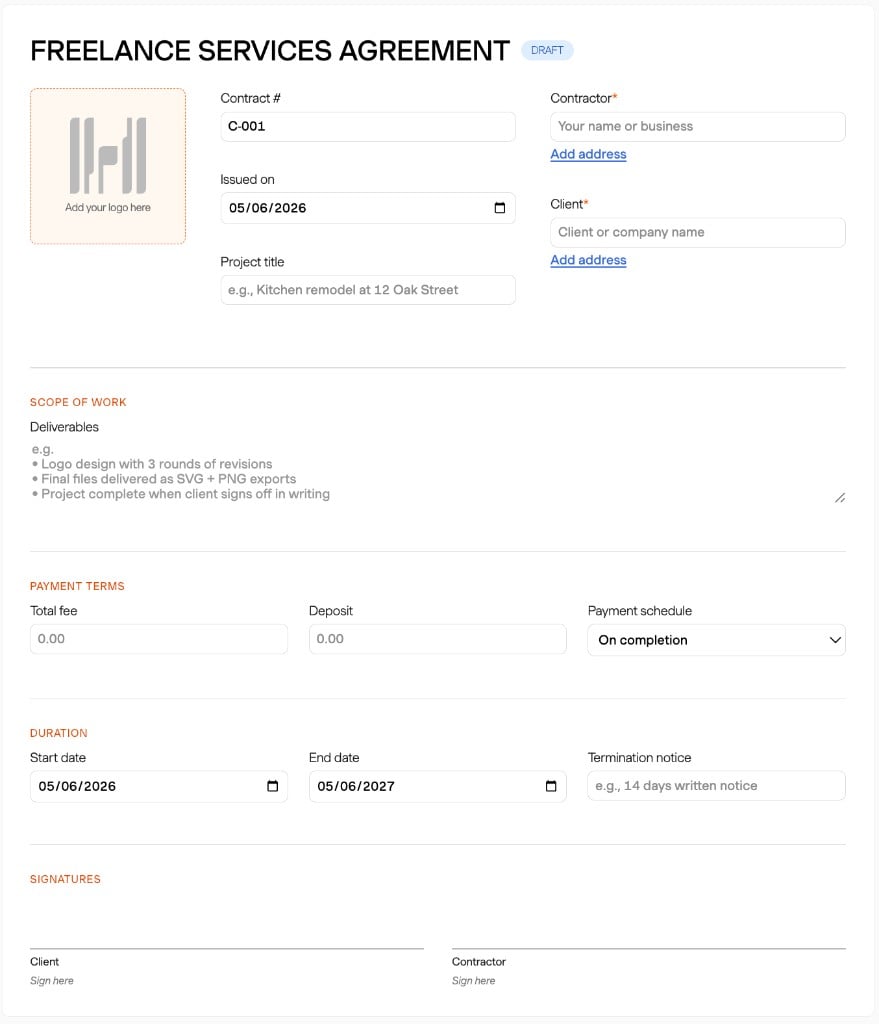
AGREEMENT DRAFT

Add your logo here

Scope of work

Payment terms

Duration

Signatures

Client

Sign here

Contractor

Sign here

Get paid via:
Credit card / Debit card
ACH
Wire transfer

Customize contract

Appearance

Add a logo
Show contract title

Contract settings

Include payment terms Total fee, deposit, and schedule
Include termination clause Notice required to end the contract
Include signature blocks Both parties sign at the bottom

Key Clauses in a Finnish Service Agreement

Creating a comprehensive service agreement in Finnish requires attention to specific clauses that align with Finnish legal standards. Core elements include the scope of work, payment terms, and liability limitations. Each clause should be clearly defined to avoid potential disputes. For instance, the Contracts Act (228/1929) emphasizes contractual freedom but insists on good faith and fairness, requiring explicit terms for clarity.

Another crucial inclusion is addressing liability for damages. Given the Finnish system’s approach, it’s vital to distinguish between direct and indirect damages, specifying liability regimes to protect both parties. Furthermore, clauses should reflect recent employment law amendments, such as the 2026 changes impacting dismissal thresholds and fixed-term contracts. These adjustments ensure service agreements remain compliant with current legislation and protect against potential reclassification risks.

Legal Requirements for Service Agreements in Finland

Understanding the legal framework surrounding Finnish service agreements is essential for compliance and effective contract management. Finnish contract law is rooted in the principle of contractual freedom, allowing parties to define their terms while adhering to good faith and fairness. This principle is a cornerstone, as outlined in the Contracts Act (228/1929), governing contract formation and validity.

Recent legal amendments, such as the 2023 criteria distinguishing self-employment from contractual employment, are crucial to incorporate into service agreements. These changes aim to reduce misclassification risks, ensuring clear definitions of employment relationships. Additionally, Finnish courts have the discretion to adjust terms deemed unfair, emphasizing the importance of precise and fair drafting to withstand judicial scrutiny.

Customizing a Finnish Service Agreement for Your Business

Customizing a service agreement in Finnish to fit specific business needs involves more than translation; it requires a contextual understanding of local legal nuances. Each clause should reflect the actual project and the interests of both parties, ensuring the contract is tailored for the intended business relationship.

Legal experts recommend context-specific drafting, particularly in areas like liability and termination rights. Given the Finnish courts' wide discretion, it’s essential to articulate these areas carefully to avoid potential disputes. Updates should also reflect recent legislative changes to mitigate risks associated with employment law reforms.

Integrating the contract into business processes is another critical step. Ensure that general terms are consistent across offers, invoices, and order confirmations. This integration supports compliance and enhances operational efficiency. Regular audits of agreements can further ensure they remain aligned with evolving legal standards, safeguarding against potential liabilities.

Common Pitfalls in Drafting Finnish Service Agreements

When drafting service agreements in Finnish, several common pitfalls can undermine the effectiveness of the contract. One major issue is ambiguity in terms and conditions, which can lead to disputes over contract interpretation. Finnish law allows courts to adjust unfair terms, meaning imprecise language can result in unintended liabilities.

Another pitfall is failing to update agreements in light of recent legal changes. For instance, the 2026 employment law amendments impact dismissal and fixed-term contract policies, necessitating revisions in service agreements to ensure compliance. Regular audits and updates are critical to avoid legal repercussions.

Additionally, many companies underestimate the importance of explicitly defining liability for damages. Given Finland’s approach to damages, it’s crucial to specify liability regimes for direct and indirect damages. This clarity helps avoid unexpected financial burdens and ensures both parties understand their obligations.

Simplify with Harvest

See how Harvest streamlines invoicing and time tracking for Finnish service agreements.

Screenshot of Harvest's invoicing feature tailored for Finnish agreements.

Service Agreement Template in Finnish FAQs

  • Essential clauses in a Finnish service agreement include the scope of work, payment terms, and liability limitations. These should be clearly defined to ensure compliance and avoid disputes.

  • Yes, Finnish service agreements must adhere to the Contracts Act (228/1929), emphasizing contractual freedom, good faith, and fairness. Recent amendments also impact employment and dismissal clauses.

  • Customization involves contextual drafting that considers local legal nuances, aligning clauses with specific business needs and recent legislative changes to ensure compliance.

  • Avoid ambiguous terms, failing to update agreements with legal changes, and not clearly defining liability for damages. Regular audits can help maintain compliance.

  • Finnish courts have discretion to adjust unfair terms, emphasizing the need for precise and fair contract drafting to withstand judicial scrutiny.

  • Recent changes include the 2026 amendments affecting dismissal thresholds and fixed-term contracts, requiring updates to service agreements for compliance.

  • Integration ensures consistency across offers, invoices, and confirmations, supporting compliance and operational efficiency. Regular audits are advisable to stay aligned with legal standards.