
Harvest
Contracts
Sign up

Service Agreement Template in Arabic

Harvest offers practical solutions for businesses needing service agreement templates in Arabic, focusing on compliance with UAE laws. Create comprehensive agreements effortlessly.

Start from a template

AGREEMENT DRAFT

Add your logo here

Scope of work

Payment terms

Duration

Signatures

Client

Sign here

Contractor

Sign here

Get paid via:
Credit card / Debit card
ACH
Wire transfer

Customize contract

Appearance

Add a logo
Show contract title

Contract settings

Include payment terms Total fee, deposit, and schedule
Include termination clause Notice required to end the contract
Include signature blocks Both parties sign at the bottom

Understanding Service Agreements in the UAE

When creating a service agreement for businesses in the UAE, it’s crucial to understand the legal framework governing such contracts. The UAE’s Federal Law No. 5 of 1985, known as the Civil Transactions Law, alongside its Commercial Code, forms the foundation for service agreements. Additionally, financial free zones like the Dubai International Financial Centre (DIFC) and Abu Dhabi Global Market (ADGM) operate under independent legal frameworks derived from English common law. This makes it essential to draft agreements that comply with both federal and specific free-zone regulations.

Service agreements should include key clauses such as a detailed scope of services, payment terms, duration, confidentiality provisions, and governing law. For example, a force majeure clause is critical in the UAE to account for unforeseen events that might impact contract fulfillment. Ensuring these elements are clearly defined helps in mitigating potential disputes and enhances the enforceability of the agreement under local laws.

Key Clauses for Arabic Service Agreements

Drafting a service agreement in Arabic for the UAE necessitates attention to specific clauses that ensure legal soundness. Essential components include a comprehensive scope of services, payment and duration terms, confidentiality obligations, and liability limitations. Each clause must be tailored to reflect the precise nature of the services and the legal context within which the contract operates.

Additionally, intellectual property rights and amendment procedures are vital in protecting both parties' interests. The inclusion of a governing law clause is crucial, as disputes are often resolved under UAE law, with Arabic being the prevalent language for legal proceedings. Contracts must also account for the possibility of electronic execution, a growing trend supported by the electronic transactions laws in the region.

Drafting and Translating Legal Documents

Translating legal documents into Arabic involves more than just linguistic accuracy; it requires a deep understanding of legal terminology and cultural nuances. A structured translation process is recommended, where translators first familiarize themselves with specific legal terminologies and consult specialized legal dictionaries. This ensures that the translated document accurately conveys the intended legal meaning within the context of UAE law.

Maintaining consistent terminology throughout the document is paramount to avoid ambiguity. Creating a glossary of terms at the outset can aid in this consistency. Additionally, proofreading and consultation with subject matter experts are critical steps in the translation process to ensure precision and reliability of the final document.

Integrating Legal Technology in Contract Drafting

The integration of legal technology in contract drafting and review processes offers significant efficiency gains for businesses in the UAE. AI tools can rapidly analyze contracts, identify potential risks, and suggest revisions, thus streamlining these critical business functions. Though AI's role is growing, especially in the UAE, human oversight remains indispensable to ensure the cultural and contextual appropriateness of the legal content.

Moreover, leveraging legal tech can reduce the time spent on routine tasks from hours to minutes, allowing legal professionals to focus on more strategic activities. As businesses increasingly adopt digital tools, understanding how to effectively integrate these into their contract management processes can provide a competitive edge in the evolving legal landscape of the GCC region.

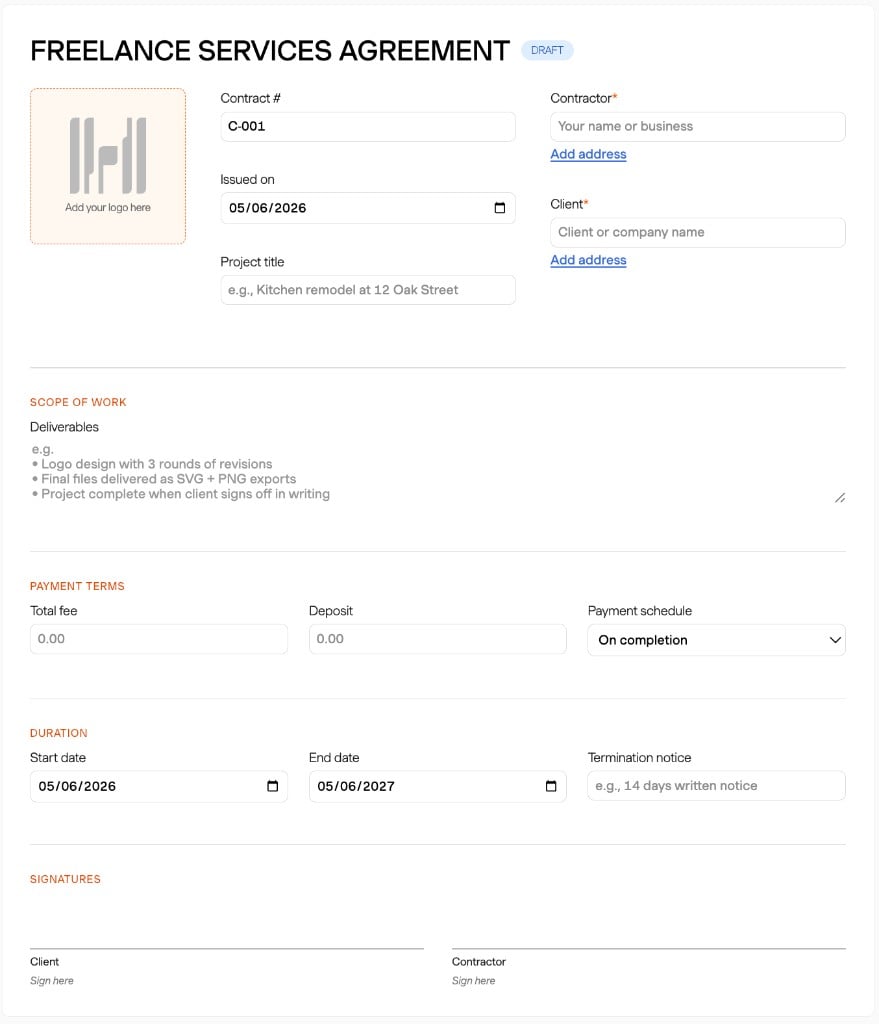
Service Agreement Templates with Harvest

Explore how Harvest facilitates the creation of service agreements in Arabic, ensuring compliance with UAE regulations.

Service agreement template interface on Harvest

Service Agreement Template in Arabic FAQs

  • Harvest provides access to service agreement templates tailored for UAE businesses. These templates are designed to comply with local laws and are available in Arabic, offering a practical solution for businesses operating in the region.

  • Essential clauses for a UAE service agreement include the scope of services, payment terms, duration, confidentiality provisions, liability limitations, intellectual property rights, and governing law. These ensure the contract is comprehensive and legally sound.

  • Yes, contracts in the UAE are often prepared in both English and Arabic, with the Arabic version prevailing in legal proceedings. It’s important to ensure all legal terms are accurately translated and reflect the intended meaning within the UAE legal context.

  • Legal technology streamlines contract management by automating routine tasks, reducing the time required from hours to minutes. AI tools can analyze contracts, identify risks, and suggest revisions, enhancing efficiency and accuracy in the drafting process.

  • Translating legal documents into Arabic involves ensuring linguistic accuracy and cultural appropriateness. Common challenges include maintaining consistent terminology and accurately conveying legal concepts within the context of UAE law.

  • Businesses can ensure accuracy by using native Arabic speakers familiar with legal terminologies, creating a glossary of terms for consistency, and engaging subject matter experts for review. Thorough proofreading is also essential.

  • Yes, electronic contracts are increasingly used in the UAE, supported by the Electronic Transactions Law, which provides a framework for digital signatures and consent standards. This trend facilitates modern contract management practices.