
Harvest
Contracts
Sign up

Service Agreement Template in Chinese

Harvest helps businesses manage the financial aspects of service agreements in China, ensuring accurate payment tracking and project management.

Start from a template

AGREEMENT DRAFT

Add your logo here

Scope of work

Payment terms

Duration

Signatures

Client

Sign here

Contractor

Sign here

Get paid via:
Credit card / Debit card
ACH
Wire transfer

Customize contract

Appearance

Add a logo
Show contract title

Contract settings

Include payment terms Total fee, deposit, and schedule
Include termination clause Notice required to end the contract
Include signature blocks Both parties sign at the bottom

Understanding Service Agreements in China

Service agreements are crucial for businesses operating in China, especially given the nuances of the Chinese legal system. With the implementation of China's new Civil Code in January 2021, which superseded the 1999 Contract Law, the legal landscape for contracts has evolved significantly. The Civil Code dedicates 526 articles to contract law, underscoring the importance of precise contractual terms. When drafting a service agreement in Chinese, it is essential to include mandatory clauses such as the subject matter, quantity, quality, price, and dispute resolution methods. Additionally, electronic signatures have been legally recognized since 2004, making them a valid option for contract execution, although the traditional company chop remains a preferred practice for enforceability.

For foreign businesses, service agreements offer a strategic approach to engaging Chinese professionals for specific projects without the need to establish a formal legal entity, thus accelerating market entry and reducing costs. However, it is important to navigate challenges such as enforcement of foreign judgments, which are rarely settled in Chinese courts, emphasizing the need for meticulous contractual documentation. Understanding these complexities can help businesses avoid common pitfalls and ensure smoother operations within the Chinese market.

Key Clauses in a Chinese Service Agreement

A well-structured service agreement in China should address several critical clauses to safeguard the interests of all parties involved. One of the most important is the inclusion of terms related to payment and service scope. Harvest can assist in managing these aspects by providing tools for tracking invoices and project details. This ensures transparency and helps avoid potential disputes over financial matters.

Moreover, the agreement should clearly define the scope of services, timelines, and responsibilities. Given the local legal requirements, it's advisable to draft bilingual contracts, with Chinese designated as the prevailing language in case of any discrepancies. This is crucial because Chinese courts often default to the Chinese version if no governing language is specified. Additionally, ensuring the document is properly signed with wet ink and affixed with the official company chop is vital for its legal validity. Including these elements not only complies with legal standards but also enhances the enforceability of the contract.

Navigating Legal and Compliance Challenges

Legal and compliance challenges are significant considerations when drafting service agreements in China. The Personal Information Protection Law (PIPL), effective as of 2021, imposes strict data retention guidelines, necessitating that personal data be kept only for the minimum duration required. To comply, businesses should develop a "Personal Information Retention Period Table" to document and manage these periods effectively.

Furthermore, the Chinese legal framework places a strong emphasis on procedural correctness. This includes verifying the Chinese counterparty’s registration details and ensuring the individual signing the contract is authorized to do so. Failure to adhere to these procedural requirements can lead to significant complications. Harvest, while not providing specific legal compliance features, supports businesses by managing the financial and project aspects of service agreements, such as payment terms and project tracking, which are integral to contractual success.

Practical Tips for Drafting Effective Service Agreements

To draft effective service agreements in China, businesses should prioritize the inclusion of concise, essential clauses that focus on the transaction's terms and conditions, rights and obligations, termination procedures, and dispute resolution mechanisms. Shorter contracts, typically between 5 to 10 pages, are often preferred by Chinese companies and can foster positive business relationships.

Another practical tip is to define the dispute resolution process clearly within the contract. Opting for arbitration in major Chinese cities or litigation in the People's Courts is often recommended for enforceability. Harvest assists by providing flexibility in managing engagement terms for short-term projects, making it easier to align project tracking with the contractual obligations.

Harvest Service Agreement Template in Chinese

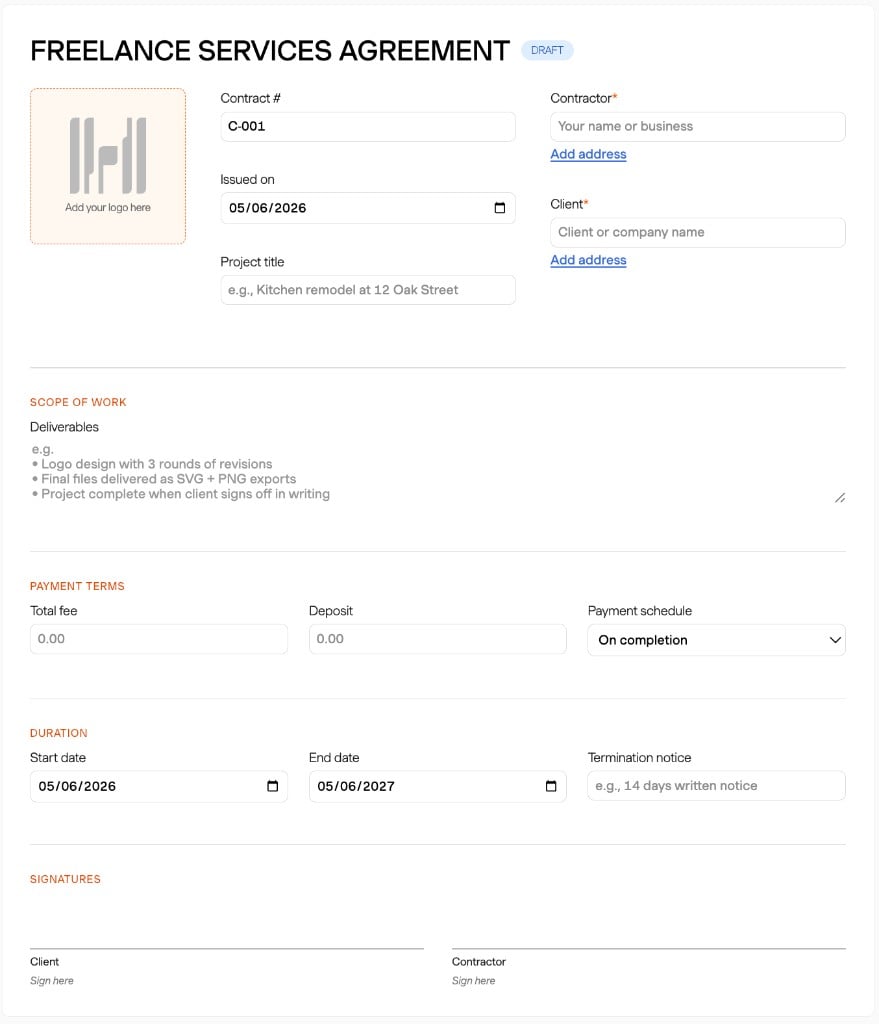
This preview showcases Harvest's tools for managing payment terms and project details within a Chinese service agreement.

Screenshot of Harvest's service agreement template in Chinese.

Service Agreement Template in Chinese FAQs

  • A Chinese service agreement must include clauses detailing the names and domiciles of parties, subject matter, quality, price, and dispute resolution methods. Ensuring these elements are clearly defined is crucial for legal compliance.

  • Yes, bilingual contracts are strongly recommended in China. It's important to specify which language prevails in case of discrepancies to avoid translation issues in legal disputes.

  • Harvest supports the management of financial and project aspects of service agreements in China, such as tracking payment terms and project details, which are crucial for maintaining contractual compliance.

  • The company chop (公章) is essential for the legal validity of contracts in China. It must be affixed to all official documents, ensuring enforceability and compliance with local practices.

  • Foreign companies often face challenges enforcing foreign judgments in China. It's crucial to adhere to local legal practices, such as using bilingual contracts and ensuring proper execution with the company chop.

  • Yes, electronic signatures are legally valid in China since 2004. However, a wet signature combined with the company chop is often considered more secure for enforceability.

  • Harvest provides flexibility in managing engagement terms for short-term projects by tracking time and project budgets, helping businesses align with contractual obligations effectively.