Harvest
Invoices
Sign up

Invoicing Software for Brazil

Harvest simplifies invoicing by automating processes and supporting XML formats, though it may require additional tools for full compliance with Brazilian e-invoicing regulations.

INVOICE DRAFT

Add your logo here
Item type
Description
Quantity
Unit price
Tax
Amount
Subtotal
$0.00
Discount
$0.00
Amount Due
$0.00
Get paid via:
Credit card / Debit card
ACH
Wire transfer

Customise invoice

Appearance

Add a logo
Show invoice title

Invoice settings

Tax Add up to 2 tax rates
%
Discount Apply a discount percentage
%

Key Features for Brazilian Compliance

Invoicing software for Brazil must inherently support the country's complex electronic fiscal document requirements. Crucially, the system needs to manage Nota Fiscal Eletrônica (NF-e) for goods and Nota Fiscal de Serviços Eletrônica (NFS-e) for services, which are fundamental for legal operation. The software must generate these documents in the specific XML format mandated by tax authorities, applying proper electronic signatures to ensure authenticity and integrity. Furthermore, seamless integration with federal (SEFAZ) and various municipal tax authorities is non-negotiable for real-time validation and authorization of fiscal documents. Ensure the solution can handle the distinct regulatory frameworks for each document type.
Essential Selection Criteria

Selecting the right invoicing software for Brazil hinges on its ability to automate compliance and adapt to the country's unique tax landscape.

  1. Automated Validation: The system should offer automated processes for e-invoice validation, performing pre-checks to prevent rejections and ensure immediate compliance with tax authority rules.
  2. Fragmented Tax System Handling: It must effectively manage Brazil's highly fragmented tax system, encompassing federal, state, and municipal taxes, which often vary significantly by location and the nature of the transaction.
  3. Five-Year Archiving: A robust solution will provide secure, long-term storage for all fiscal documents, adhering strictly to the five-year archiving requirement mandated by Brazilian law for audit purposes.

Look for features that simplify complex tax calculations and reporting across diverse jurisdictions.

Avoiding Common Pitfalls

Navigating Brazilian invoicing requires vigilance to avoid common pitfalls that can lead to significant operational disruptions and financial penalties. A primary challenge is ensuring real-time validation of e-invoices with tax authorities; any delays can halt business operations. Another frequent issue arises from integration across different municipalities for NFS-e, as each city may have unique technical standards and APIs, demanding a highly adaptable software solution. Critically, potential penalties for non-compliance with fiscal document requirements are severe, often calculated as a percentage of the invoice value (e.g., 10-50% of the transaction value) and can even lead to business suspension. Verify the software provides clear audit trails and robust error reporting to proactively address discrepancies.

See Your Brazilian Invoice Template in Action

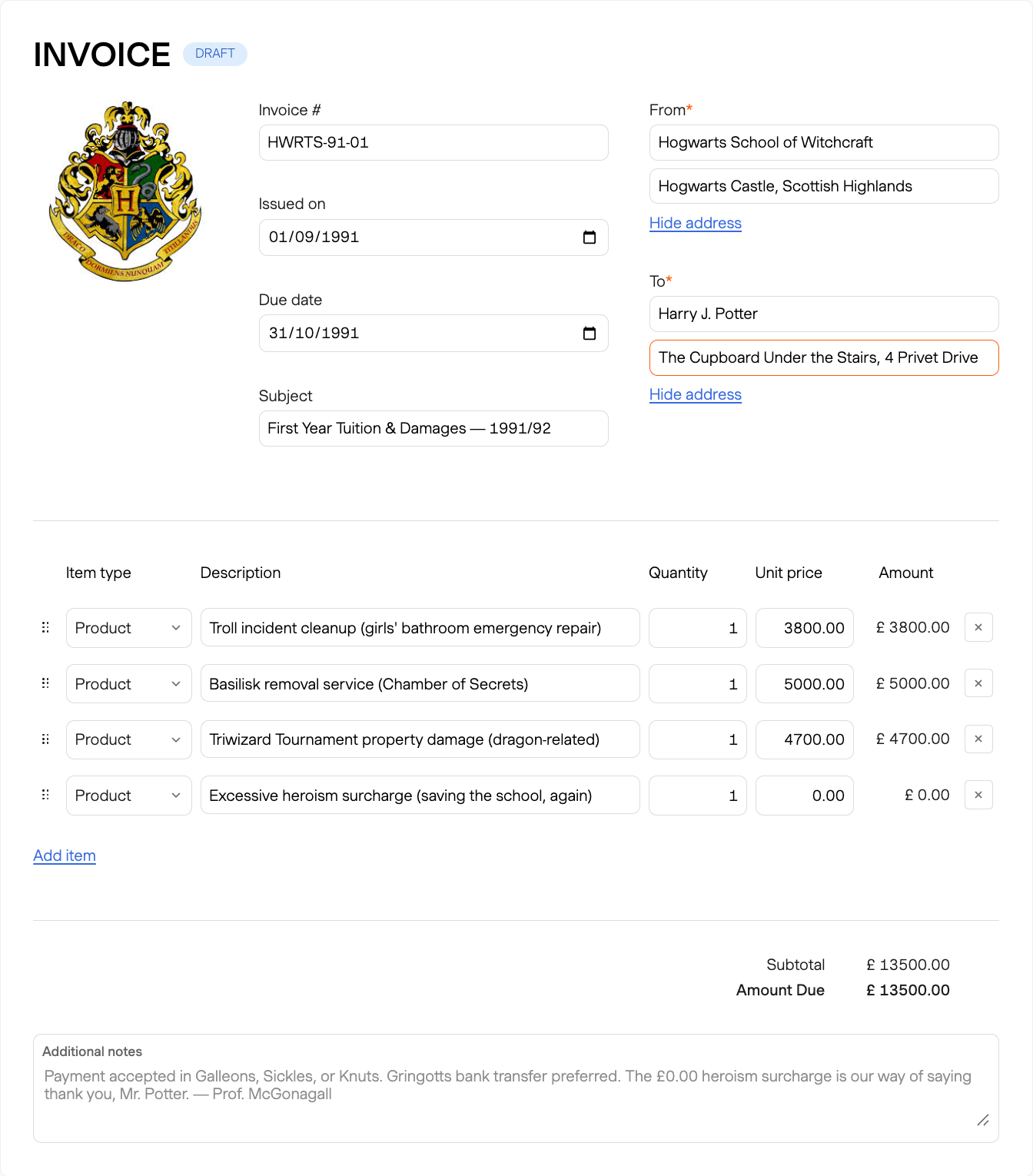
Preview how your invoice will look with Nota Fiscal Eletrônica (NF-e) and Nota Fiscal de Serviços Eletrônica (NFS-e) compliance, ready for Brazilian clients.

Invoicing Software for Brazil FAQs

  • Harvest automates invoice creation by generating invoices from tracked time and expenses, minimizing manual errors and enhancing efficiency.
  • Electronic signature requirements in Brazil involve the use of digital certificates to ensure the authenticity and integrity of electronic invoices. These signatures must comply with specific legal standards to be valid for tax purposes.
  • Yes, Harvest provides reporting features that allow you to analyze invoicing performance, including total amounts billed, outstanding invoices, and revenue trends over specific periods. These insights help you evaluate your business's financial health.
  • While invoicing software can streamline many compliance processes, full automation is challenging due to Brazil's diverse tax requirements across different jurisdictions. Manual oversight is often necessary to ensure complete compliance.
  • Businesses in Brazil are required to issue electronic invoices such as the Nota Fiscal Eletrônica (NF-e) for goods and Nota Fiscal de Serviços Eletrônica (NFS-e) for services. These invoices must comply with specific federal and municipal regulations.