
Harvest
Time Tracking
Sign up free

Billable Hours Calculator vs Time Tracker

Harvest simplifies invoicing and time tracking with real-time logging and detailed reporting, addressing revenue loss from inaccurate time records.

Try Harvest Free

How much revenue is your team leaving on the table?

Most agencies run at 55-60% utilization. Even a small improvement means significant revenue. See what closing the gap looks like for your team.

Number of people who track billable time
$
Blended rate across roles (junior, senior, lead)
55%
Percentage of total hours that are billable. Industry average is 55-60%.
75%
A realistic target for service businesses is 70-80%.
Monthly revenue gap $0
Revenue at current utilization $0/mo
Revenue at target utilization $0/mo
Extra billable hours needed per person/day 0h
Annual revenue opportunity $0

Start tracking team utilization

Walk through the entire flow below. Start a timer, check your reports, and create a real invoice — all in three clicks.

Go ahead — start tracking!

One click and you're timing. Try it right here: start a timer, add an entry, edit the details. This is exactly how it feels in Harvest.

  • One-click timer from browser, desktop & mobile
  • Works inside Jira, Asana, Trello, GitHub & 50+ tools
  • Duration or start/end — your call
  • Day, week & calendar views to stay on top of it all
  • Friendly reminders so no hour gets left behind
Acme Corp
Website Redesign
Homepage layout revisions
1:24:09
Content Strategy
Blog calendar planning
1:30:00
SEO Audit
Technical audit report
0:45:00
Brand Guidelines
Color system documentation
2:15:00
Logo Concepts
Initial sketches round 1
1:00:00

Understanding Billable Hours vs. Time Tracking

Understanding the distinction between billable hours and time tracking is crucial for optimizing your invoicing process. Billable hours represent the time spent on tasks directly chargeable to clients, such as meetings and project deliverables. Accurate management of these hours is vital, especially in industries like law, where firms may target 1,800 to 2,500 billable hours annually. In contrast, time tracking involves recording all work hours, whether billable or non-billable, to maintain a comprehensive view of resource allocation and productivity. Real-time tracking can prevent revenue leakage, which is a significant issue; lawyers who delay time logging can lose up to 50% of potential revenue annually.

While billable hours calculators are useful for post-tracking computations, they often lack the precision needed for real-time insights. Harvest excels in this area by offering one-click start/stop timers that automatically log time to projects, ensuring accuracy and preventing data loss. This capability is especially beneficial for industries with high utilization rates, such as consulting and law, where even a 15-minute under-recording daily can lead to over 60 hours of lost billable time per person each year.
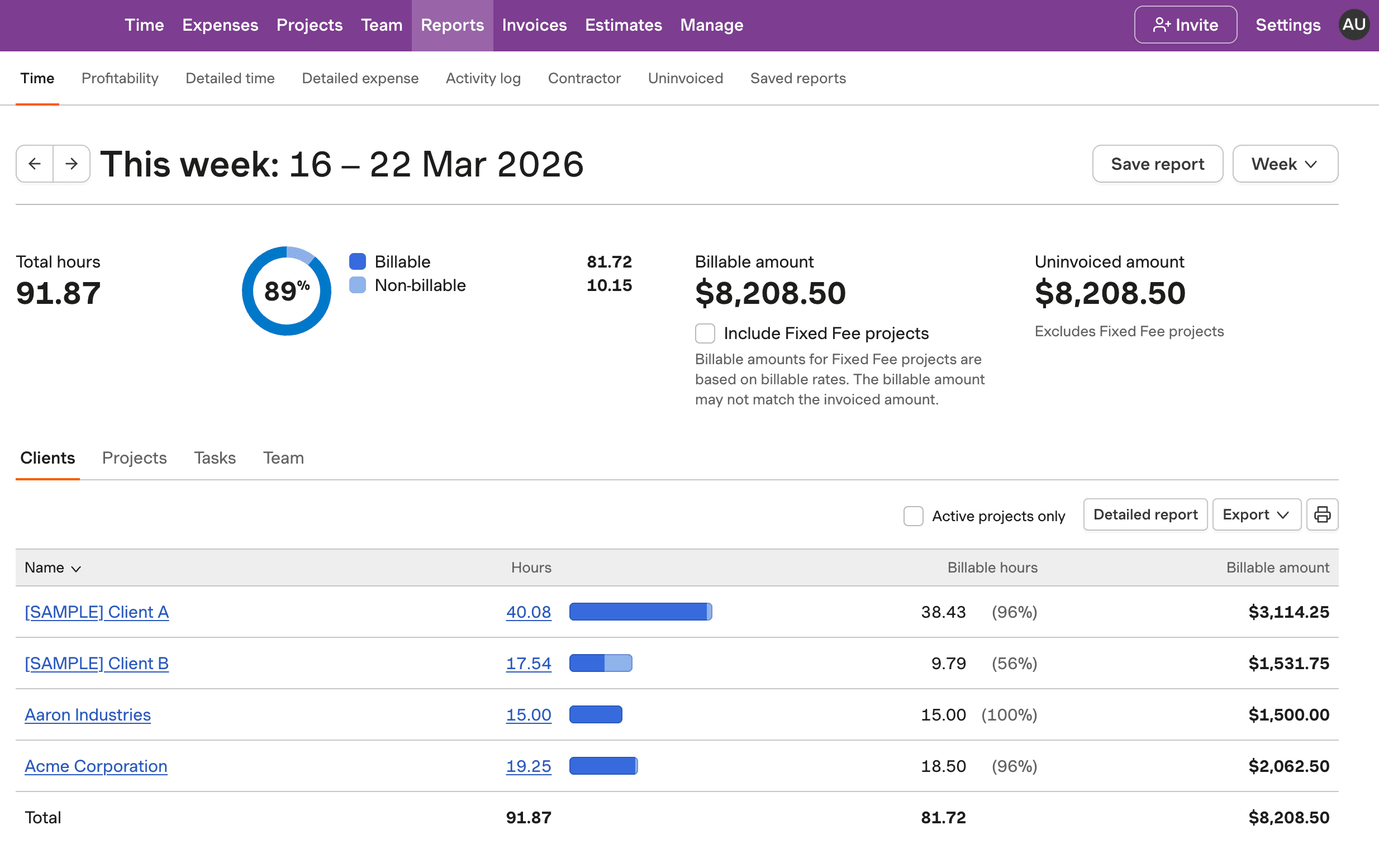
Choosing the Right Tool for Your Business Needs

When deciding between a billable hours calculator and a time tracker, consider your business's specific needs. Billable hours calculators are straightforward for computing fees after the fact, but they can miss nuances that impact profitability, such as non-billable time. Time trackers, like Harvest, provide a more holistic approach by capturing all work hours, enabling businesses to track billable and non-billable hours effectively. This comprehensive tracking aids in improving utilization rates, which are crucial for profitability. For instance, agencies typically target a utilization rate of 75%-85%, while freelancers aim for 60%-70% billable time.

Harvest not only tracks time but also integrates with tools like QuickBooks and Slack, facilitating seamless invoicing and team collaboration. This integration capability helps ensure that all tracked hours are accurately reflected in invoices, reducing the risk of revenue loss due to unbilled time. By providing detailed reports on time, expenses, and team utilization, Harvest empowers businesses to make informed decisions that enhance revenue generation.

Maximizing Efficiency with Time Tracking Software

Time tracking software offers significant advantages over traditional billable hours calculators by providing real-time data that informs resource management and client billing. For example, attorneys who track time in real-time capture up to 98% of their billable hours, significantly reducing the revenue loss associated with retrospective time logging. Harvest's real-time tracking eliminates the guesswork and errors commonly associated with manual time entry, helping firms meet high billable hour targets efficiently.

In addition to real-time tracking, Harvest's detailed reporting capabilities allow businesses to analyze work patterns, identify inefficiencies, and optimize workflows. This is particularly important in professional services where accurate billing and resource allocation are critical to maintaining profitability. By differentiating between billable and non-billable tasks, Harvest helps businesses focus on revenue-generating activities, ultimately enhancing their financial performance.

Integrating Time Tracking with Invoicing for Seamless Billing

Integrating time tracking with invoicing is essential for maintaining accurate financial records and client trust. Harvest offers a seamless integration by allowing users to convert tracked time directly into professional invoices, minimizing errors and ensuring that all billable work is accounted for. This integration is particularly beneficial in industries like law and consulting, where the complexity of billing can lead to significant revenue loss if not managed correctly.

Harvest's platform supports billing in industry-standard increments, such as six-minute intervals, to ensure fair and precise client billing. Moreover, its detailed reports provide insights into uninvoiced amounts and budget utilization, aiding in financial forecasting and client negotiations. By automating the invoicing process, Harvest streamlines administrative tasks, allowing professionals to focus more on delivering value to their clients.

Harvest: Time Tracking Simplified

See how Harvest tracks time and converts it to invoices, enhancing accuracy and profitability for your business.

Harvest time tracking and invoicing tool screenshot.

Billable Hours Calculator vs Time Tracker FAQs

  • Billable hours are the time spent on tasks that can be directly charged to a client, such as client meetings and project work. They are crucial for generating revenue in service-based industries.

  • Time tracking involves real-time logging of all work hours, providing comprehensive data for resource management. A billable hours calculator, on the other hand, computes fees after tracking is complete, often missing detailed insights.

  • Accurate time tracking prevents revenue loss by ensuring all billable work is accounted for. It helps firms meet targets and avoid losing up to 50% of potential revenue due to delayed logging.

  • Harvest offers one-click timers for real-time tracking, detailed reporting on billable and non-billable hours, and integration with billing tools, ensuring accurate and efficient management of billable hours.

  • Industries such as law, consulting, and design benefit significantly from time tracking software due to their reliance on billable hours for revenue. Accurate tracking aids in meeting utilization targets and optimizing profitability.

  • Yes, Harvest integrates with tools like QuickBooks, Slack, and Trello, facilitating seamless billing and team collaboration. This integration ensures accurate invoicing and efficient workflow management.

  • Best practices include real-time tracking, using consistent billing increments, differentiating billable from non-billable tasks, and providing detailed time entry descriptions to enhance transparency and accuracy.