
Harvest
Contracts
Sign up

Contract Generator for Freelancers

Freelancers often struggle with manual contract generation, leading to errors and disputes. Harvest supports freelancers by tracking time and managing projects, complementing contract needs.

Start from a template

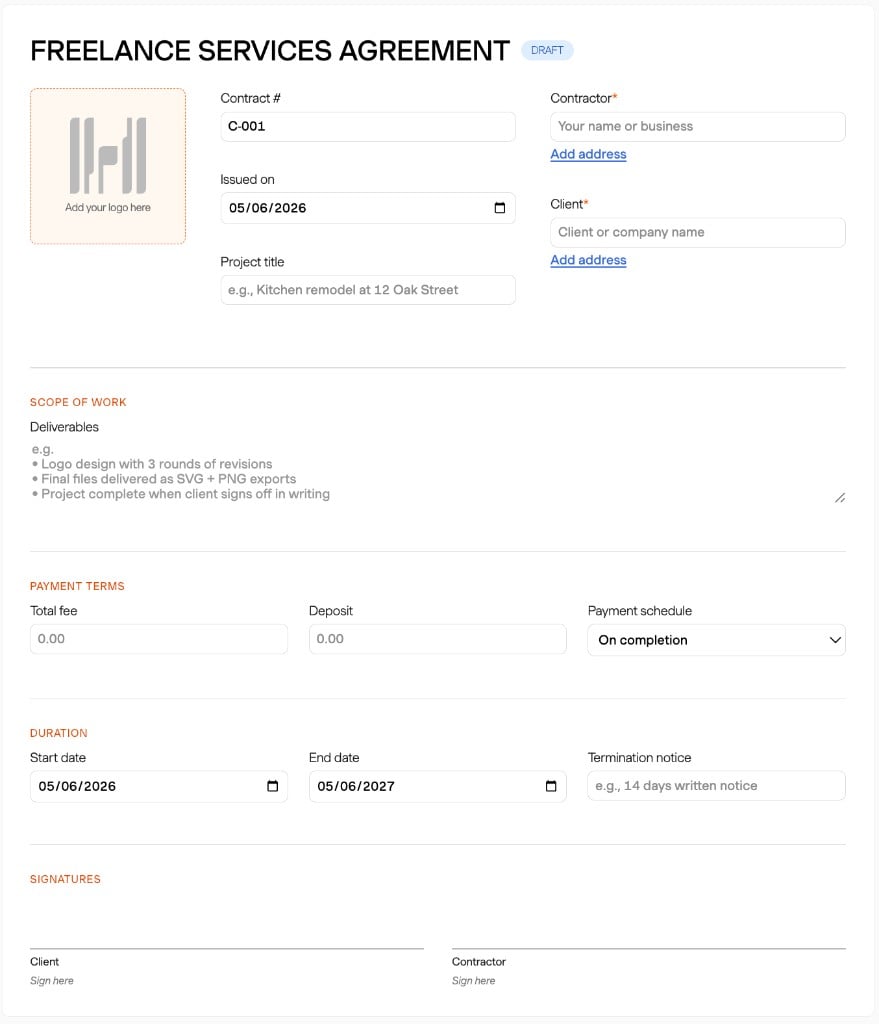
AGREEMENT DRAFT

Add your logo here

Scope of work

Payment terms

Duration

Signatures

Client

Sign here

Contractor

Sign here

Get paid via:
Credit card / Debit card
ACH
Wire transfer

Customize contract

Appearance

Add a logo
Show contract title

Contract settings

Include payment terms Total fee, deposit, and schedule
Include termination clause Notice required to end the contract
Include signature blocks Both parties sign at the bottom

The Importance of Contracts for Freelancers

For freelancers, having a well-drafted contract is crucial to protect both their work and financial interests. Contracts help clarify the scope of work, payment terms, and intellectual property rights, reducing the risk of disputes. According to industry experts, vagueness in contracts, such as unclear scope and expectations, is often a leading cause of freelance disputes. Moreover, lacking a signed contract or relying on client-created agreements can result in payment issues and intellectual property disputes, with many freelancers facing challenges due to insufficient legal safeguards.

In the growing freelance economy, where over 13% of the UK workforce are independent contractors, ensuring detailed contracts become even more essential. Contracts need to include specific elements like precise project descriptions, payment schedules, and confidentiality agreements. While many freelancers make the mistake of not having a signed agreement, leveraging contract generators can help mitigate these risks by providing customizable templates tailored to different types of freelance work.

Challenges in Manual Contract Generation

Manual contract generation is often fraught with inefficiencies and errors, leading to time-consuming processes that can hamper business agility. According to World Commerce and Contracting, inefficiencies in contract management cost companies approximately 9% of their bottom line. Many traditional methods involve drafting contracts from scratch, which can take weeks, particularly for new client relationships.

Freelancers, especially in creative and IT sectors, face unique challenges such as 'scope creep,' where the amount of work increases without a corresponding change in payment. This often results from vague contract terms that do not clearly define deliverables or revision limits. By integrating modern contract generation processes, freelancers can ensure their contracts are precise, reducing the risk of scope creep. While Harvest doesn't offer contract generation, it supports freelancers by tracking time and managing project budgets, ensuring they stay on track financially.

Customizing Contracts for Different Freelance Projects

Customization of contracts is vital for freelancers who deal with varied projects and clients. Different industries have specific requirements; for example, creative freelancers often need inclusion of clauses about design revisions and content ownership, while IT freelancers might focus on software deliverables and technical support. Contracts should be adaptable to include these industry-specific clauses, ensuring they are comprehensive and cater to each unique project.

Freelancers are encouraged to develop a contract template that can be modified for each client and project, thus saving time and effort. By tying payments to clear triggers, such as milestones or deliverables, freelancers can maintain cash flow and client commitment. Although Harvest does not provide contract customization, it aids freelancers in managing project budgets and tracking time, offering a financial overview that complements the contractual elements of project management.

Legal Considerations for Freelance Contracts

Freelancers must navigate a complex landscape of legal requirements that differ by region. In the US, freelancers vary in classification under laws like the Fair Labor Standards Act and must adhere to local laws such as California's Freelance Worker Protection Act. Similarly, UK freelancers must comply with contract law and tax legislation, including IR35 rules, which ensure correct classification for tax purposes.

To ensure compliance, freelancers should include essential clauses in their contracts, like confidentiality agreements and explicit IP assignment clauses. Legal complexities underscore the importance of having a robust contract in place before starting work, as misclassifications can lead to significant penalties. While Harvest focuses on time tracking and invoicing, freelancers should seek legal advice or use specialized contract generation tools to ensure their contracts meet local legal standards.

The Role of Technology in Contract Management

Technology plays a pivotal role in streamlining contract management for freelancers. Modern contract generation platforms can integrate with business systems like CRM and e-signature tools, automating data population and reducing manual errors. This integration can significantly cut down processing time from weeks to mere hours, enhancing efficiency.

Freelancers can leverage these tools to automate contract workflows, ensuring that all necessary fields are accurately filled, and reminders are set for signature completion. While Harvest does not offer contract generation, its tools for time tracking, expense management, and invoicing help freelancers maintain financial clarity and efficiency throughout their projects. By using Harvest, freelancers can focus on delivering quality work while keeping track of their project finances effectively.

Explore Harvest's Tools for Freelancers

See how Harvest's time tracking and project management tools support freelancers in managing their contracts and projects efficiently.

Contract generator interface for freelancers using Harvest.

Contract Generator for Freelancers FAQs

  • A freelance contract should include clear definitions of the scope of work, payment terms, timelines, confidentiality clauses, and intellectual property rights. It's essential to customize these elements for each project to prevent disputes and ensure both parties have a mutual understanding.

  • Yes, many contract generators offer templates tailored to various industries, such as creative, IT, and consulting. These templates often include industry-specific clauses, making it easier to create comprehensive contracts quickly.

  • To ensure compliance, freelancers should include clauses required by local laws, such as payment terms and confidentiality agreements. Consulting a legal professional or using a contract tool that supports local compliance can help keep your contracts legally sound.

  • Absolutely. Customizing contracts for each client or project is important to address specific needs and expectations. This can include adding clauses for specific deliverables, payment schedules, and revision limits.

  • Scope creep occurs when the project's requirements expand without corresponding changes in budget or timelines. To avoid this, contracts should clearly define the scope of work, including the number of revisions and deliverables.

  • Technology can streamline contract management by integrating with CRM and e-signature tools, reducing manual errors, and speeding up processing times. These tools help automate workflows, ensuring accuracy and efficiency.