
Harvest
Contracts
Sign up

Contract Template for Drilling Contractors

Harvest helps drilling contractors streamline time tracking and invoicing, enabling them to focus on operational efficiency and project success.

Start from a template

AGREEMENT DRAFT

Add your logo here

Scope of work

Payment terms

Duration

Signatures

Client

Sign here

Contractor

Sign here

Get paid via:
Credit card / Debit card
ACH
Wire transfer

Customize contract

Appearance

Add a logo
Show contract title

Contract settings

Include payment terms Total fee, deposit, and schedule
Include termination clause Notice required to end the contract
Include signature blocks Both parties sign at the bottom

Understanding Essential Clauses in Drilling Contracts

Drilling contracts are vital agreements that establish the framework for drilling operations, detailing the rights and responsibilities of both the operator and the contractor. Essential clauses in these contracts include the scope of work, which outlines the specific tasks the contractor will perform, and payment terms, which define how and when the contractor will be compensated. Additionally, drilling contracts often incorporate performance standards, setting benchmarks for operational efficiency and safety.

A critical component is the indemnity clause, which allocates risks related to personal injury, property damage, and other liabilities. Notably, some U.S. states have enacted statutes like the Texas Oilfield Anti-Indemnity Act (TOAIA), which limits the enforceability of certain indemnity provisions, ensuring a fair distribution of risk. This highlights the importance of understanding regional legal requirements when drafting or using drilling contracts.

Moreover, the contract should specify termination conditions, allowing both parties to understand the circumstances under which the contract can be ended. By including these elements, drilling contracts provide a comprehensive framework that governs the operational and financial aspects of drilling projects, safeguarding both parties' interests.

Choosing the Right Type of Drilling Contract

In the drilling industry, selecting the appropriate contract type is crucial for aligning operational goals and risk management between operators and contractors. Three primary types of contracts are commonly used: Daywork, Footage, and Turnkey. Each type allocates risk and control differently, catering to specific project needs.

Daywork contracts are prevalent, compensating contractors on a daily rate and allowing operators more control over the drilling process. In contrast, Footage contracts pay contractors per foot drilled, shifting more risk to the contractor but potentially incentivizing faster drilling speeds. Meanwhile, Turnkey contracts offer a fixed price for drilling to a specified depth, with the contractor assuming significant risk and control.

The choice between these contracts depends on factors such as project complexity, risk tolerance, and budget. For instance, operators might prefer Daywork contracts for projects with uncertain conditions, while Footage or Turnkey contracts might be suitable for well-defined projects with predictable risks. Understanding these options helps contractors and operators tailor contracts to their specific needs, ensuring project success.

Legal Considerations in Drilling Contracts

Legal considerations are paramount when drafting or using drilling contracts, as they define the contractual obligations and risk allocations. Drilling contracts are legally binding documents that must comply with state and federal laws, including anti-indemnity statutes. For example, the Louisiana Oilfield Indemnity Act (LOIA) restricts certain indemnity agreements, ensuring that liability is fairly distributed between parties.

Additionally, contracts should specify the governing law and jurisdiction, providing clarity on where legal disputes will be resolved. This is particularly important for contracts involving offshore drilling operations, where U.S. admiralty and maritime laws might apply. Ensuring that indemnity clauses are "specific and conspicuous" is also crucial, as these clauses protect parties from unforeseen liabilities.

To avoid legal pitfalls, it is advisable to consult with legal professionals when drafting drilling contracts. This ensures that the contract not only adheres to legal standards but also effectively manages risk, safeguarding both operators and contractors during drilling operations.

Customizing Contract Templates for Drilling Projects

Customizing contract templates for drilling projects is essential to address specific operational needs and legal requirements. A well-tailored contract template should include clear definitions of key terms, precise language to avoid ambiguities, and specific provisions that align with the project's scope and objectives.

For instance, performance standards such as cycle time and tripping speeds can be incorporated into the contract to incentivize efficiency and safety. Moreover, including a Definitions section can clarify terms and prevent misunderstandings. It's also crucial to consider state-specific laws that may impact contract terms, especially indemnity provisions.

Operators and contractors should collaborate closely to customize contract templates, ensuring that all parties' interests are adequately represented and protected. By doing so, they can create robust contracts that facilitate successful project execution and minimize the risk of disputes.

Avoiding Common Pitfalls in Drilling Contracts

Drilling contracts are complex documents that require careful drafting to avoid common pitfalls. One frequent mistake is the use of vague or ambiguous language, which can lead to disputes and litigation. To mitigate this risk, contracts should employ clear and precise language, outlining specific responsibilities and obligations of each party.

Another common issue is the failure to include termination and breach clauses. These clauses are essential for defining the conditions under which the contract can be terminated or breached, providing a clear process for dispute resolution. Additionally, ensuring that the contract aligns with regulatory requirements is crucial, as non-compliance can result in significant legal and financial repercussions.

To prevent these pitfalls, it's advisable to engage legal professionals in the contract drafting process and to conduct thorough reviews of contract terms. This proactive approach ensures that contracts are comprehensive, enforceable, and conducive to successful drilling operations.

Streamline Contracts with Harvest

Explore Harvest's contract template designed for drilling contractors, ensuring comprehensive coverage of essential clauses.

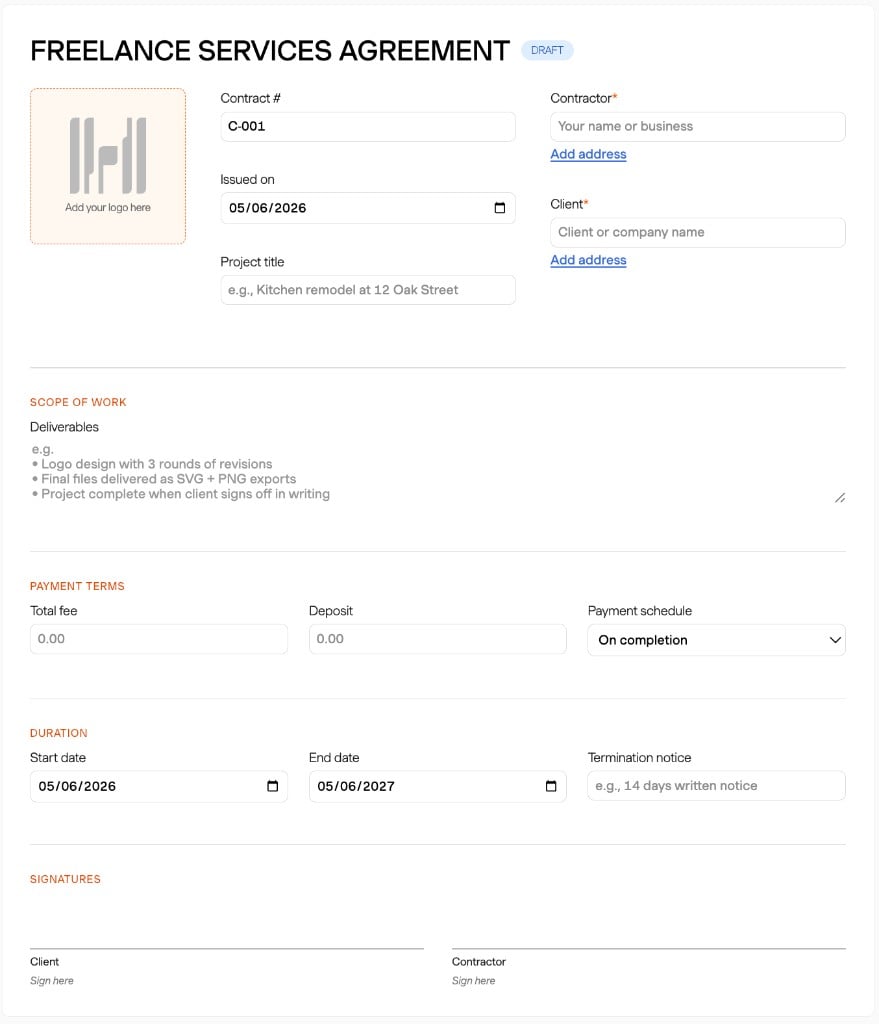
Screenshot of contract template for drilling contractors in Harvest.

Contract Template for Drilling Contractors FAQs

  • Essential clauses in a drilling contract include the scope of work, payment terms, performance standards, indemnity clauses, and termination conditions. These elements ensure clear responsibilities and risk management between parties.

  • Yes, standard templates like those from the International Association of Drilling Contractors (IADC) are widely used. However, larger operators may develop proprietary forms to better suit specific project needs.

  • Customizing a drilling contract template involves adding specific performance standards, clear definitions, and considering regional legal requirements. Collaboration with legal experts ensures the template meets all necessary conditions.

  • Legal considerations include compliance with state and federal laws, clear indemnity clauses, and specifying governing law and jurisdiction. Consulting legal professionals ensures the contract is enforceable and protects all parties.

  • Common pitfalls include vague language, lack of termination clauses, and non-compliance with regulations. Clear, precise language and legal consultation help avoid these issues.

  • Drilling contracts come in three main types: Daywork, Footage, and Turnkey. Each type allocates risk and control differently, suiting various project needs and risk tolerances.

  • Customizing drilling contracts is important to address specific operational and legal requirements, ensuring that the contract aligns with project goals and minimizes risks.