
Harvest
Contracts
Sign up

Contract Template in French

Navigating French contract requirements can be complex, but Harvest supports your business by streamlining time tracking and invoicing, ensuring clarity and accountability.

Start from a template

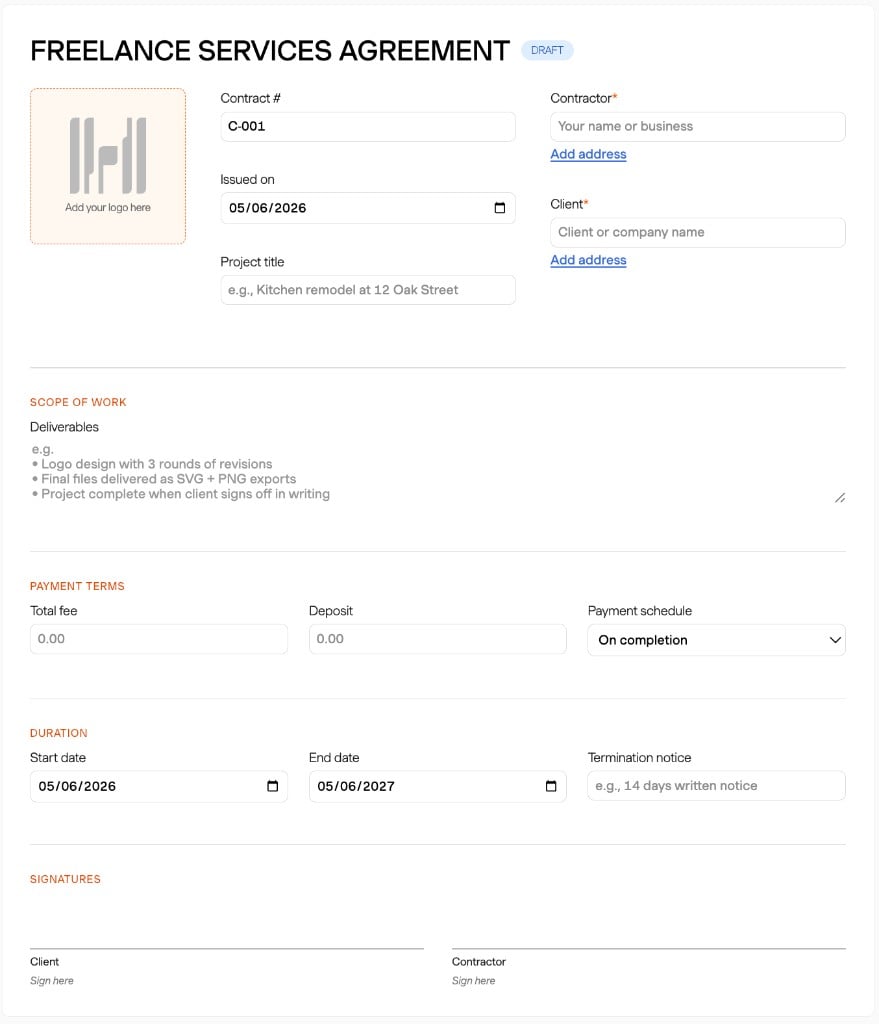
AGREEMENT DRAFT

Add your logo here

Scope of work

Payment terms

Duration

Signatures

Client

Sign here

Contractor

Sign here

Get paid via:
Credit card / Debit card
ACH
Wire transfer

Customize contract

Appearance

Add a logo
Show contract title

Contract settings

Include payment terms Total fee, deposit, and schedule
Include termination clause Notice required to end the contract
Include signature blocks Both parties sign at the bottom

Understanding French Contract Templates

French contract templates are essential tools for businesses operating within or with partners in France. These templates provide a structured framework to ensure agreements comply with the rigorous standards set by French law. The 2016 reform of the French Civil Code significantly impacted contract law, introducing doctrines such as "hardship," which allows for renegotiation under unforeseen circumstances. This ensures contracts can adapt to changing conditions, a crucial feature given that 58% of professionals face payment disputes without written agreements.

French contracts must incorporate specific legal clauses to be enforceable. These include identifying the parties involved, detailing the contract’s purpose, and specifying payment terms. The inclusion of clauses for governing law, termination conditions, and confidentiality is also crucial. The emphasis on precision in these documents cannot be overstated; vague language can lead to disputes, which can be costly and time-consuming. With well-structured contracts reducing conflicts by 72%, the importance of clarity and thoroughness is evident.

Key Components of a Bilingual French Contract Template

Creating a bilingual French contract template involves more than just translation; it requires ensuring that both language versions are legally coherent and aligned. French law mandates contracts over EUR 1,500 to be written, highlighting the need for precise documentation. Additionally, certain contracts, like labor agreements, must legally be drafted in French, especially when dealing with Francophone parties or consumers.

Essential components of a French contract template include explicitly defining the scope of work, payment terms, intellectual property rights, and dispute resolution mechanisms. Including a clause that specifies which language version prevails in the event of discrepancies is a best practice. This is particularly important for international agreements where multiple jurisdictions might be involved. Legal experts recommend collaborating with French law professionals to ensure compliance and mitigate potential risks.

Customizing Your French Contract Template

Customization is crucial when using a French contract template. Each contract should reflect the particularities of the agreement, from basic information to specific financial terms and obligations. For instance, freelance contracts should incorporate details about mission scope and payment scheduling, while rental agreements must adhere to specific legal formats post-Loi ALUR.

To effectively customize a contract, start by clearly identifying all parties and defining the purpose of the contract. Include payment terms, such as amounts and deadlines, and specify the governing law. In case of potential disputes, a mediation clause can be advantageous, as 89% of conflicts resolve before reaching litigation. This proactive approach not only aligns with French cultural preferences for formal agreements but also ensures legal robustness.

Legal and Compliance Considerations

Compliance with French legal standards is non-negotiable when drafting contracts. The French Civil Code governs contractual obligations, emphasizing principles like good faith and mutual consent. Contracts often require adherence to mandatory legal provisions, particularly in employee rights and commercial obligations.

For employment contracts, the importance of integration with business processes cannot be overstated. These contracts must align with French labor laws and applicable Collective Bargaining Agreements to avoid significant legal penalties. Additionally, GDPR compliance is essential for any contract involving personal data, necessitating clear statements on data processing and rights. Regularly reviewing and updating contracts ensures they remain compliant with evolving legal landscapes.

Harvest and Contract Management

While Harvest does not directly offer contract templates, it plays a vital role in managing the operational aspects that follow contractual agreements. For businesses using contracts to outline project scopes and payment terms, Harvest supports these processes with effective time tracking and invoicing solutions.

By using Harvest, contractors and businesses can seamlessly track time spent on contracted projects and ensure accurate billing. This integration of time tracking with invoicing helps maintain financial clarity and accountability, crucial for sustaining the benefits of well-structured contracts. Although Harvest is not a legal tool, its capabilities complement the contract management process by streamlining the financial management aspects.

Streamline Contracts with Harvest

Explore how Harvest aids in managing contracts efficiently through time tracking and invoicing.

Screenshot of Harvest's time tracking and invoicing features related to French contracts.

Contract Template in French FAQs

  • A French contract should include key clauses such as identifying parties, defining the contract's purpose, specifying payment terms, and outlining conditions for termination and confidentiality. Clarity is crucial to avoid disputes.

  • Yes, certain contracts, like labor agreements and those concerning property in France, must be drafted in French. This ensures compliance with local laws and facilitates understanding among French-speaking parties.

  • Customization involves inserting specific details such as party information, financial terms, and obligations. It's important to reflect the unique aspects of the agreement to ensure clarity and legal compliance.

  • Common pitfalls include using vague language, failing to comply with mandatory legal provisions, and neglecting to include dispute resolution mechanisms. Precise language and compliance are essential for effective contracts.

  • Harvest helps businesses manage contracts by offering tools for time tracking and invoicing. This ensures accurate billing and financial clarity, complementing the benefits of well-structured contracts.

  • The hardship doctrine allows contract renegotiation if unforeseeable changes make performance excessively onerous. This ensures contracts can adapt to significant changes, safeguarding both parties' interests.

  • GDPR requires contracts involving personal data to include statements on data processing, transfers, and rights. Compliance with GDPR is crucial for legal validity and protecting data subjects' rights.