
Harvest
Contracts
Sign up

Plumbing Contract Template

Harvest provides a practical solution for time tracking and invoicing, essential for managing plumbing contracts efficiently. By streamlining these processes, Harvest helps plumbers avoid costly misunderstandings and streamline operations.

Start from a template

AGREEMENT DRAFT

Add your logo here

Scope of work

Payment terms

Duration

Signatures

Client

Sign here

Contractor

Sign here

Get paid via:
Credit card / Debit card
ACH
Wire transfer

Customize contract

Appearance

Add a logo
Show contract title

Contract settings

Include payment terms Total fee, deposit, and schedule
Include termination clause Notice required to end the contract
Include signature blocks Both parties sign at the bottom

Understanding the Essentials of a Plumbing Contract

A well-crafted plumbing contract is essential to prevent misunderstandings and disputes in plumbing projects. These contracts clearly define the scope of work, pricing, timelines, and legal protections for all parties involved. According to industry experts, a comprehensive contract serves as the first line of defense against disputes, ensuring that all parties have a mutual understanding of the project's details. This is particularly important, as misunderstandings regarding the scope of work and pricing are common challenges in plumbing projects.

For plumbers, having a detailed written agreement can prevent disputes over unexpected charges or services by outlining what is included and excluded in the contract. This clarity is crucial not only for residential plumbing but also for commercial and government contracts, where the stakes and complexities are often higher. By clearly spelling out tasks, materials, exclusions, and payment terms, businesses can avoid costly disputes and maintain positive client relationships.

Incorporating digital tools for contract management can further streamline these processes. Digital solutions offer features such as e-signatures and template automation, which can significantly increase average revenue—as reported by some businesses, by as much as 21% in their first two years. Leveraging such technology can enhance efficiency and ensure compliance with contractual obligations.

Key Components to Include in Your Plumbing Contract

When drafting a plumbing contract, it's vital to include specific components to safeguard both the contractor and the client. Industry experts recommend that contracts clearly outline the scope of work, payment terms, warranties, and procedures for dispute resolution. This thoroughness helps prevent potential disputes and ensures smooth project execution.

Important elements to include are client and business information, a detailed list of materials and equipment, and the service frequency and duration. Additionally, contracts should set clear pricing and payment terms, including deposit amounts, final payment schedules, and due dates. Legal professionals often advise including termination clauses to protect both parties in case of unforeseen circumstances.

To enhance enforceability and protection, plumbing contracts should also include proof of professional licensure, bond, and insurance. This not only ensures legal compliance but also instills confidence in clients, knowing that the contractor is qualified and covered for potential liabilities.

Customizing Your Plumbing Contract for Various Jobs

Plumbing contracts need to be adaptable to suit different types of plumbing jobs, whether they are residential, commercial, or government-related. Customization begins with tailoring the scope of work to the specific requirements of each project. This involves detailing the tasks, materials, and timelines particular to the job at hand.

For residential projects, contracts might focus on repair, maintenance, or installation services, addressing common household issues like leaks, which can waste up to 9,400 gallons of water annually if not promptly repaired. In contrast, commercial and government contracts may require more extensive specifications due to the scale and complexity of projects, such as new installations in large buildings or public infrastructure projects.

Leveraging digital templates allows for easy customization and ensures that all necessary components are included. Additionally, integrating contracts with other business processes, such as invoicing and scheduling, can help streamline operations, reduce manual errors, and improve overall efficiency. Implementing digital solutions can also facilitate easier updates and renewals of contracts, ensuring they remain compliant with evolving industry standards and legal requirements.

Legal Considerations for Plumbing Contracts

Legal compliance is a critical aspect of plumbing contracts that cannot be overlooked. In the USA, plumbing contractors must adhere to state-specific licensing laws, which vary significantly across states. For instance, Washington's Chapter 18.106 RCW outlines specific requirements for plumbing contractors, while California's upcoming home improvement contract laws will introduce additional transparency requirements starting January 1, 2026.

In the UK, compliance with the Health and Safety at Work Act 1974 and the Construction (Design and Management) Regulations 2015 is mandatory. Contracts should reference each party's duty to comply with these regulations to avoid legal repercussions. Specific plumbing work, such as new installations, also requires adherence to Building Regulations 2010 and Water Supply (Water Fittings) Regulations 1999, which may necessitate notifying local authorities or water companies.

Failure to comply with these regulations can result in significant penalties, including fines and legal action. Therefore, ensuring that your plumbing contracts include necessary legal documentation and compliance measures is imperative for smooth operations and to protect against potential liabilities.

Streamline Your Plumbing Contracts with Harvest

Harvest offers customizable plumbing contract templates to ensure clarity and compliance, supported by efficient time tracking and invoicing tools.

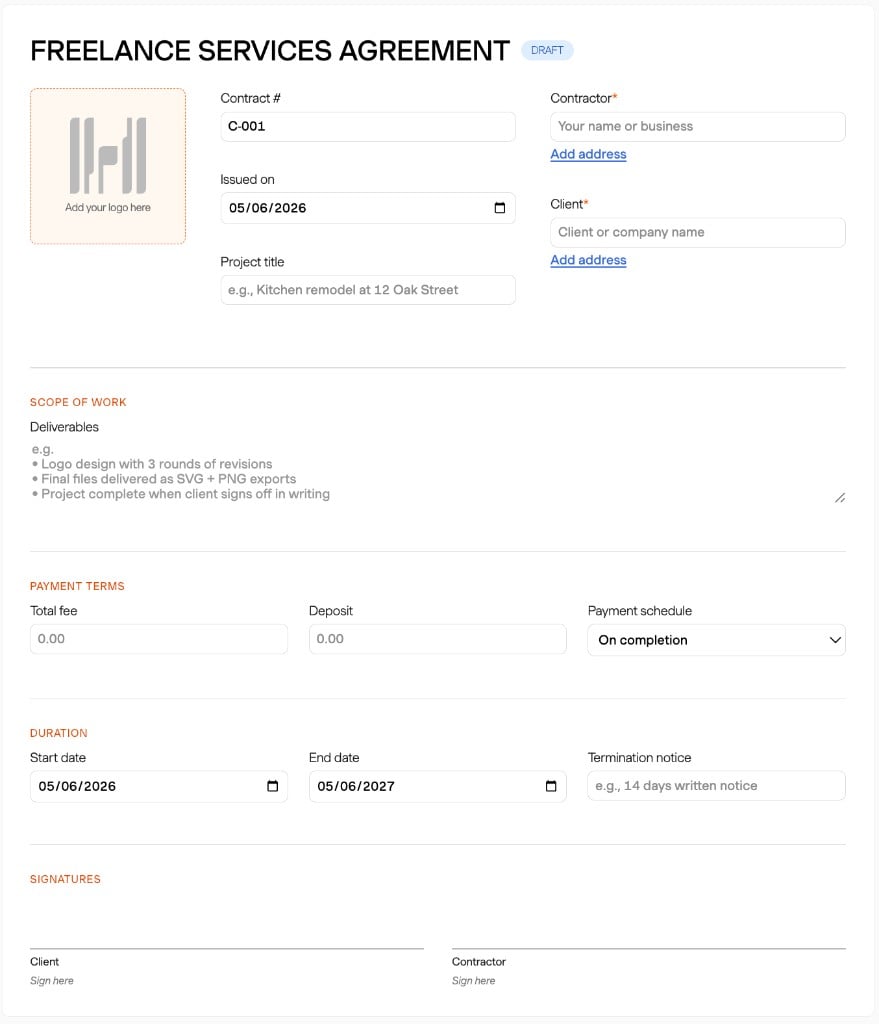
Screenshot of a customizable plumbing contract template in Harvest.

Plumbing Contract Template FAQs

  • A plumbing contract should include the scope of work, payment terms, warranty information, and dispute resolution procedures. It's essential to outline the tasks, materials, and timelines specific to the project to prevent misunderstandings.

  • To customize a plumbing contract template, begin by tailoring the scope of work and materials to the specific job. Use digital templates to easily update sections like client information, pricing, and payment terms, ensuring all legal and compliance aspects are covered.

  • Yes, plumbing contracts must comply with local and state regulations. In the USA, this includes state-specific licensing laws, while in the UK, compliance with the Health and Safety at Work Act 1974 and Building Regulations is required. Including proof of licensure, bond, and insurance is also recommended.

  • Yes, plumbing contract templates can be customized for various job types, whether residential, commercial, or government projects. Adjust the scope of work, materials, and timelines to suit the specific requirements of each project.

  • Common clauses in plumbing contracts include scope of work, payment terms, warranty details, and termination clauses. These help define responsibilities and protect both parties from potential disputes.

  • Digital contract management streamlines processes, reduces manual errors, and integrates with other business tools like invoicing and scheduling software. Businesses have reported increased revenue by adopting such solutions, with some seeing a 21% rise in two years.

  • Avoid failing to define the scope of work clearly, neglecting to outline payment terms, and not addressing necessary permits. Ensure contracts are detailed, legally compliant, and reviewed by a professional if needed.