
Harvest
Contracts
Sign up

Contract Template in German

Navigating German contracts can be complex. Harvest simplifies the process by aiding time tracking and invoicing, ensuring projects stay on track and within budget.

Start from a template

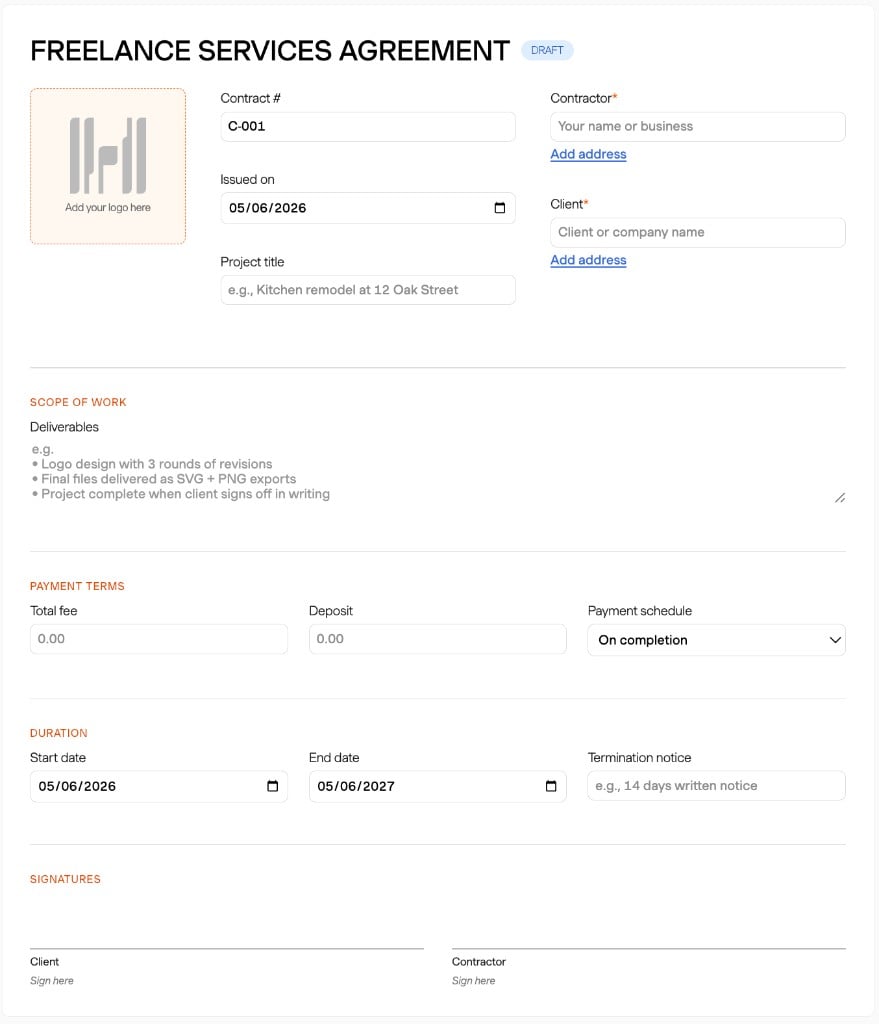
AGREEMENT DRAFT

Add your logo here

Scope of work

Payment terms

Duration

Signatures

Client

Sign here

Contractor

Sign here

Get paid via:
Credit card / Debit card
ACH
Wire transfer

Customize contract

Appearance

Add a logo
Show contract title

Contract settings

Include payment terms Total fee, deposit, and schedule
Include termination clause Notice required to end the contract
Include signature blocks Both parties sign at the bottom

Understanding the German Contract Template Landscape

In Germany, using a contract template in German can be a valuable resource for businesses and individuals who need to create formal agreements. The German legal system is known for its predictability, enforceability, and affordability, making it a preferred choice for many. Contracts drafted under German law are typically concise yet comprehensive, which helps in maintaining clarity and reducing potential disputes. However, it is important to note that while many contracts can be concluded orally or electronically, written agreements are recommended for legal certainty and evidence.

Employment contracts, for instance, must include essential details such as the names and addresses of the parties involved, start date, place of work, a job description, working hours, remuneration, and termination procedures. Since January 2025, essential terms for permanent contracts can be provided in text form, but fixed-term contracts still require a written format. Non-compliance with the German Verification Act can result in significant fines, emphasizing the importance of adherence to these requirements.

Leveraging Contract Templates for Various Needs

Contract templates in German are particularly advantageous for streamlining the drafting process across various industries. Whether for employment, rental, or service agreements, these templates offer a practical starting point. They are designed to include standard clauses that meet legal requirements, ensuring that users comply with German law while saving time on drafting from scratch. For example, in the healthcare sector, new standard contractual clauses introduced in 2025 have helped streamline clinical trial agreements, reducing negotiation times significantly.

However, while templates provide a foundation, they are not a substitute for legal advice. It is crucial for users to customize these templates to suit their specific needs and consult legal experts to ensure all obligatory clauses are included and compliance with current laws is achieved. This customization is particularly important given the diverse requirements across different types of contracts, such as employment or rental agreements.

Digital Solutions and Compliance in Contract Management

The adoption of digital solutions in contract management is a growing trend in Germany, driven by the need for efficiency and compliance. Cloud-based Contract Management Systems (CMS) are gaining popularity due to their scalability and flexibility, allowing businesses to manage contracts effectively without heavy infrastructure costs. In fact, the cloud segment accounted for over 68% of the contract management software market in 2024, underscoring a strong preference for these solutions.

Moreover, compliance with regulatory changes is crucial. With the ongoing digital transformation under initiatives like "Industry 4.0," businesses must ensure their contracts reflect current legal standards. For instance, by June 2026, online businesses must integrate a two-click cancellation function into their websites, highlighting the importance of keeping contracts up-to-date with legal requirements. As such, leveraging digital solutions can significantly aid in maintaining compliance and enhancing overall contract management efficiency.

The Role of Harvest in Complementing Contract Management

While Harvest is not a dedicated contract management tool, it complements contract-related workflows by supporting time tracking and invoicing, which are integral to many contractual agreements. For businesses that rely on contracts to define project scopes and deliverables, Harvest provides visibility into time spent on tasks, helping ensure that projects remain on track and within budget.

Moreover, Harvest's invoicing capabilities streamline the billing process, ensuring that contractual terms regarding payments are adhered to efficiently. By integrating these functionalities, businesses can enhance their contract management processes, making it easier to track project progress and ensure timely payments. Harvest’s tools, therefore, serve as a valuable addition to the overall contract management strategy, especially for service-based industries.

Harness Harvest for German Contracts

Discover how Harvest complements German contract management with efficient time tracking and invoicing solutions.

Screenshot of Harvest's time tracking and invoicing for German contracts.

Contract Template in German FAQs

  • In Germany, employment contracts must include the names and addresses of both parties, start date, place of work, job description, working hours, remuneration, and termination procedures. Compliance with these elements is crucial to avoid fines under the German Verification Act.

  • Contract templates should be tailored to fit specific contractual needs. While templates provide a foundation, consulting a legal expert to ensure compliance with current laws and inclusion of obligatory clauses is recommended.

  • In Germany, most contracts can be concluded orally or electronically, but written contracts are recommended for legal certainty. Certain transactions, such as real estate transfers, require a written or notarial form.

  • Harvest supports contract management by providing time tracking and invoicing tools. These features help businesses manage project scopes, track time, and ensure timely invoicing, complementing contract management processes.

  • Cloud-based Contract Management Systems (CMS) are popular in Germany for their scalability and flexibility. They help businesses manage contracts efficiently, adapting to regulatory changes and business needs.

  • Rental contracts in Germany must adhere to specific legal standards, including clauses on rent, duration, and tenant rights. Using a template can help ensure these are met, but legal advice is recommended for customization.

  • Written contracts provide legal certainty and serve as evidence in disputes. While oral and electronic contracts are valid, having a written document is a best practice to ensure clarity and compliance.