
Harvest
Contracts
Sign up

Create a Plumbing Contract

Harvest simplifies time tracking and invoicing for plumbing businesses, reducing administrative burdens and ensuring accurate billing.

Start from a template

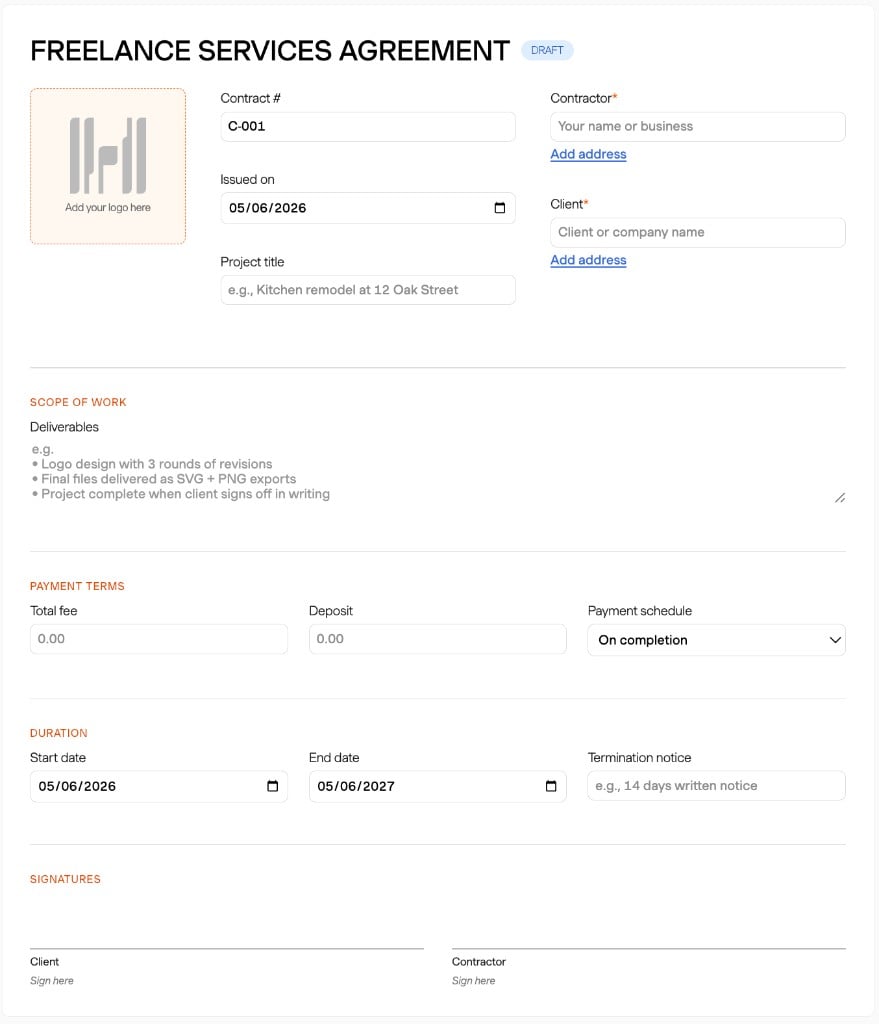
AGREEMENT DRAFT

Add your logo here

Scope of work

Payment terms

Duration

Signatures

Client

Sign here

Contractor

Sign here

Get paid via:
Credit card / Debit card
ACH
Wire transfer

Customize contract

Appearance

Add a logo
Show contract title

Contract settings

Include payment terms Total fee, deposit, and schedule
Include termination clause Notice required to end the contract
Include signature blocks Both parties sign at the bottom

Essential Components of a Plumbing Contract

Creating a comprehensive plumbing contract is crucial for defining the scope of work, setting expectations, and ensuring both parties are on the same page. A well-structured contract typically includes identifying details of the parties involved, a detailed scope of work, and a list of required materials and equipment. It's important to clearly describe all plumbing tasks, including diagnostic steps, repairs, and installations, to prevent misunderstandings.

Further, contracts should specify timelines and payment terms. This means outlining estimated start and completion dates, along with milestone dates for larger projects. Payment terms should include the total cost, deposit requirements, milestone payments, and accepted payment methods. Explicitly stating what's not included in the contract can prevent disputes over expectations and costs.

Lastly, a plumbing contract should include warranties and liability clauses, termination clauses, and be signed by both parties. Including workmanship warranties and manufacturer warranties can provide peace of mind for clients. Termination clauses should outline conditions for ending the agreement, notice periods, and handling of deposits.

Common Mistakes When Drafting Plumbing Contracts

Avoiding common pitfalls when drafting a plumbing contract can save both time and resources. One frequent mistake is relying on verbal agreements. These can lead to disputes over what was agreed upon, making written contracts essential for clarity and legal protection. Another issue is vague descriptions in the scope of work, which can lead to 'scope creep' and client dissatisfaction. Being specific about tasks, materials, and exclusions is essential.

Failing to secure necessary permits can result in fines and project delays. It's important to address permit requirements in the contract and clarify who is responsible for obtaining them. Additionally, using overly technical language can make the contract difficult to understand. It's more effective to use clear, everyday language to ensure both parties comprehend the terms.

Furthermore, not allowing clients ample time to review the contract before signing can appear unprofessional. Providing time for review and feedback helps build trust and ensures both parties are comfortable with the agreement.

Leveraging Digital Tools for Contract Efficiency

Integrating digital tools into your plumbing business can significantly streamline contract management. Field Service Management (FSM) software allows for the creation, storage, e-signing, and tracking of digital agreements, reducing the time spent on administrative tasks. This digital transformation can help eliminate inefficiencies related to manual contract management, such as chasing signatures or tracking renewals.

Additionally, estimating software that integrates with contracts can streamline the bidding process, allowing you to generate accurate bids quickly. By connecting pricing directly to invoices and utilizing job costing features, businesses can enhance efficiency and accuracy in financial management. This integration can lead to increased transparency, enhanced reporting, and streamlined workflows across all operational levels.

Harvest can further support your business by offering time tracking and invoicing capabilities, ensuring that you can manage time and expenses effectively and maintain accurate invoicing processes. This enables plumbing businesses to focus more on service delivery and less on administrative burdens.

Legal Considerations for Plumbing Contracts

Understanding the legal framework surrounding plumbing contracts is critical for compliance and risk mitigation. In the U.S., federal and public works plumbing contracts must adhere to regulations like the Federal Acquisition Regulation (FAR), the Davis-Bacon Act, and the Miller Act, which often require payment and performance bonds. These regulations underscore the importance of ensuring compliance with federal and state-specific requirements.

Licensing is another crucial aspect; most U.S. states require plumbing contractors to obtain a license before offering services. The requirements vary by state, with some states demanding contractors pass specific exams and obtain insurance. For instance, California requires plumbers to pass a Law & Business Exam and Plumbing Trade Exam, and provide proof of insurance.

Moreover, plumbing contracts should confirm that the contractor carries all required insurance, such as general liability and workers' compensation. This not only protects the business but also reassures clients of the contractor's professionalism and commitment to safety standards.

Enhancing Client Relationships Through Detailed Contracts

Detailed plumbing contracts can enhance client relationships by preventing misunderstandings and ensuring transparency. Clear contracts help outline what is included in the scope of work, the expected timelines, and any payment schedules, which can lead to increased client satisfaction. This transparency is crucial in building trust and mitigating disputes.

Additionally, well-drafted contracts can reflect a plumbing business’s professionalism, attracting better clients and contributing to a more stable business. They serve not only as a legal safeguard but also as a testament to the business's commitment to quality and customer satisfaction. By outlining protections that limit financial exposure, contracts can prevent partners from being personally liable for business debts or lawsuits.

Harvest can play a role in maintaining these relationships by providing tools for accurate time tracking and invoicing, ensuring clients are billed correctly and promptly, which is essential for maintaining a healthy cash flow and strong client relationships.

Create Plumbing Contracts with Harvest

See how Harvest facilitates time tracking and invoicing for plumbing contracts, ensuring precision and efficiency.

Screenshot of Harvest's time tracking and invoicing tools for plumbing contracts.

Create a Plumbing Contract FAQs

  • A plumbing contract should include the identification of parties, a detailed scope of work, materials, timelines, payment terms, warranties, and termination clauses. This ensures clarity and prevents misunderstandings.

  • Yes, plumbing contracts often need to comply with federal, state, and local regulations. This includes licensing, insurance, and permit requirements, which vary by location. Compliance ensures legal protection and operational legitimacy.

  • To customize a plumbing contract template, start by adding specific details about the project scope, materials, timelines, and payment terms. Ensure it meets local legal requirements and consider seeking legal review for important agreements.

  • A written plumbing contract provides legal protection, clarifies expectations, and prevents disputes over scope, pricing, and project timelines. It serves as a professional agreement that outlines the responsibilities of both parties.

  • Common pitfalls include relying on verbal agreements, vague scope descriptions, ignoring permits, and using overly technical language. These can lead to disputes, delays, and misunderstandings, so clarity and thoroughness are critical.

  • Digital tools, like Field Service Management software, streamline contract management by enabling digital creation, e-signing, and tracking. This reduces administrative burdens and increases efficiency.

  • Harvest helps plumbing businesses by providing seamless time tracking and invoicing solutions, ensuring accurate billing and efficient administrative processes. This allows more focus on service delivery.

  • When setting payment terms, specify the total cost, deposit requirements, milestone payments, and accepted payment methods. Clear terms help prevent disputes and maintain healthy cash flow.