
Harvest
Contracts
Sign up

Contract Template in Portuguese

Navigating the complexities of contract templates in Portuguese can be daunting. Harvest offers tools to streamline your workflow, ensuring efficiency and compliance.

Start from a template

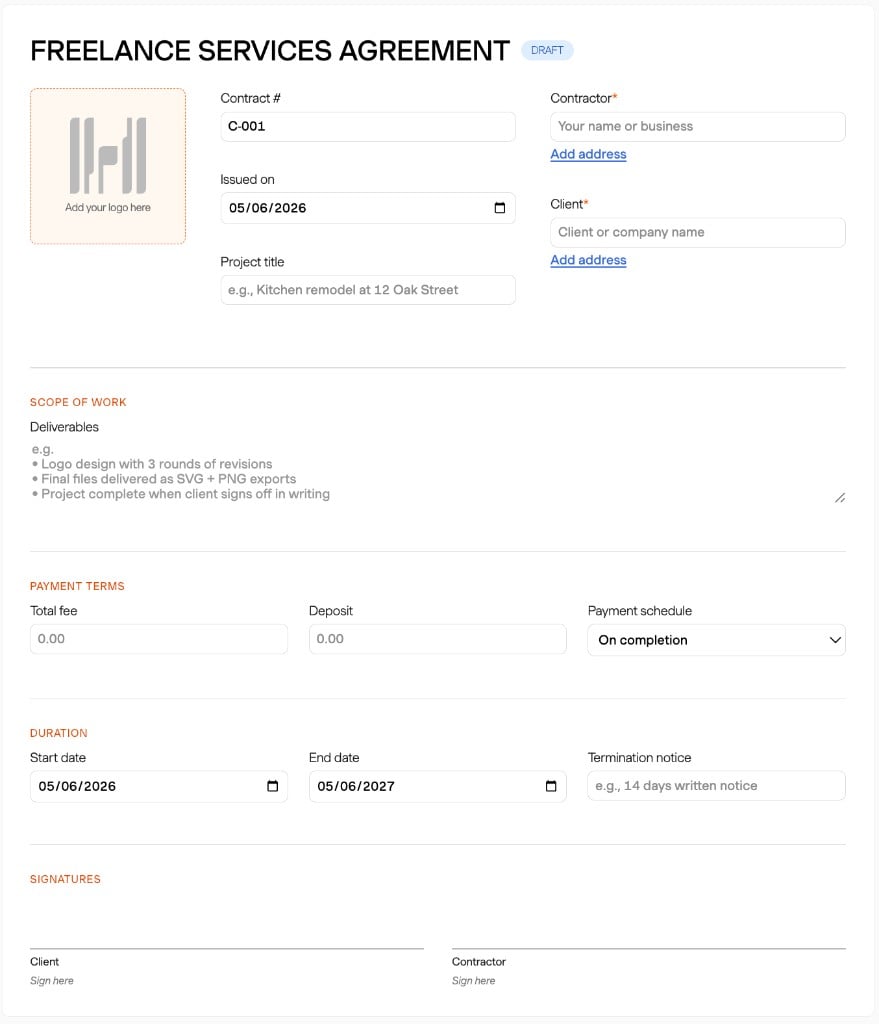
AGREEMENT DRAFT

Add your logo here

Scope of work

Payment terms

Duration

Signatures

Client

Sign here

Contractor

Sign here

Get paid via:
Credit card / Debit card
ACH
Wire transfer

Customize contract

Appearance

Add a logo
Show contract title

Contract settings

Include payment terms Total fee, deposit, and schedule
Include termination clause Notice required to end the contract
Include signature blocks Both parties sign at the bottom

Understanding Portuguese Contract Requirements

When crafting a contract template in Portuguese, it's crucial to understand the specific legal requirements that govern these documents in Portugal. The Labor Code of the Portuguese Republic mandates that certain types of employment contracts, such as fixed-term or part-time agreements, must be in writing. These contracts should include essential details like the parties' names, job descriptions, and termination terms. Failure to comply with these stipulations can lead to legal complications and non-compliance with local regulations.

Moreover, contracts in Portugal often need to adhere to additional rules, particularly when they involve data privacy or international elements. For instance, the General Data Protection Regulation (GDPR) applies to any contract involving personal data processing. Ensuring that your contract template aligns with these guidelines is essential for legal acceptance and operational efficiency.

Leveraging Bilingual Templates for Clarity

For international agreements, especially those involving foreign nationals residing in Portugal, using bilingual contract templates can be highly advantageous. These templates, typically available in Portuguese and English, help ensure clarity for all parties involved. They are particularly beneficial for agreements requiring registration with the Portuguese tax authority, such as long-term rental contracts.

However, it's important to note that in legal disputes, the Portuguese version of a contract usually holds precedence. This makes it imperative to ensure that the Portuguese version is accurate and comprehensive. Employing bilingual templates not only aids understanding but also facilitates compliance with local legal requirements, thus minimizing potential legal risks.

The Role of Technology in Contract Management

The digital transformation of contract management is reshaping how businesses handle legal agreements. With 44% of Chief Legal Officers planning to increase their technology investments by 2025, tools that enhance operational efficiency, such as contract management systems, are becoming indispensable. These systems streamline the drafting process, reduce the time spent on contract creation, and ensure consistency across all agreements.

For instance, the Brazilian banking sector has seen a significant shift towards digital contracts, with 63% of new accounts opened through digital channels in 2021. This trend underscores the growing importance of adopting digital solutions in contract management to stay competitive and compliant.

Customization and Legal Oversight

While contract templates provide a solid foundation, customization is key to meeting specific business needs and legal requirements. Each contract should be tailored to address unique project or client stipulations, ensuring all necessary clauses are included and the agreement complies with relevant laws.

Moreover, legal experts emphasize the importance of involving qualified professionals in the contract drafting process. This ensures that the templates are not only legally sound but also adaptable to the dynamic legal and technological landscapes. Regular reviews and updates to contract templates are crucial to maintaining compliance with evolving regulations, such as the GDPR in the EU.

Practical Tips for Effective Contract Use

Implementing contract templates effectively requires attention to detail and a commitment to regular updates. To avoid ambiguities, contracts should clearly articulate terms and conditions, including payment schedules, deadlines, and penalties for non-compliance. This clarity helps prevent disputes and ensures smooth execution.

Additionally, for digital contracts in Brazil, it's best to include clauses acknowledging electronic signatures, referencing Provisional Measure 2200-2/2001. This practice not only legitimizes the contract but also aligns it with the latest technological standards. By doing so, businesses can leverage technology to enhance contract management efficiency and reduce legal risks.

Explore Harvest's Contract Solutions

Discover how Harvest can assist in creating and managing contract templates in Portuguese, ensuring compliance and clarity.

Contract template in Portuguese interface on Harvest platform.

Contract Template in Portuguese FAQs

  • In Portugal, contracts must adhere to the Labor Code and include key details such as party names, job descriptions, and termination terms. Compliance with GDPR is also essential for contracts involving personal data.

  • Bilingual templates, typically in Portuguese and English, are beneficial for clarity in international agreements. However, the Portuguese version usually holds legal precedence.

  • Technology, such as contract management systems, enhances efficiency by streamlining the drafting process and ensuring consistency. It also helps businesses stay competitive and compliant with digital transformations.

  • Customization ensures that contracts meet specific business needs and legal requirements. Tailoring templates helps include necessary clauses and address unique project or client stipulations.

  • A Portuguese employment contract should include party names, job title, salary, work schedule, and termination terms. Compliance with the Labor Code is essential.

  • In Brazil, digital contracts are becoming prevalent, especially in sectors like banking. They often include clauses acknowledging electronic signatures, aligning with Provisional Measure 2200-2/2001.

  • Legal oversight ensures that contract templates are legally sound and adaptable to changing regulations. It helps avoid ambiguous or non-compliant clauses, safeguarding against potential disputes.