
Harvest
Contracts
Sign up

Sow Template

Harvest enables contractors to efficiently manage projects by tracking time, expenses, and budgets, providing clarity and control even without specific SOW templates.

Start from a template

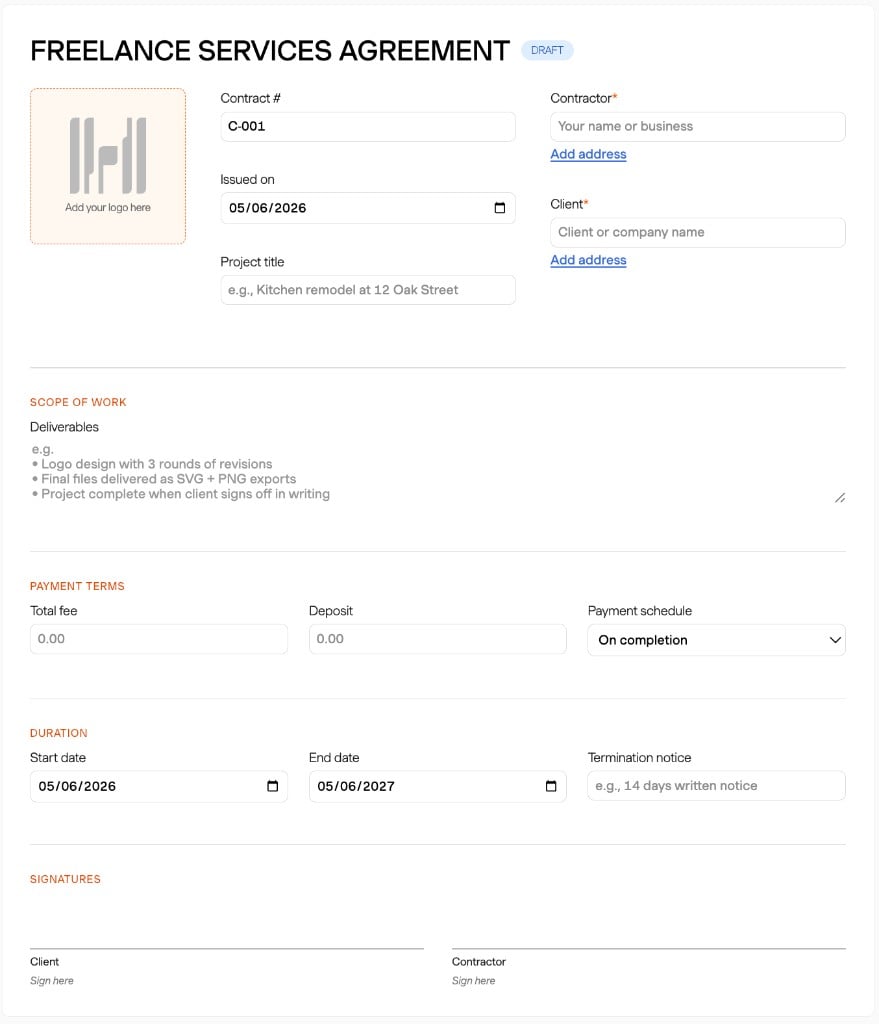
AGREEMENT DRAFT

Add your logo here

Scope of work

Payment terms

Duration

Signatures

Client

Sign here

Contractor

Sign here

Get paid via:
Credit card / Debit card
ACH
Wire transfer

Customize contract

Appearance

Add a logo
Show contract title

Contract settings

Include payment terms Total fee, deposit, and schedule
Include termination clause Notice required to end the contract
Include signature blocks Both parties sign at the bottom

Understanding the Importance of a Statement of Work (SOW)

A Statement of Work (SOW) is a critical document in project management that outlines the scope, deliverables, timelines, and responsibilities for a project. This document acts as a blueprint for success, ensuring all parties involved have a clear understanding of what is expected. Industry research shows that organizations using standardized project management practices, including SOWs, are 2.3 times more likely to succeed in their projects. This demonstrates the value of having a well-structured SOW in place to prevent misunderstandings and scope creep.

However, relying on generic SOW templates can lead to inefficiencies. Studies have found that teams waste over 15 hours per week managing "template chaos," which includes version control issues and manual customizations. To avoid these pitfalls, it's crucial to customize SOWs to fit the specific needs of a project. This customization process can be streamlined with tools that integrate with existing project management systems, reducing errors and improving clarity.

Key Components of an Effective SOW

Creating an effective SOW involves several key components that ensure clarity and specificity. The document should include a detailed scope of work, clear deliverables, and a realistic timeline. Each deliverable must have measurable, achievable, relevant, and time-bound (SMART) acceptance criteria to eliminate ambiguity. Additionally, a well-defined change management process is essential to manage scope changes without disrupting the project.

Research indicates that poorly defined SOWs can result in financial losses of up to 9% of contract value due to ineffective contract management. Therefore, integrating SOWs with contract lifecycle management systems can help maintain consistency and reduce drafting time. This integration allows organizations to automate review and approval workflows, ensuring that all necessary legal and contractual clauses are included and up-to-date.

Types of SOWs and Their Application

Different types of SOWs cater to various project needs, each with its own focus and application. For instance, Design/Detail SOWs are common in construction and government contracts where precise specifications are necessary. Performance-Based SOWs, on the other hand, emphasize desired outcomes and are suitable for projects that require flexibility, such as marketing campaigns or software development.

Time and Materials SOWs are ideal for projects with evolving requirements, such as consulting or IT support, where scope may change over time. Selecting the right type of SOW is crucial, as it directly impacts project execution and risk management. By choosing the appropriate SOW type, organizations can better align their project goals with execution strategies, thereby reducing the likelihood of project failure due to misaligned expectations or unclear deliverables.

How Harvest Supports Project Management

While Harvest does not offer specific SOW templates, it plays a pivotal role in project management by helping businesses track time, expenses, and budgets effectively. Harvest's tools are designed to provide visibility into project performance, allowing contractors to monitor progress and adjust resources as needed to stay on track.

By integrating with existing project management systems, Harvest helps businesses maintain budgetary control and ensure that all billable hours are accurately tracked, which is crucial for aligning with the financial aspects of an SOW. This integration can significantly reduce the administrative burden associated with manual tracking and improve overall project efficiency.

Practical Tips for Using SOW Templates

To make the most of an SOW template, follow a structured drafting process. Begin by gathering requirements from all stakeholders, then choose the appropriate SOW type for your project. Draft the SOW using clear and consistent language, and review it with relevant parties to ensure accuracy.

Incorporate visuals such as charts and diagrams to clarify complex information, making the document easier to navigate. Finally, integrate the SOW with project management platforms to track progress and manage tasks effectively. By following these steps, organizations can create an SOW that not only outlines project expectations but also supports successful execution and delivery.

Explore Harvest's Project Management Tools

Harvest supports effective project management by tracking time, expenses, and budgets. Customize your SOW for success with Harvest's tools.

Harvest project management interface showing SOW tracking.

Sow Template FAQs

  • A Statement of Work (SOW) is a document that outlines the scope, deliverables, timelines, and expectations for a project. It serves as a blueprint for project execution, ensuring all parties are aligned on objectives and responsibilities.

  • To use a SOW template effectively, customize it to fit your project's specific needs. Include detailed scopes, deliverables, timelines, and acceptance criteria. Review with stakeholders and integrate with management tools for tracking.

  • The key components of an SOW include a detailed scope of work, deliverables, timelines, acceptance criteria, and a change management process. These elements help prevent misunderstandings and scope creep.

  • Harvest supports your SOW process by tracking project time, expenses, and budgets. While it doesn't provide SOW templates, it helps manage the financial aspects and monitor project performance effectively.

  • Yes, SOW templates can be customized for different industries by adapting the scope, deliverables, and requirements to fit specific project needs, such as construction, IT, or marketing projects.

  • There are several types of SOWs, including Design/Detail, Performance-Based, and Time and Materials SOWs. Each type suits different project needs, such as construction, marketing, or consulting.

  • Avoid vague scopes and unclear deliverables. Use specific, measurable criteria and establish a clear change management process to prevent misunderstandings and manage scope changes.

  • Reviewing an SOW with stakeholders ensures that all parties have a clear understanding of project expectations and responsibilities. This collaborative approach helps prevent misunderstandings and aligns project goals.