
Harvest
Contracts
Sign up

Independent Contractor Agreement Template in Korean

Navigating the complexities of independent contractor agreements in South Korea is crucial for compliance. Harvest helps contractors manage workflows, ensuring efficient time and expense tracking.

Start from a template

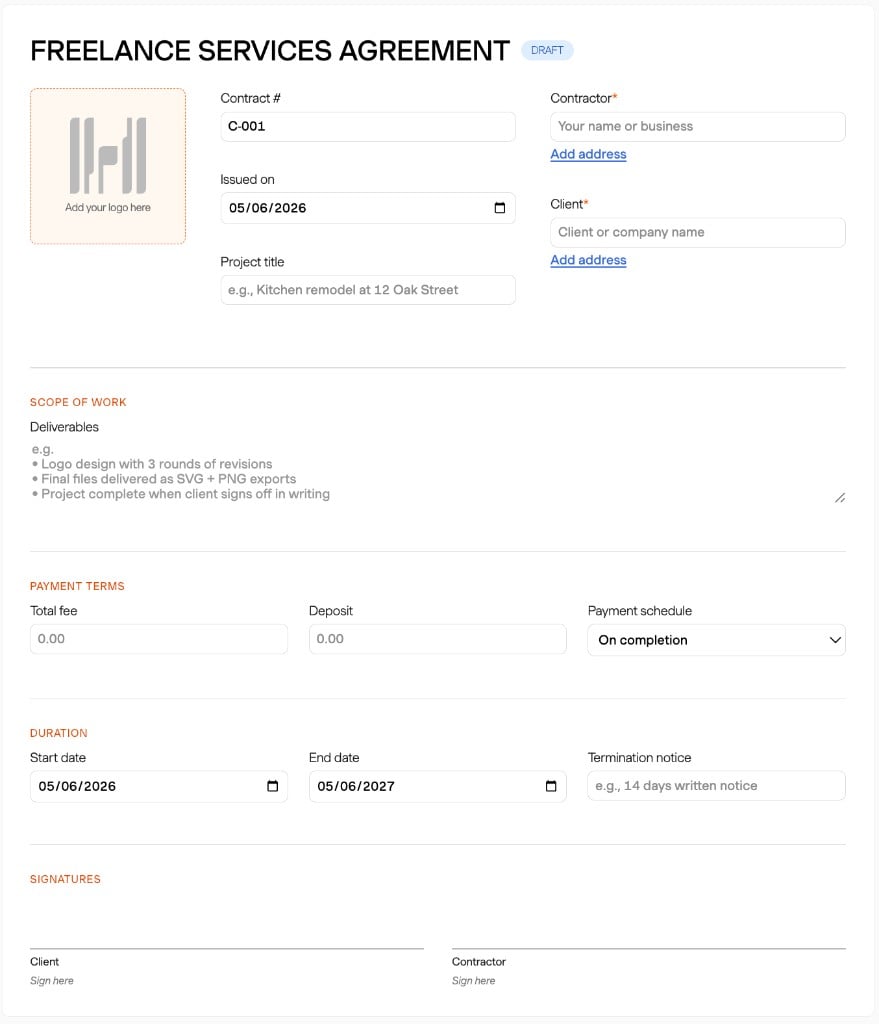
AGREEMENT DRAFT

Add your logo here

Scope of work

Payment terms

Duration

Signatures

Client

Sign here

Contractor

Sign here

Get paid via:
Credit card / Debit card
ACH
Wire transfer

Customize contract

Appearance

Add a logo
Show contract title

Contract settings

Include payment terms Total fee, deposit, and schedule
Include termination clause Notice required to end the contract
Include signature blocks Both parties sign at the bottom

Understanding Independent Contractor Agreements in South Korea

Independent contractor agreements in South Korea are essential for ensuring compliance with the country's legal framework. As the gig economy expands, with a 38.6% increase in gig workers over five years, having a well-drafted agreement is crucial. These agreements must clearly outline the contractor's status, scope of work, payment terms, and other key conditions. Compliance with the Korean Civil Code is necessary, as misclassifying workers can lead to significant legal and financial penalties. For instance, misclassification can result in fines, back payments, and tax audits.

When drafting an agreement, include clauses that specify the contractor's independent status, deliverables, payment schedules, and intellectual property rights. Additionally, confidentiality and non-compete clauses protect both parties' interests. It's important to review these agreements periodically to ensure they align with current legal requirements and accurately reflect the working relationship. Businesses are advised to maintain comprehensive documentation to support the classification of workers as independent contractors.

Legal Considerations for Independent Contractors in South Korea

In South Korea, distinguishing between an independent contractor and an employee is critical, as it impacts legal rights and obligations. Courts assess factors like control over work, integration into the business, and economic dependency to classify workers. Recent legal changes, effective May 1, 2026, presume anyone providing labor to a business is an employee unless proven otherwise, shifting the burden of proof to employers. This highlights the importance of accurately classifying workers to avoid penalties.

Contractors must understand their tax responsibilities, which include managing income tax and social security contributions. For example, the National Pension Service contributions will increase from 9% to 13% by 2033. Clients typically withhold 3.3% of payments as an advance on taxes. Legal experts recommend seeking professional guidance to navigate these complexities and mitigate misclassification risks, especially given the evolving labor frameworks.

Common Mistakes in Drafting Korean Contractor Agreements

Avoiding common pitfalls in drafting contractor agreements is crucial for compliance and maintaining a business's legal standing. A significant mistake is not clearly defining the contractor's independent status, which can lead to misclassification as an employee. Misclassification can result in administrative fines and back payments for unpaid wages and benefits. Additionally, providing company equipment or dictating work hours can blur the line between contractor and employee.

To avoid these issues, agreements should explicitly state that the contractor is not an employee and outline their autonomy in service delivery. Businesses should also avoid "command-and-control" structures, ensuring contractors have the freedom to manage their work and accept other clients. Regular audits of employment arrangements can help ensure compliance with current regulations. Maintaining thorough records and evidence of independent contractor status is vital in case of legal scrutiny.

The Role of Harvest in Managing Contractor Workflows

While Harvest does not provide legal templates for South Korean contractor agreements, it supports contractors in managing essential workflows. Harvest offers tools for tracking time, managing expenses, and invoicing, which are critical for independent contractors handling multiple projects. This can be particularly valuable as the number of gig workers in South Korea continues to rise, reaching 8.3 million in 2022.

Harvest helps contractors maintain accurate records of billable hours and expenses, which is vital for invoicing clients and managing personal income taxes. By providing visibility into project budgets and expenses, Harvest allows contractors to focus on their core work without worrying about administrative tasks. This makes it easier for contractors to comply with financial obligations, even if Harvest does not directly address legal requirements for contractor agreements.

Harvest for Contractor Agreements

See how Harvest supports contractors with time tracking, expense management, and invoicing, even if it doesn't provide legal templates.

Screenshot of Harvest interface for contractor agreement management.

Independent Contractor Agreement Template in Korean FAQs

  • A Korean independent contractor agreement should include clauses on contractor status, scope of work, payment terms, intellectual property, confidentiality, and termination conditions. It's important to specify South Korean law as the governing law to ensure compliance.

  • Classification depends on factors like control over work, economic dependency, and integration into the business. Recent legal changes presume workers are employees unless proven otherwise, emphasizing the need for clear agreements and compliance.

  • Contractors must manage their own taxes, including income tax and social contributions. Clients typically withhold 3.3% as an advance on taxes. Contributions to the National Pension Service are set to increase to 13% by 2033.

  • To avoid misclassification, businesses should clearly outline the independent status of contractors in agreements and avoid "command-and-control" structures. Regular audits of employment arrangements are recommended to ensure compliance with legal standards.

  • Harvest helps independent contractors by providing tools for time tracking, expense management, and invoicing. This support ensures contractors can efficiently manage multiple projects and maintain accurate records for tax purposes.

  • The number of gig workers in South Korea has risen by 38.6% over five years. Younger individuals and those over 60 are increasingly engaging in contingent work, reflecting broader shifts in the labor market.

  • Penalties for misclassification include fines, back payments for wages and benefits, and potential tax audits. Businesses must ensure clear agreements and compliance with classification criteria to avoid these substantial legal and financial ramifications.