
Harvest
Contracts
Sign up

Contract Template in Chinese

Navigating Chinese contract templates can be challenging due to complex legal requirements. Harvest offers tools to streamline time tracking and invoicing, simplifying business operations.

Start from a template

AGREEMENT DRAFT

Add your logo here

Scope of work

Payment terms

Duration

Signatures

Client

Sign here

Contractor

Sign here

Get paid via:
Credit card / Debit card
ACH
Wire transfer

Customize contract

Appearance

Add a logo
Show contract title

Contract settings

Include payment terms Total fee, deposit, and schedule
Include termination clause Notice required to end the contract
Include signature blocks Both parties sign at the bottom

Understanding Essential Clauses in Chinese Contracts

To draft effective contracts in China, it's crucial to understand the essential clauses that ensure compliance and enforceability. Chinese contracts, whether for employment or business, must adhere to the PRC Civil Code, effective from January 1, 2021. Key clauses include the parties' details, contract duration, scope of work, payment terms, and dispute resolution mechanisms. For employment contracts, mandatory provisions such as job description, working hours, and remuneration must be included. Missing these can result in penalties, including double wages.

Chinese courts require contracts to be in Chinese for dispute resolution. It's recommended to draft bilingual contracts, explicitly stating that the Chinese version prevails in case of discrepancies. This practice is critical for enforcing agreements in Chinese courts. Furthermore, contracts must be signed by the legal representative and affixed with the company's official seal to be legally binding.

Legal Framework and Compliance in Chinese Contracts

China's legal landscape for contracts has evolved significantly, requiring compliance with the comprehensive PRC Civil Code. The code consolidates over 40% of its provisions from the previous contract law, with substantial amendments. A crucial legal requirement is the adherence to execution formalities, such as affixing the company's official seal (chop) and ensuring the legal representative's signature. Chinese courts place significant weight on these formalities over mere signatures.

Recent legislative reforms, including the Revised Foreign Trade Law and Arbitration Law, have further shaped the legal environment. These reforms impact dispute resolution and contract enforcement mechanisms, which foreign businesses must navigate carefully. It's essential to understand these legal requirements to mitigate risks and ensure contract validity in China.

Navigating Contract Risks in China

Contracting in China presents unique challenges, including regulatory concerns and counterparty verification. Despite attracting $173 billion in foreign direct investment in 2022, 71% of European companies cite regulatory challenges as a major concern. A common pitfall is failing to verify the registration of a Chinese counterparty, which can lead to unenforceable contracts. It's advisable to conduct due diligence through official channels before entering agreements.

Another risk involves the use of boilerplate clauses from foreign jurisdictions, which may not align with Chinese legal standards. Contracts should be tailored to Chinese statutory provisions to avoid invalidation. Additionally, while digital contracts are recognized, ensuring compliance with electronic signature laws is vital for enforceability. For critical agreements, it's recommended to exchange printed originals with wet-ink signatures.

Practical Tips for Drafting Chinese Contracts

When drafting contracts in China, clarity and specificity are paramount. Clearly outline obligations, timelines, and remedies for breaches. Chinese companies often prefer concise contracts, typically 5-10 pages, especially when trust is established. This approach aligns with cultural preferences and aids in smoother negotiations.

For bilingual contracts, explicitly stipulate the prevailing language to prevent disputes. Additionally, strategic choices regarding governing law and dispute resolution can enhance enforceability. Opting for Chinese law can be more practical for enforcement within Chinese courts. When using electronic contracts, verify electronic signatures and consider exchanging printed originals for high-stakes agreements.

Explore Harvest Contract Tools

Harvest offers tools to streamline time tracking and invoicing, aiding in managing contracts effectively for Chinese business contexts.

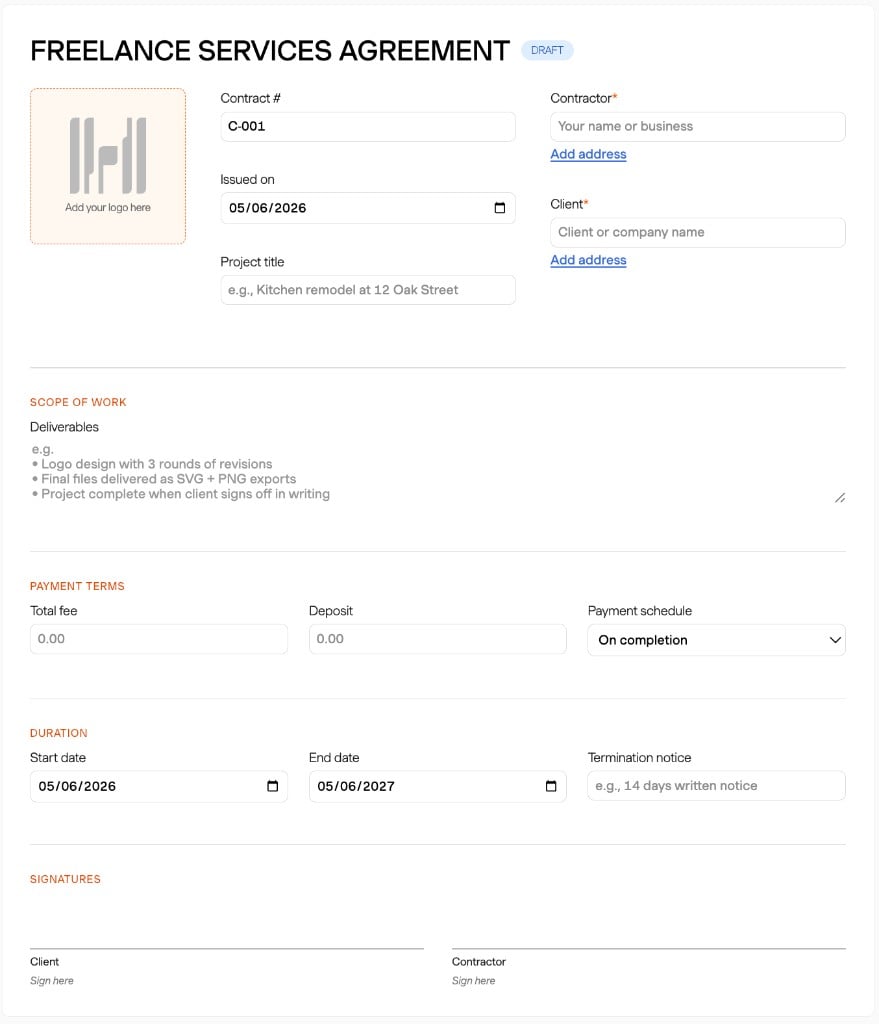
Screenshot of Harvest contract template in Chinese context.

Contract Template in Chinese FAQs

  • Essential clauses in a Chinese contract include the parties' details, contract duration, payment terms, and dispute resolution methods. Employment contracts must also cover job description, working hours, and remuneration. Compliance with these requirements ensures enforceability.

  • To ensure compliance with Chinese law, draft contracts in Chinese, adhere to execution formalities like the company seal, and include all mandatory clauses. Consulting a bilingual legal professional can help tailor contracts to Chinese statutory provisions.

  • Common risks include failing to verify the Chinese counterparty's registration and using boilerplate clauses not aligned with Chinese law. Conduct due diligence and tailor contracts to meet Chinese legal standards to avoid enforceability issues.

  • Yes, digital contracts are legally recognized in China if they comply with the Electronic Signature Law. Ensure electronic signatures are reliable and consider exchanging printed originals for critical agreements.

  • Verify a Chinese counterparty's registration through official channels like the Ministry of Industry and Commerce website. This ensures the legal existence of the counterparty and the authenticity of the agreement.

  • Bilingual contracts are enforceable in China, provided the Chinese version is declared as the prevailing language in case of discrepancies. This stipulation is crucial for enforceability in Chinese courts.

  • Execution formalities include affixing the company's official seal and signing by the legal representative. Chinese courts prioritize these over mere signatures for legal binding.