
Harvest
Time Tracking
Sign up free

How to Track Time for Client Billing

Lose up to 15-20% of billable time without precise tracking. Harvest's real-time tracking and invoicing tools ensure accurate client billing.

Try Harvest Free

How much revenue is your team leaving on the table?

Most agencies run at 55-60% utilization. Even a small improvement means significant revenue. See what closing the gap looks like for your team.

Number of people who track billable time
$
Blended rate across roles (junior, senior, lead)
55%
Percentage of total hours that are billable. Industry average is 55-60%.
75%
A realistic target for service businesses is 70-80%.
Monthly revenue gap $0
Revenue at current utilization $0/mo
Revenue at target utilization $0/mo
Extra billable hours needed per person/day 0h
Annual revenue opportunity $0

Start tracking team utilization

Walk through the entire flow below. Start a timer, check your reports, and create a real invoice — all in three clicks.

Go ahead — start tracking!

One click and you're timing. Try it right here: start a timer, add an entry, edit the details. This is exactly how it feels in Harvest.

  • One-click timer from browser, desktop & mobile
  • Works inside Jira, Asana, Trello, GitHub & 50+ tools
  • Duration or start/end — your call
  • Day, week & calendar views to stay on top of it all
  • Friendly reminders so no hour gets left behind
Acme Corp
Website Redesign
Homepage layout revisions
1:24:09
Content Strategy
Blog calendar planning
1:30:00
SEO Audit
Technical audit report
0:45:00
Brand Guidelines
Color system documentation
2:15:00
Logo Concepts
Initial sketches round 1
1:00:00

Understanding Billable vs. Non-Billable Hours

When tracking time for client billing, distinguishing between billable and non-billable hours is crucial for accurate invoicing and maximizing profitability. Billable hours typically include tasks directly related to client work, such as meetings, project deliverables, and consultations. Non-billable hours, on the other hand, encompass internal meetings, administrative duties, and training sessions. Misclassifying these hours can significantly impact revenue; for instance, misclassifying just 2 hours weekly per employee in a 10-person firm can lead to an annual loss of $104,000 at a $100/hour rate.

Understanding industry benchmarks can also guide effective time management. Top firms achieve a billable utilization rate of 75-85%, translating to 30-32 billable hours in a 40-hour workweek. Harvest simplifies this process by allowing users to categorize time entries into billable or non-billable categories, ensuring every hour is accurately recorded and billed.
Implementing Effective Time Tracking Methods

Accurate time tracking is essential for client billing, yet 10% of billable hours can be lost when professionals wait until the end of the day to log time. To combat this, real-time tracking methods should be employed. This involves logging time as tasks are completed, using consistent increments, and providing detailed descriptions. Tools like Harvest facilitate this with one-click timers and detailed logging, preventing loss of billable hours.

Integrating time tracking with billing software can further enhance efficiency. Harvest’s integration with platforms like QuickBooks and Xero automates the billing process, reducing manual entry errors and saving time. Regular review of time entries and setting clear objectives for time tracking can improve accuracy and foster team-wide adoption of best practices.

Optimizing for Client Billing and Maximizing Revenue

To maximize revenue, businesses must optimize their client billing processes. Automating time tracking and invoicing is a crucial step, with Harvest providing seamless integration between tracked time and billing software. This automation not only enhances accuracy but also saves valuable administrative time. By leveraging time tracking data, firms can conduct detailed profitability analyses, improving resource allocation and project budgeting.

Additionally, setting clear client expectations is vital. Communicating fee structures, billing frequencies, and payment terms upfront can prevent disputes and enhance client trust. Harvest supports this by enabling detailed invoice creation and the attachment of comprehensive time reports, ensuring transparency and clarity in all client interactions.

Navigating Legal and Ethical Considerations

Compliance with legal and ethical standards in time tracking is essential to avoid costly penalties. In the U.S., for example, time records must be retained for at least three years, with specific state requirements for data collection disclosure. Globally, countries like Germany and South Korea mandate prior written consent for tracking. Harvest helps businesses adhere to these regulations by providing reliable and transparent time tracking solutions.

Ethical billing practices, such as using detailed time entries and maintaining transparency, are crucial to client trust and legal compliance. Harvest supports ethical practices by allowing users to include detailed descriptions in invoices and maintain transparent records, ensuring that businesses not only comply with regulations but also build lasting client relationships.

Track Client Billing with Harvest

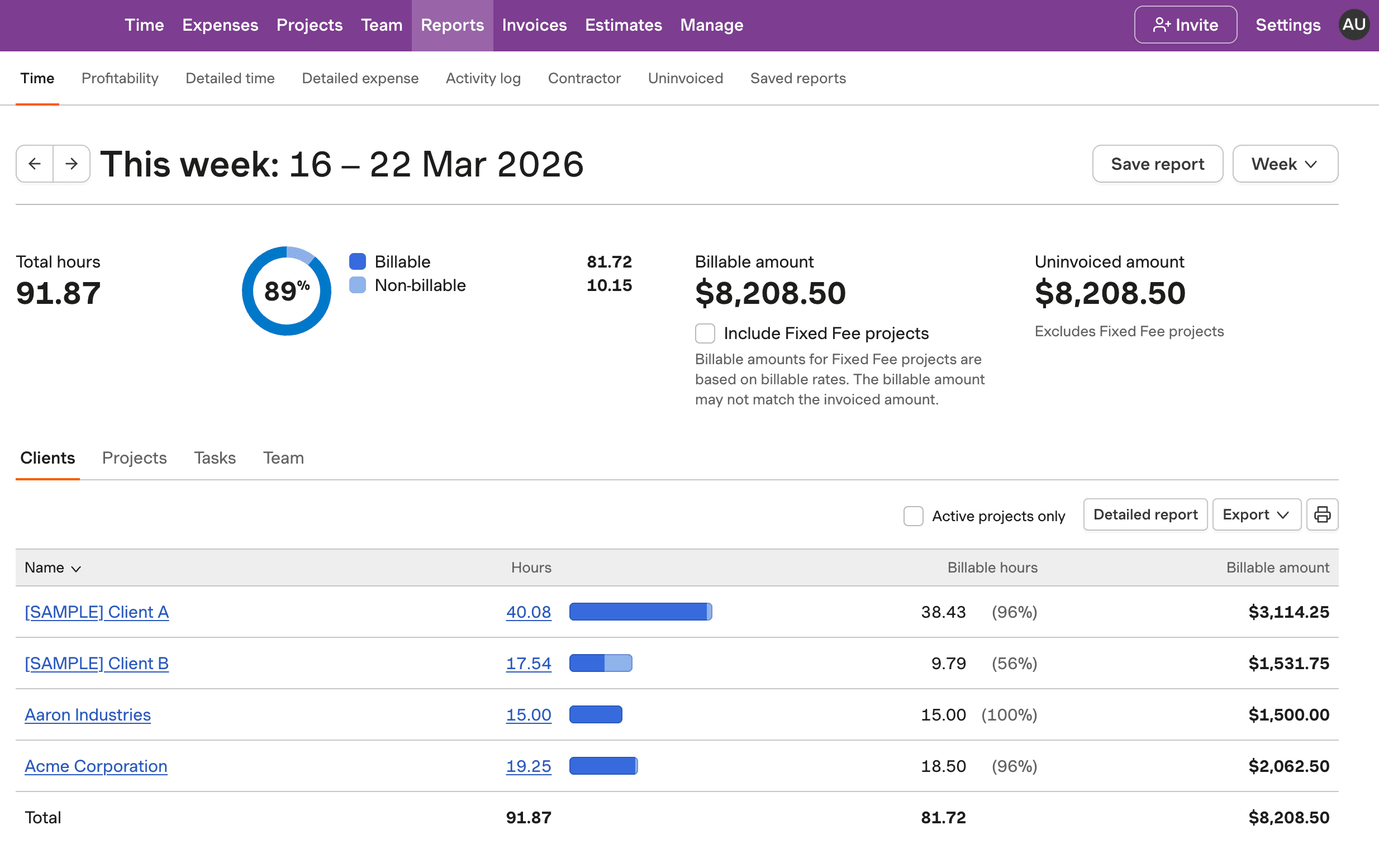
See how Harvest tracks billable hours with real-time timers and automated invoicing to streamline client billing.

Harvest time tracking dashboard for client billing

How to Track Time for Client Billing FAQs

  • Harvest is an excellent tool for tracking billable hours. It offers one-click timers, manual entry for past work, and integrates with popular billing software like QuickBooks and Xero. This ensures seamless tracking and invoicing for accurate client billing.

  • Billable hours are tasks directly related to client work, while non-billable hours include internal activities like admin work. Harvest allows you to categorize tasks as billable or non-billable, ensuring accurate time tracking and invoicing.

  • Best practices include logging time in real-time, using consistent increments, and providing detailed descriptions. Harvest supports these practices with its real-time tracking features and detailed time entry options, reducing the risk of lost billable hours.

  • Automation can be achieved by using software like Harvest, which integrates time tracking with billing systems. This reduces manual entry errors and speeds up the invoicing process, ensuring timely and accurate client billing.

  • Clear communication of fee structures, billing cycles, and payment terms is crucial. Harvest facilitates this by allowing you to create detailed invoices and attach comprehensive time reports, helping to prevent disputes and build trust.

  • Maximizing billable hours involves minimizing non-billable tasks and distractions. Delegating administrative tasks and using tools like Harvest can help you focus on client work, increasing your billable time and profitability.

  • Yes, Harvest allows you to track expenses alongside time entries. You can capture receipts and manage expenses easily, integrating them into your project budgets for comprehensive financial tracking.

  • Harvest integrates with Asana, allowing you to track time on tasks directly within the Asana platform. This integration streamlines project management and time tracking, ensuring all billable hours are captured efficiently.