
Harvest
Time Tracking
Sign up free

Track Team Utilization

Tracking team utilization is essential for optimizing workloads and preventing burnout. Harvest offers comprehensive tools to manage team capacity effectively.

Try Harvest Free

How much revenue is your team leaving on the table?

Most agencies run at 55-60% utilization. Even a small improvement means significant revenue. See what closing the gap looks like for your team.

Number of people who track billable time
$
Blended rate across roles (junior, senior, lead)
55%
Percentage of total hours that are billable. Industry average is 55-60%.
75%
A realistic target for service businesses is 70-80%.
Monthly revenue gap $0
Revenue at current utilization $0/mo
Revenue at target utilization $0/mo
Extra billable hours needed per person/day 0h
Annual revenue opportunity $0

Start tracking team utilization

Walk through the entire flow below. Start a timer, check your reports, and create a real invoice — all in three clicks.

Go ahead — start tracking!

One click and you're timing. Try it right here: start a timer, add an entry, edit the details. This is exactly how it feels in Harvest.

  • One-click timer from browser, desktop & mobile
  • Works inside Jira, Asana, Trello, GitHub & 50+ tools
  • Duration or start/end — your call
  • Day, week & calendar views to stay on top of it all
  • Friendly reminders so no hour gets left behind
Acme Corp
Website Redesign
Homepage layout revisions
1:24:09
Content Strategy
Blog calendar planning
1:30:00
SEO Audit
Technical audit report
0:45:00
Brand Guidelines
Color system documentation
2:15:00
Logo Concepts
Initial sketches round 1
1:00:00

Understanding Team Utilization: The Key to Efficiency

Tracking team utilization effectively is crucial for optimizing workloads and ensuring efficient resource allocation. Utilization rate, defined as the percentage of available work time spent on productive, billable activities, is a critical metric for assessing a team's efficiency. For example, if an employee logs 25 billable hours out of a 40-hour workweek, their utilization rate is 62.5%. Ideally, teams should aim for a utilization rate between 70% and 80% to balance billable work with necessary non-billable activities such as meetings and training.

Common misconceptions, such as striving for 100% utilization, can lead to burnout and reduced productivity. In fact, 80% of global knowledge workers report feeling overworked, leading to decreased engagement and potential burnout. Misclassifying even a few hours per week can result in significant revenue loss, such as over $200,000 annually for a 10-person firm. Therefore, it's essential to accurately track both billable and non-billable hours to maintain healthy utilization rates and prevent employee burnout.
Calculating and Benchmarking Your Team's Utilization

Calculating utilization rates is a straightforward yet powerful way to measure team performance. The formula is simple: (Total Billable Hours / Total Hours Available) x 100. Industry benchmarks vary, with production staff often targeting 70% to 90%, while account managers may aim for 60% to 80%. In Architecture & Engineering firms, technical staff average 82.4% utilization, translating to 1,600-1,900 billable hours annually.

Accurate calculation requires defining "total available hours" by considering factors like holidays and administrative time. Ignoring or miscalculating utilization data can lead to underutilization or overburdening of employees, impacting both profitability and employee well-being. Harvest facilitates this process by allowing teams to customize capacity per person, setting unique benchmarks based on roles and ensuring accurate tracking of both billable and non-billable hours.

Effective Tools for Tracking Utilization

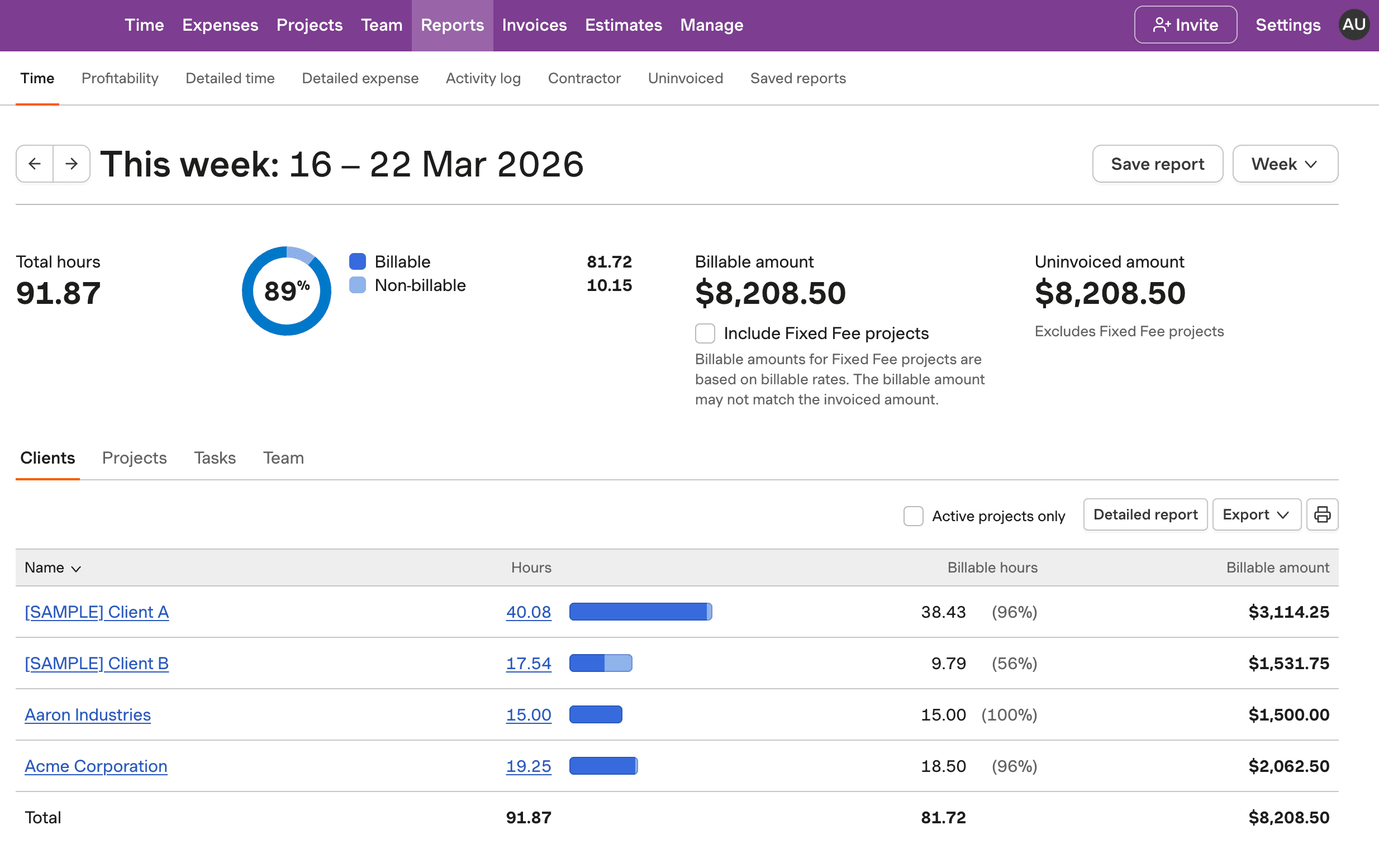
Tracking team utilization manually can be cumbersome and error-prone. Thankfully, software solutions like Harvest offer comprehensive tools to streamline this process. Harvest tracks both billable and non-billable hours, providing insights into team efficiency and helping differentiate between task types. These features are crucial for understanding utilization rates and making informed decisions about resource allocation.

Harvest integrates with Forecast, enabling visualization of team capacity and workload management. This integration allows for capacity planning and helps prevent burnout by comparing scheduled hours with actual tracked time. Real-time dashboards and detailed reports provide clarity on utilization rates across departments, aiding in better resource allocation and strategic planning. By leveraging these tools, teams can enhance their efficiency and optimize workloads effectively.

Optimizing Workloads and Preventing Burnout

To optimize workloads and prevent burnout, it's essential to implement strategic workload management practices. Techniques such as capacity planning, task prioritization, and effective delegation can significantly enhance team efficiency. For instance, prioritizing tasks by impact rather than urgency ensures that high-value work is completed first.

Open communication and flexible work arrangements, including remote options, foster a healthy work-life balance, crucial for preventing burnout. Automation tools can also alleviate the burden of repetitive tasks, freeing up time for strategic initiatives. Harvest supports these efforts by providing detailed reports that monitor utilization rates and highlight areas for improvement, thus helping maintain balanced workloads and promoting employee well-being.

Track Team Utilization with Harvest

See how Harvest helps track team utilization, optimize workloads, and prevent burnout through detailed reports and integrations.

Screenshot of Harvest's team utilization tracking feature.

Track Team Utilization FAQs

  • Team utilization rate measures the percentage of available work time that team members spend on productive, billable activities. It reflects how effectively a team is utilizing its work hours for value-adding tasks.

  • To calculate your team's utilization rate, use the formula: (Total Billable Hours / Total Hours Available) x 100. This will give you the percentage of time spent on billable tasks compared to the total available time.

  • Common benchmarks for team utilization vary by role: production staff often target 70% to 90%, account managers aim for 60% to 80%, and technical staff in A&E firms average 82.4%. These benchmarks help balance billable work with essential non-billable activities.

  • Harvest helps prevent burnout by providing tools for capacity planning and workload management. By integrating with Forecast, Harvest allows teams to visualize capacity, compare scheduled hours with tracked time, and make informed adjustments to prevent overwork.

  • Yes, Harvest tracks both billable and non-billable hours. This differentiation is crucial for understanding utilization rates and ensuring accurate resource allocation. It helps teams maintain a healthy balance between productive work and essential non-billable activities.

  • Effective methods for optimizing team workloads include capacity planning, task prioritization, and effective delegation. Utilizing tools like Harvest can enhance these efforts by providing insights into utilization rates and workload distribution.

  • Team utilization should be tracked on a weekly or monthly basis to identify trends and make timely adjustments. Regular tracking helps ensure that workloads are balanced and resources are allocated efficiently.