
Harvest
Quotes
Sign up

Construction Estimate Template

Harvest empowers contractors to create accurate estimates by tracking labor and material costs, enhancing project efficiency and financial alignment.

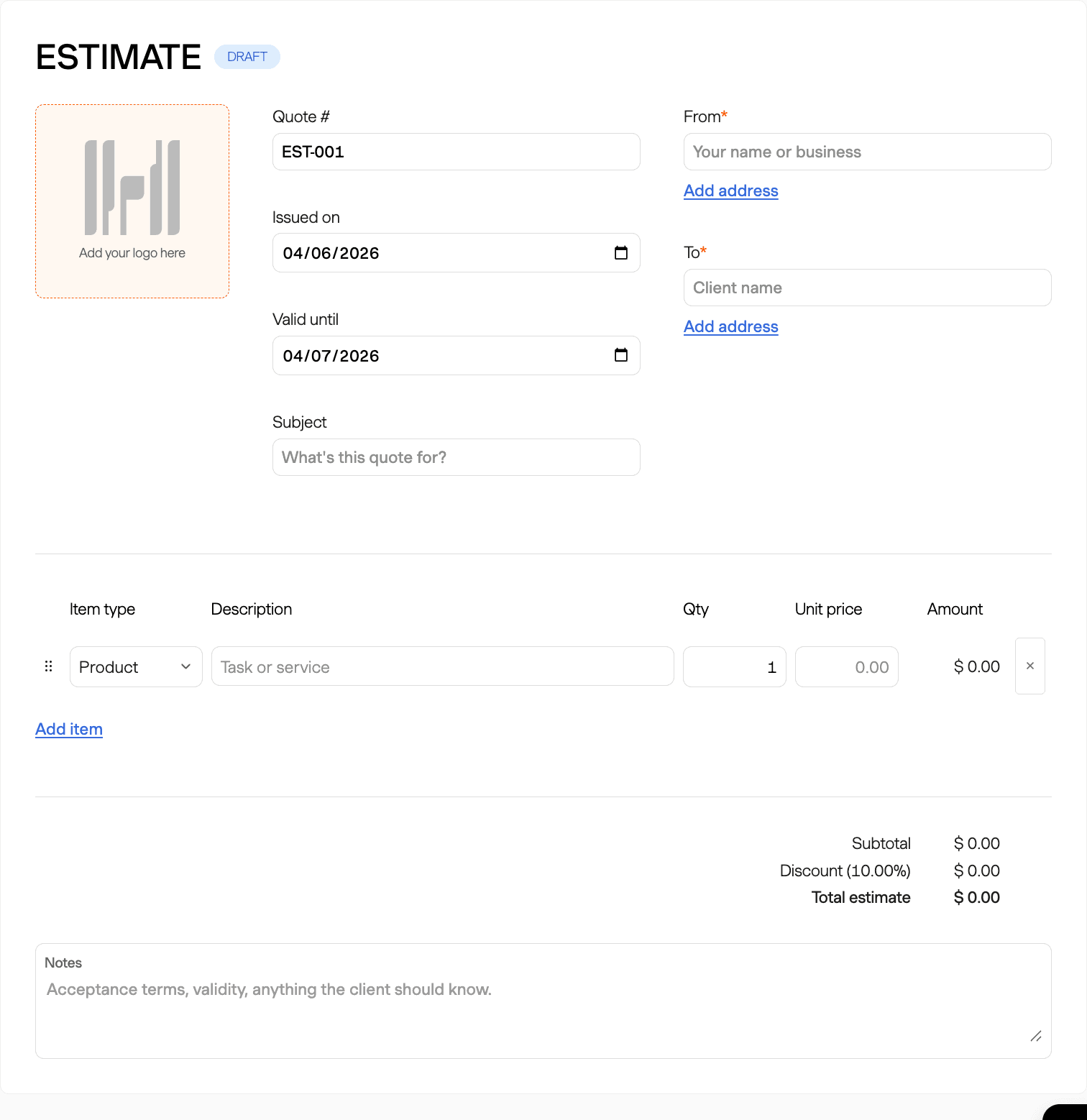
ESTIMATE DRAFT

Add your logo here
Item type
Description
Qty
Unit price
Tax
Amount
Subtotal
$0.00
Discount
$0.00
Total estimate
$0.00
Get paid via:
Credit card / Debit card
ACH
Wire transfer

Customize estimate

Appearance

Add a logo
Show estimate title

Quote settings

Tax Add up to 2 tax rates
%
Discount Apply a discount percentage
%

Understanding Construction Estimate Templates

Construction estimate templates are vital tools for accurately forecasting project costs and ensuring financial alignment between stakeholders. These templates have evolved from manual calculations on graph paper to sophisticated digital formats that streamline the estimating process. Currently, 85% of construction professionals still rely on spreadsheets like Microsoft Excel, demonstrating the enduring value of digital templates in the industry. With the construction estimating software market projected to grow significantly, reaching USD 2.62 billion by 2030, the trend toward digitization is evident.

Templates are not just a convenience; they represent a best practice recommended by industry experts for standardizing estimates. By facilitating a consistent structure, these templates help reduce errors, streamline reviews, and ensure comprehensive cost breakdowns. They can include direct costs, such as materials and labor, along with indirect costs like permits and insurance, which can constitute 10-15% of total project costs. Using standardized templates also aids in documenting estimates, crucial for audits and compliance.

Customizing Your Construction Estimate Template

Customizing a construction estimate template allows contractors to tailor forecasts to specific project needs, enhancing accuracy and efficiency. A comprehensive template should break down costs into direct expenses like materials and labor, indirect expenses, and soft costs such as design fees. Including a contingency allowance is also essential to account for unforeseen conditions, which are common in volatile markets.

Effective customization involves a step-by-step process: reviewing project drawings and specifications, performing quantity takeoffs, applying unit costs, and including labor rates. Contractors should ensure that templates integrate smoothly with accounting software for seamless financial management. Despite Harvest not offering templates for bid submissions, it supports contractors by tracking labor and material costs, which are crucial for precise estimating. Harvest's capabilities in time tracking and expense management can significantly enhance the accuracy of customized estimates.

Maximizing Efficiency with Digital Estimating Tools

Digital estimating tools offer significant advantages over traditional methods, particularly in accuracy and efficiency. With AI and Building Information Modeling (BIM) becoming more prevalent, contractors can reduce estimate preparation time by up to 50%, thanks to automated data entry and takeoff processes. This technological shift not only speeds up the estimating process but also enhances precision by minimizing human error.

While Harvest does not feature AI-driven estimating or BIM integration, it supports contractors by tracking project budgets and expenses, providing a solid foundation for cost estimation. These tools are vital for adapting to market challenges, such as fluctuating material costs and labor shortages, with concrete costs rising 6.7% year-over-year. By leveraging Harvest's tracking capabilities, contractors can maintain accurate, up-to-date cost data, crucial for effective project management.

Ensuring Accuracy in Construction Estimates

Accurate construction estimates are essential for project success, guiding decision-making and ensuring stakeholder alignment. Inaccurate estimates often lead to budget overruns and delays, negatively impacting client relationships. Industry experts stress the importance of using historical data and standardized templates to improve estimate accuracy. A mid-sized contractor reduced costs by 15% on a project by leveraging precise estimates and completing it ahead of schedule.

Harvest supports contractors in maintaining estimate accuracy by enabling the tracking of time, labor, and materials costs. This approach helps ensure that estimates remain realistic and reflective of actual project conditions. Although Harvest does not provide detailed cost breakdowns for specific trades or phases, its ability to track expenses and project budgets offers contractors a reliable method for managing costs effectively.

Explore Harvest's Estimate Tracking

See how Harvest helps you track labor and material costs to create accurate construction estimates for your projects.

Screenshot showing Harvest's construction estimate features.

Construction Estimate Template FAQs

  • A construction estimate should include direct costs like materials and labor, indirect costs such as permits and insurance, and potential soft costs like design fees. It's important to also factor in contingency allowances to cover unforeseen conditions, which can account for 10-15% of total project costs.

  • To ensure accuracy, use standardized templates and historical data to inform your estimates. This approach helps identify trends and anticipate potential issues. Tools like Harvest can aid by tracking labor and material costs, ensuring your estimates reflect real project conditions.

  • Yes, templates can be tailored for various project types, such as commercial or specialty subcontractor work. These templates help organize costs by trades or project divisions, ensuring comprehensive tracking and reporting.

  • Digital tools enhance estimating by automating data entry and takeoffs, reducing preparation time by up to 50%. They improve accuracy by minimizing errors and providing real-time data, essential for managing volatile material costs and labor shortages.

  • Construction estimate templates standardize the estimating process, reducing errors and streamlining reviews. They ensure detailed cost breakdowns and maintain a documented trail for audits and compliance, fostering confidence in project delivery.

  • Harvest aids construction estimates by tracking labor and material costs, crucial for accurate forecasting. It supports project budget management, ensuring estimates align with actual project conditions and financial goals.

  • Historical data informs accurate estimates by revealing trends and potential issues. It allows contractors to refine budgeting plans, gaining a competitive edge through data-driven decision-making.