
Harvest
Contracts
Sign up

Contract Template in Hebrew

Harvest supports freelancers and contractors by efficiently managing time, expenses, and invoicing, complementing the operational needs of Hebrew contracts.

Start from a template

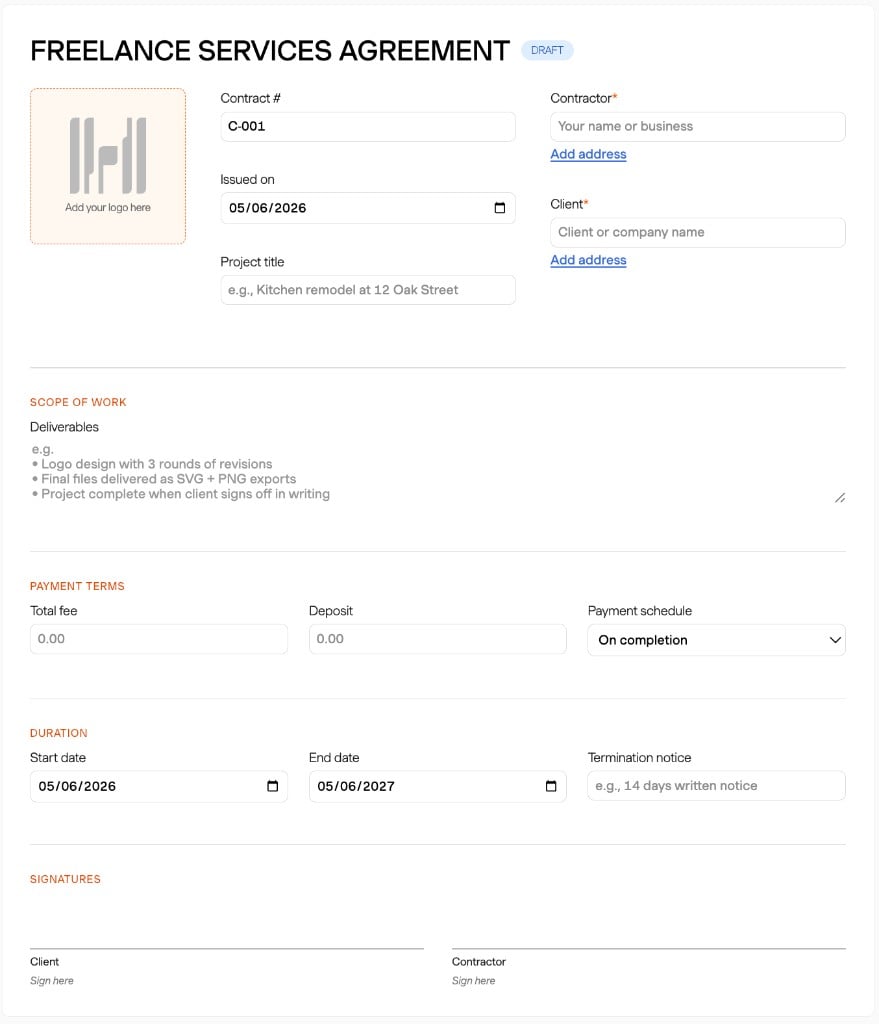
AGREEMENT DRAFT

Add your logo here

Scope of work

Payment terms

Duration

Signatures

Client

Sign here

Contractor

Sign here

Get paid via:
Credit card / Debit card
ACH
Wire transfer

Customize contract

Appearance

Add a logo
Show contract title

Contract settings

Include payment terms Total fee, deposit, and schedule
Include termination clause Notice required to end the contract
Include signature blocks Both parties sign at the bottom

Essential Clauses in a Hebrew Freelance Contract

Drafting a freelance contract in Hebrew requires careful attention to the essential clauses that ensure compliance with Israeli law. These contracts must include key components such as the scope of work, payment terms, and confidentiality agreements. According to experts, the recent amendment to Israel's Contracts Law emphasizes the importance of the precise language used in contracts, making it crucial to avoid vague terms. This shift means that every word in a Hebrew contract carries significant legal weight, and misinterpretations can lead to disputes.

It's also important to consider cultural nuances when drafting these contracts. In Israeli business culture, clear and direct communication is preferred. Contracts that are overly formal might be perceived as insincere, potentially complicating negotiations or enforcement. Additionally, engaging certified legal translators can ensure that contracts comply with both Israeli and international standards, safeguarding your interests in cross-border agreements.

While Harvest does not directly offer contract templates in Hebrew, it can support freelancers and contractors by managing their time, expenses, and invoicing efficiently. This focus on operational aspects allows professionals to streamline their workflow, ensuring they meet contractual obligations without administrative burdens.

Legal Requirements and Compliance for Hebrew Contracts

Understanding the legal framework is crucial when creating a freelance contract in Hebrew. Israeli law does not impose strict formal requirements on contracts, allowing flexibility in how agreements are formalized. However, certain types of contracts, like employment agreements, must be documented in writing to be legally valid. This flexibility means that many contracts can technically be oral, but written agreements are strongly recommended to protect all parties involved.

Electronic signatures are legally valid in Israel, thanks to the Electronic Signature Law 5761 – 2001. This law supports the use of digital signatures, which can simplify contract execution and storage. However, ensuring that a contract complies with Israeli law requires more than just a signature. Tailoring contracts to meet specific legal requirements is essential, particularly for clauses related to payment schedules and deliverables.

Harvest does not provide legal templates or compliance guidance, but it assists contractors in managing the operational aspects of their agreements. By using Harvest to track time, expenses, and invoices, freelancers can align their operational practices with contractual commitments, ensuring smooth execution and compliance.

The Role of Technology in Contract Management

Technology is playing an increasingly important role in contract management, particularly in Israel's burgeoning legal tech landscape. With approximately 40 companies offering solutions in areas like contract review and automation, the efficiency of managing Hebrew contracts is on the rise. For instance, AI tools have demonstrated significant potential, with one system achieving 94% accuracy in reviewing non-disclosure agreements within seconds, compared to human lawyers who took much longer.

This trend towards digital transformation is supported by the adoption of electronic signatures and contract management platforms. These tools help streamline the drafting, execution, and storage of contracts, making them indispensable for freelancers and contractors operating in fast-paced environments.

While Harvest focuses on operational management rather than contract drafting, it aligns well with these technological advancements. By integrating time tracking, expense management, and invoicing, Harvest enables freelancers to maintain accurate records and streamline processes, complementing the efficiency brought by legal tech tools.

Practical Tips for Drafting Contracts in Hebrew

When drafting contracts in Hebrew, it is crucial to prioritize clear, unambiguous language. The recent changes in Israel's Contracts Law mean that any lack of clarity can be exploited in legal disputes. Therefore, avoiding vague terms and ensuring that all parties have the legal capacity and competence to enter into the contract is vital.

Engaging a certified legal translator is recommended for cross-border contracts to ensure linguistic accuracy and compliance with local legal standards. Additionally, implementing a robust review process involving bilingual legal professionals can prevent errors that may lead to costly disputes.

While Harvest does not provide contract templates or drafting services, it can streamline the administrative side of contract management. By efficiently tracking billable hours and managing expenses, Harvest allows freelancers to focus on fulfilling their contractual obligations rather than being bogged down by paperwork.

Manage Hebrew Contracts with Harvest

Harvest helps freelancers streamline time tracking and expense management, essential for Hebrew contract compliance.

Screenshot of Harvest's time tracking and expense management features.

Contract Template in Hebrew FAQs

  • Essential clauses in a Hebrew freelance contract include the scope of work, payment terms, confidentiality, and termination conditions. Clear language is crucial due to recent legal amendments emphasizing text interpretation.

  • Yes, electronic signatures are legally valid in Israel under the Electronic Signature Law 5761 – 2001. This law supports digital contracts, making execution and storage more efficient.

  • Precise language is critical due to a legal amendment prioritizing written text over presumed intent. Every word carries weight, and vague terms can lead to disputes.

  • Technology, especially AI, enhances contract management by increasing review accuracy and speed. This efficiency complements tools like Harvest for operational management.

  • Hebrew contracts must comply with Israeli law, which is flexible but requires written documentation for certain agreements like employment contracts. Compliance ensures enforceability.

  • Avoid using generic templates that aren't tailored to Israeli law. These might lack essential clauses, leading to significant legal risks and disputes.