
Harvest
Contracts
Sign up

Construction Subcontractor Agreement Template

In construction, managing subcontractor agreements is challenging due to payment delays and compliance complexities. Harvest helps streamline financial management and project tracking, ensuring clarity and timely execution.

Start from a template

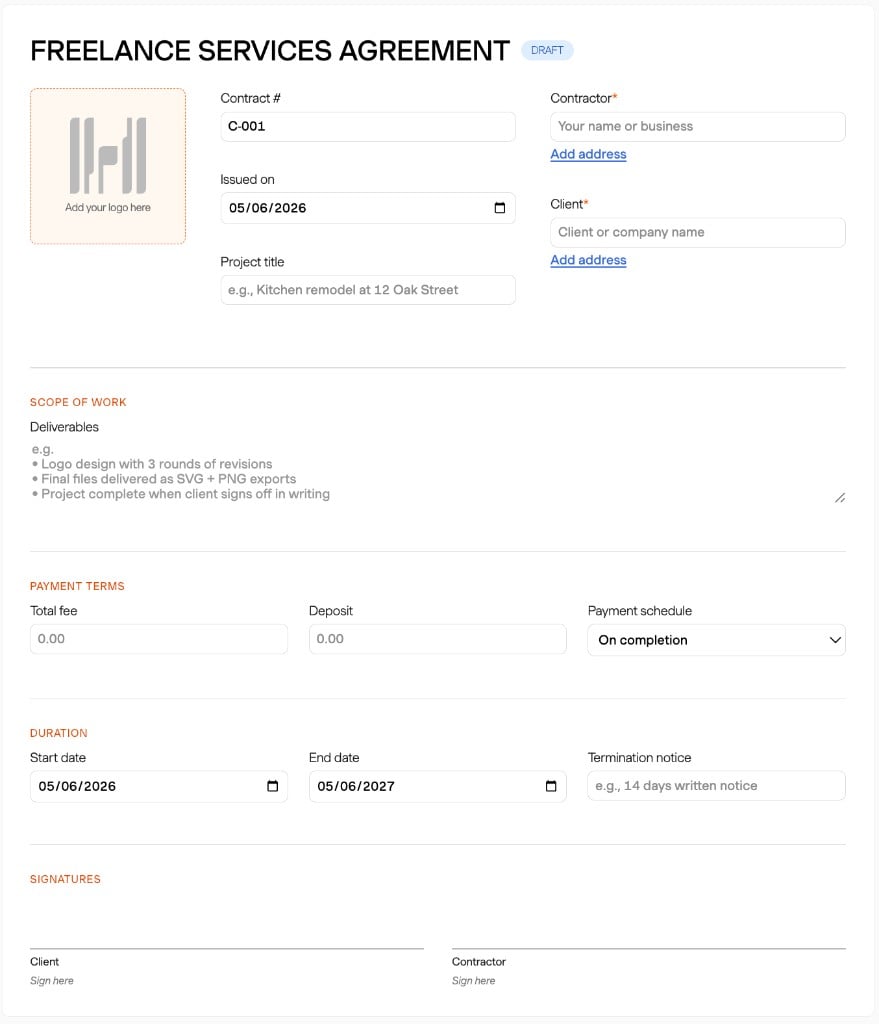
AGREEMENT DRAFT

Add your logo here

Scope of work

Payment terms

Duration

Signatures

Client

Sign here

Contractor

Sign here

Get paid via:
Credit card / Debit card
ACH
Wire transfer

Customize contract

Appearance

Add a logo
Show contract title

Contract settings

Include payment terms Total fee, deposit, and schedule
Include termination clause Notice required to end the contract
Include signature blocks Both parties sign at the bottom

Essential Clauses in a Subcontractor Agreement

A well-crafted subcontractor agreement is crucial for construction projects, outlining essential clauses to ensure clarity and compliance. Key elements include a defined scope of work, which specifies tasks, deliverables, and timelines to avoid ambiguity and disputes. It's vital for these agreements to incorporate drawings, specifications, and performance requirements to prevent misunderstandings, as vague definitions can lead to costly errors.

Another critical component is payment terms. The agreement should clearly outline the contract price, payment schedule, progress payments, and final payment terms. Industry data reveals that despite standard 30-day payment terms, subcontractors often wait an average of 74 days to receive payment, impacting cash flow. Including provisions for lien releases and addressing potential "pay-when-paid" clauses can protect subcontractors from financial risks.

Legal compliance is another essential area. The agreement must address any relevant "flow-down" clauses from the prime contract, ensuring subcontractors understand their obligations. Subcontractors should always request and review the prime contract to be aware of any risks passed down from general contractors.

Customizing Your Agreement for Specific Projects

Customizing a subcontractor agreement to fit specific projects involves tailoring the template to address unique work requirements and compliance needs. Start by ensuring the scope of work is explicitly defined to include all necessary details, from materials to timelines. This mitigates risks of "bid busts," where overlooked scope details result in financial shortfalls.

To further customize, consider any state-specific legal requirements, such as "pay-if-paid" clauses, which are outlawed in many states. Understanding these regulations can prevent legal complications and payment delays. Also, integrating safety responsibilities and ensuring their clarity can prevent accidents and liability issues.

Using digital tools like Harvest can facilitate these processes by helping define and track project scopes and manage payment terms effectively. Harvest provides visibility into project budgets and timelines, ensuring that financial management aligns with contractual agreements, while also supporting change order tracking specific to construction projects.

Managing Compliance and Avoiding Common Pitfalls

Compliance and risk management are critical in subcontractor agreements. Common pitfalls include failing to review the prime contract or misclassifying workers, leading to significant legal and financial repercussions. For instance, misclassification has led to cases where companies paid millions in back wages and penalties, emphasizing the importance of proper contract management.

Subcontractors should proactively manage risks by negotiating onerous terms and reviewing indemnity clauses with legal advisors. It's crucial to ensure all contract terms are in writing and signed by both parties, as oral agreements or unsigned contracts are not legally enforceable.

While Harvest does not handle legal compliance or manage insurance requirements, it offers robust tools for tracking time, expenses, and project budgets. These features help subcontractors maintain financial control and alignment with their contractual obligations, making it easier to navigate complex project landscapes and avoid common pitfalls.

Integrating Technology for Efficient Contract Management

Incorporating technology into subcontractor agreements can streamline processes and enhance efficiency. The construction industry is increasingly adopting digital platforms and AI to manage agreements, which can reduce errors and optimize workflows.

Using a solution like Harvest can integrate subcontractor agreements into broader project management workflows, linking timelines, payment schedules, and compliance verification. By automating processes for time collection, invoicing, and change orders, Harvest provides real-time project insights that enhance decision-making and financial management.

Technology not only aids in the creation and management of agreements but also improves communication between contractors and subcontractors. With tools that offer clear visibility into project progress and financials, subcontractors can better align with project goals and avoid delays and cost overruns.

Streamline Agreements with Harvest

Explore how Harvest helps manage construction subcontractor agreements, offering tools for tracking budgets and managing payments efficiently.

Harvest interface showing construction subcontractor agreement template.

Construction Subcontractor Agreement Template FAQs

  • A subcontractor agreement should include clauses covering the scope of work, payment terms, legal compliance, and risk management. Defining these clearly helps prevent disputes and delays.

  • Customize a subcontractor agreement by tailoring the scope of work, payment terms, and compliance requirements to fit project specifics. Address state-specific legal regulations to avoid complications.

  • Vague agreements can lead to disputes over deliverables and timelines, impacting project progress. Clear definitions prevent misunderstandings and financial losses.

  • Harvest supports subcontractor agreements by tracking project budgets, managing payment terms, and offering visibility into project timelines, ensuring financial alignment with contractual terms.

  • Common pitfalls include not reviewing the prime contract, misclassifying workers, and unclear payment terms. Addressing these can prevent legal and financial issues.

  • Written agreements are legally enforceable and prevent disputes by clearly stating terms. Oral contracts or unsigned agreements lack legal standing and can lead to conflicts.

  • Technology streamlines agreement management by automating workflows and improving communication. Tools like Harvest provide real-time insights, enhancing project tracking and financial management.