
Harvest
Quotes
Sign up

How to Estimate a Construction Project

Construction estimating errors lead to costly overruns and delays. Harvest helps contractors track project budgets and profitability, ensuring accurate estimates and successful project outcomes.

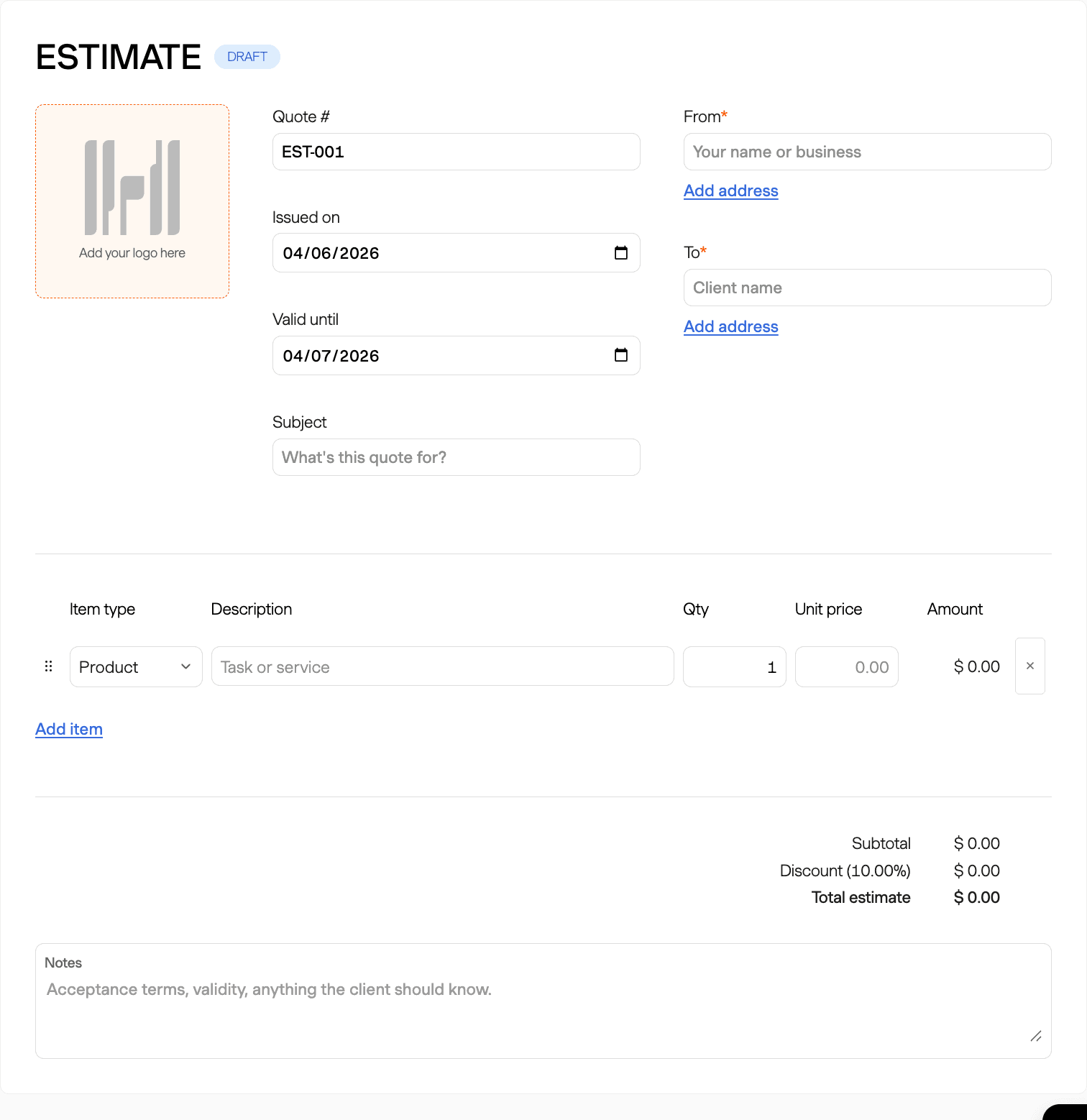
ESTIMATE DRAFT

Add your logo here
Item type
Description
Qty
Unit price
Tax
Amount
Subtotal
$0.00
Discount
$0.00
Total estimate
$0.00
Get paid via:
Credit card / Debit card
ACH
Wire transfer

Customize estimate

Appearance

Add a logo
Show estimate title

Quote settings

Tax Add up to 2 tax rates
%
Discount Apply a discount percentage
%

Understanding Construction Project Estimation

Accurate construction project estimation is vital to ensure successful project completion within budget and on time. Industry research shows that estimation errors cost U.S. construction companies an estimated $273 billion annually, accounting for up to 20% of total project costs and contributing to 52% of project delays. This highlights the importance of precise estimation practices not only to protect profit margins but also to maintain client trust and project feasibility. The role of estimators is evolving beyond simple calculations to include strategic analysis, comprehensive risk management, and optimization of project outcomes. This shift underscores the need for tools that support these complex tasks, such as Harvest, which aids in tracking project budgets and profitability.

Key Steps in Construction Estimation

Construction estimation involves several critical steps to ensure accuracy and reliability. These steps include reviewing the bid package, conducting a thorough site visit, performing a detailed material takeoff, and soliciting pricing from suppliers. Each of these activities requires careful attention to detail to prevent cost overruns and project delays. For example, a comprehensive site assessment early in the process helps make informed decisions about materials and labor, significantly reducing the risk of unexpected costs.

While Harvest does not directly facilitate site visits or material takeoffs, it excels in tracking project budgets and expenses once these elements are determined. By integrating with other business functions, Harvest helps streamline workflows and maintain accurate financial tracking throughout the project lifecycle.

Evaluating Labor Requirements and Costs

Accurately estimating labor requirements is crucial, especially given the current labor shortage in the U.S. construction industry, which is projected to need 439,000 new workers by 2025. This shortage is driving up labor costs, with wages increasing by 4.5% over the past year. Misestimating labor can lead to significant budget overruns and project delays. Harvest aids in this aspect by allowing contractors to set cost rates for team members, helping evaluate labor requirements and calculate loaded labor costs effectively.

Moreover, Harvest's tools enable contractors to monitor labor productivity and align it with project budgets, ensuring that labor costs remain within the estimated parameters. This feature is particularly beneficial in adapting to dynamic market conditions and maintaining project profitability.

The Role of Contingency Planning

Contingency planning is a critical component of construction project estimation, accounting for potential risks such as price increases and unforeseen site conditions. Experts suggest including a contingency buffer of 15-25% in concept design estimates. This practice is essential for managing unexpected costs and ensuring that projects stay within budget.

While Harvest does not directly facilitate contingency planning, its robust project budget tracking features can help manage and adjust budgets in response to unforeseen expenses. By providing visibility into project financials, Harvest supports contractors in maintaining control over their budgets, even when faced with unexpected challenges.

Leveraging Technology for Accurate Estimation

The construction industry is increasingly turning to digital solutions to enhance estimation accuracy. The global construction estimating software market is projected to reach $2.2 billion by 2028, reflecting an 8.5% CAGR. Automated tools reduce the risk of human error, with estimates showing that 88% of spreadsheets contain formula errors. Harvest, though not an estimating software, supports project budget tracking, ensuring that once estimates are set, they are accurately monitored throughout the project lifecycle.

By integrating with cloud-based platforms, Harvest facilitates real-time collaboration and quick adjustments to estimates, which is crucial in today's fast-paced construction environment. This adaptability makes Harvest an invaluable tool for contractors looking to maintain project profitability and efficiency.

Estimate Construction Projects with Harvest

See how Harvest helps track construction project budgets and profitability for accurate estimation.

Harvest project budget tracking screenshot for construction estimation.

How to Estimate a Construction Project FAQs

  • The key steps include reviewing the bid package, conducting a site visit, performing material takeoffs, soliciting supplier pricing, and evaluating labor requirements. These steps help ensure accurate and reliable estimates.

  • The U.S. construction industry faces a significant labor shortage, requiring 439,000 new workers by 2025. This shortage increases labor costs, making accurate estimation of labor requirements crucial to avoid budget overruns.

  • Contingency planning accounts for potential risks like price increases and unforeseen site conditions. Including a buffer of 15-25% in estimates helps manage unexpected costs and keeps projects within budget.

  • While Harvest doesn't perform estimation, it tracks project budgets and profitability, ensuring that once estimates are set, they are accurately monitored. This helps maintain project financial health.

  • Technology, such as digital estimating tools, enhances accuracy by reducing human errors in calculations. The market is expected to grow to $2.2 billion by 2028, highlighting the industry's shift towards digital solutions.

  • Using trade-specific estimating software that incorporates wage rates and productivity data helps avoid errors. Harvest aids by allowing contractors to set cost rates for team members, facilitating accurate labor cost tracking.

  • Inaccurate estimates can lead to project cost overruns, delays, and reduced profitability. They are responsible for 32% of cost overruns and can severely impact a construction business's success.