
Harvest
Contracts
Sign up

Catering Contract Template

Catering businesses face unique challenges in managing contracts and financial workflows. Harvest helps streamline these processes with tools for time tracking, expense management, and invoicing.

Start from a template

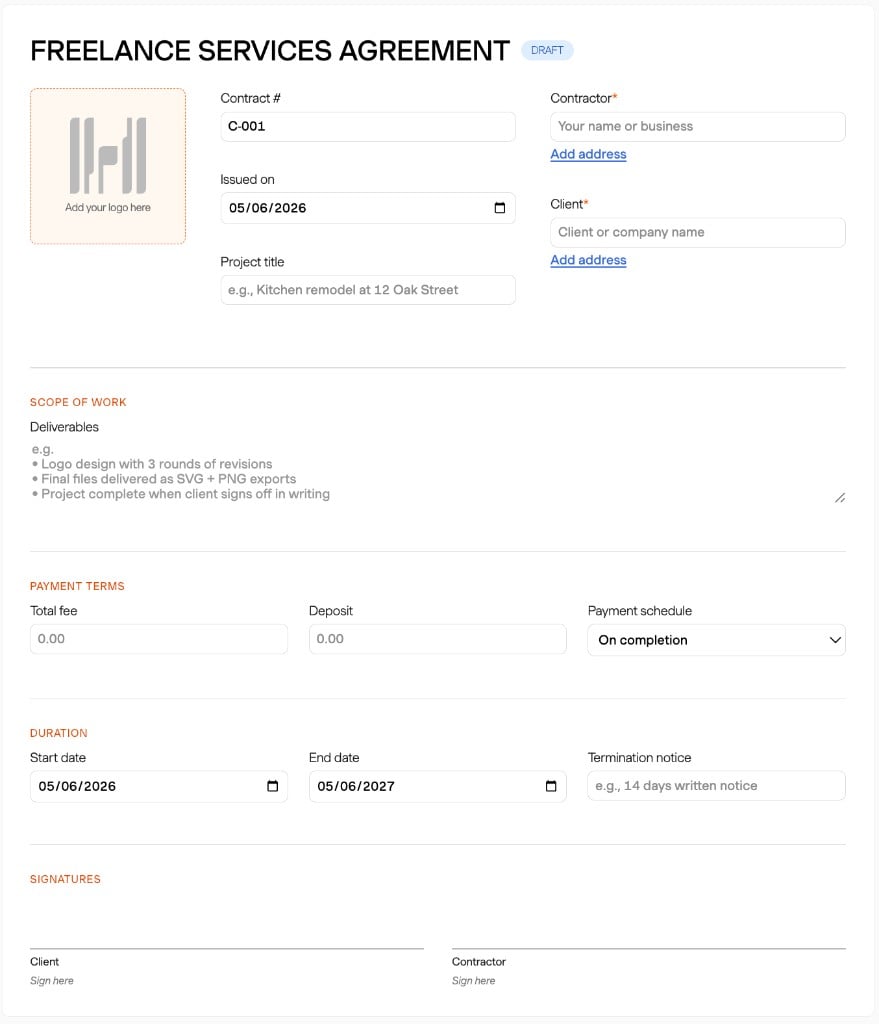
AGREEMENT DRAFT

Add your logo here

Scope of work

Payment terms

Duration

Signatures

Client

Sign here

Contractor

Sign here

Get paid via:
Credit card / Debit card
ACH
Wire transfer

Customize contract

Appearance

Add a logo
Show contract title

Contract settings

Include payment terms Total fee, deposit, and schedule
Include termination clause Notice required to end the contract
Include signature blocks Both parties sign at the bottom

Essential Elements of a Catering Contract

Catering contracts are crucial for clearly defining the terms of service between a caterer and their client, ensuring a smooth event execution. The core elements of a catering contract include detailed identification of all parties involved, specific event details such as date, time, location, and estimated guest count, as well as a complete breakdown of the menu and service style. Additionally, the contract should outline a staffing plan, event timeline, and a list of all provided rentals and equipment. These elements help avoid misunderstandings and protect both parties’ interests.

To ensure financial security, contracts should also specify itemized pricing, deposit requirements (often non-refundable), a payment schedule, and any additional charges such as overtime fees or late payment penalties. According to industry experts, nearly 70% of event-related complications arise from unclear contract terms, highlighting the importance of clarity in these agreements. While Harvest does not manage specific catering clauses, its invoicing capabilities support setting up payment terms, including non-refundable deposits, to streamline financial workflows.

Customizing Your Catering Contract Template

Customizing a catering contract template allows you to tailor it to specific events and client needs, enhancing clarity and satisfaction. Start by ensuring all client expectations are clearly specified, and itemize all costs to prevent future disputes. Include precise cancellation and refund policies; for instance, tiered penalties that correspond to how close the cancellation date is to the event can mitigate last-minute changes and no-shows.

Although Harvest does not handle cancellation policies directly, it aids catering businesses by providing robust invoicing tools that facilitate transparent financial transactions. This includes the ability to manage payment terms and conditions, offering a practical approach to handling financial aspects of catering contracts. Leveraging Harvest’s invoicing capabilities can help businesses maintain clear communication regarding financial obligations, ensuring both parties are on the same page.

Legal Considerations in Catering Contracts

Legal considerations are a pivotal aspect of catering contracts, safeguarding against disputes and ensuring compliance with regulations. Contracts must adhere to local, state, and federal health regulations, with specific clauses addressing food handling and safety standards. Moreover, liability clauses for equipment damage and venue arrangements should also be included to cover potential risks and responsibilities.

While Harvest does not manage legal aspects like liability clauses, it helps catering businesses maintain accurate financial records with its time tracking and expense management features. By focusing on these areas, Harvest provides a streamlined approach to managing the financial side of catering contracts, allowing businesses to concentrate on fulfilling legal requirements through other means.

Handling Cancellations and Changes

Catering contracts should articulate clear policies for handling cancellations and changes, which are common in the industry. These policies should include tiered refund clauses that take into account the timing of cancellations relative to the event date. Such detailed terms help in managing client expectations and protecting business interests.

Although Harvest does not directly manage cancellation policies, its invoicing capabilities can support businesses in clearly communicating payment-related aspects of cancellations, such as non-refundable deposits. This ensures that financial transactions remain transparent and consistent, providing clarity and reducing the potential for disputes. By managing financial workflows efficiently, Harvest aids in maintaining the overall integrity of catering contracts.

Explore Catering Contracts with Harvest

See how Harvest's tools simplify managing catering contracts by providing clear invoicing and time tracking solutions.

Catering contract template screenshot in Harvest.

Catering Contract Template FAQs

  • Key elements of a catering contract include identification of parties, event details (date, time, location), menu breakdown, service style, staffing plan, and pricing. These components ensure clarity and protect both parties' interests.

  • To customize a catering contract, clearly specify client expectations, itemize costs, and outline precise cancellation policies. This ensures clarity and satisfaction for both parties involved.

  • Legal considerations in a catering contract include compliance with health regulations and clauses for liability and equipment damage. These elements safeguard against disputes and ensure compliance.

  • Harvest assists catering businesses by providing invoicing tools that support managing payment terms, including non-refundable deposits, streamlining financial transactions within contracts.

  • A comprehensive cancellation policy in a catering contract should include tiered penalties based on the cancellation date's proximity to the event, ensuring protection against last-minute changes.

  • Clear financial terms prevent misunderstandings, ensuring transparency and financial security for both parties. They help manage client expectations and protect business interests.

  • Harvest supports payment terms in catering contracts by offering invoicing capabilities that include non-refundable deposits, aiding in clear and transparent financial communication.